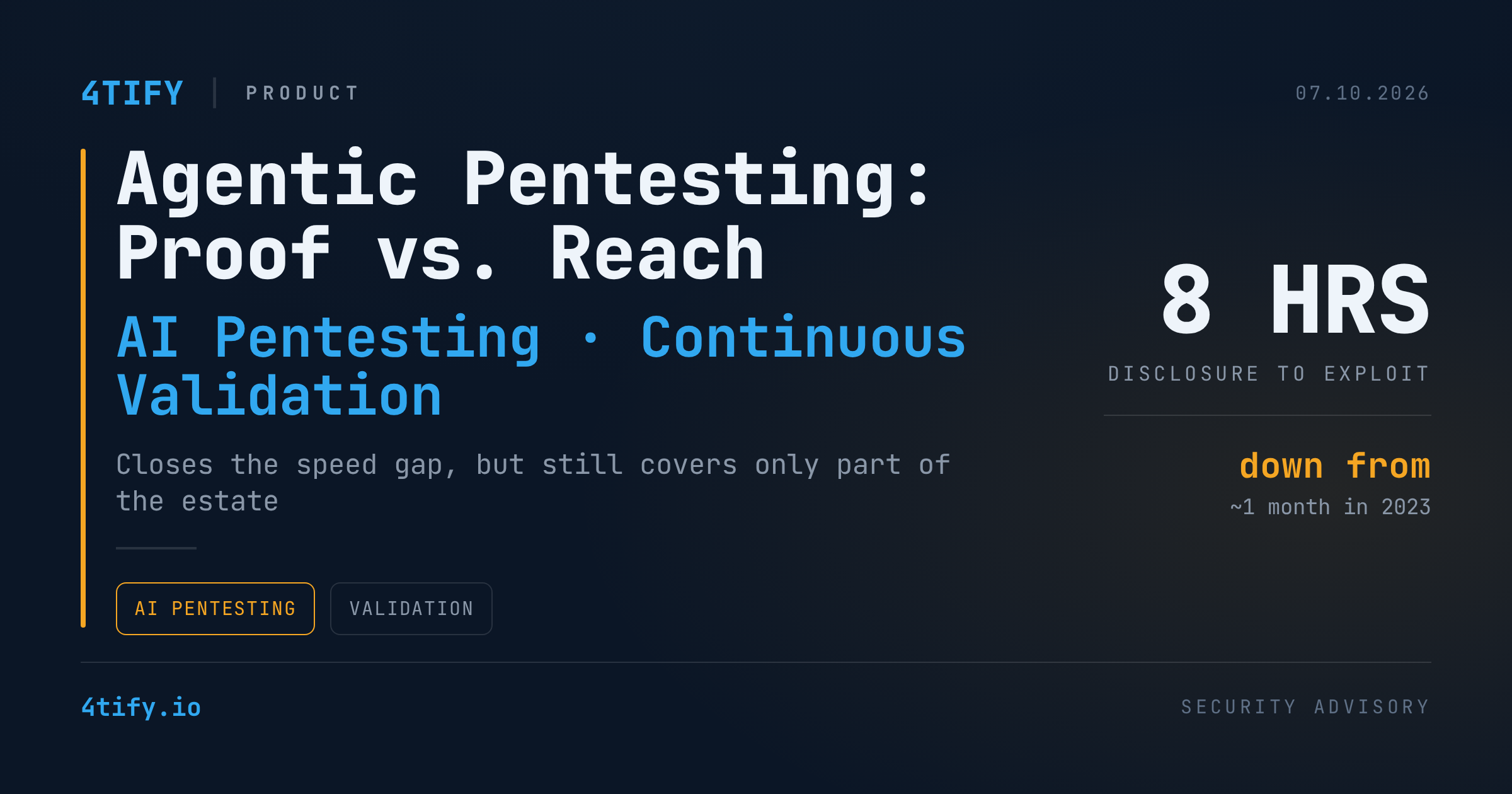
Agentic Pentesting: What It Actually Proves — and Where It Still Falls Short
Vulnerability counts aren't the only thing security teams can't keep up with anymore — speed has become just as critical. New data on CVE volume and exploitation timelines shows why "agentic," AI-driven penetration testing is gaining traction, and why it still isn't a full replacement for a layered validation strategy.
The scale of the problem
Four numbers capture why point-in-time testing is struggling to keep pace:
- Volume: over 33,000 CVEs were disclosed in the first half of 2025 alone, up roughly 50% year-over-year.
- Prioritization: of the nearly 40,000 CVEs published through August, fewer than 100 ever made it onto a known-exploited-vulnerabilities list — most severity scoring is chasing the wrong signal.
- Speed: the average time between a vulnerability's disclosure and its first real-world exploitation has collapsed from roughly a month in 2023 to just hours today.
- Capacity: of the tens of thousands of flaws now being surfaced by AI-assisted vulnerability discovery, only a few hundred have actually been patched upstream.
An annual penetration test can leave a team blind for most of a year between engagements; even weekly automated scans still leave a window of several days where a newly weaponized CVE goes unchecked.
What agentic pentesting actually delivers
Autonomous, agent-driven pentesting tools don't just flag a version number and guess — they chain real exploit steps (initial access, privilege escalation, lateral movement) to prove an attack path is genuinely exploitable, then produce evidence a defender can act on. Run repeatedly, that proof stays current instead of going stale the moment the environment changes.
That's a real gain in speed. But it comes with two structural limits worth understanding before a team leans on it as the whole strategy.
The speed gap: even agentic tooling needs weeks, not hours, once pointed at a large estate — a massive improvement over a human-led engagement, but still far slower than the hours-long window in which new exploits now get weaponized.
The coverage gap: live exploitation can only safely touch part of any real environment. Production systems, large business-critical segments, and air-gapped zones are routinely off-limits to active exploitation, and thousands of CVEs simply have no public working exploit for a tool to fire in the first place. Taken together, autonomous exploit-based testing alone tends to reach an estimated 20–30% of real exploitability across a typical enterprise — and stacking similar tools doesn't raise that ceiling, because they share the same underlying method.
Why it matters
Industry guidance is increasingly framing this as a shift from "have we been tested" to "is our validation keeping up with how fast exposure changes," with continuous, risk-tiered validation expected to become the dominant testing model for enterprises within the next few years. The practical implication: the type of change should decide the validation method — exploitability testing for a newly disclosed CVE, control simulation for an observed attack campaign, and live exploit chaining for a fresh infrastructure change that might open a new path to a critical asset.
What to do
- Don't retire scheduled, human-led penetration testing — agentic tools currently cover a minority of real-world exploitability and complement rather than replace deeper manual assessments.
- Pair exploit-based validation with exposure and control validation for the segments live testing can't safely touch (production, air-gapped, and highly restricted zones).
- Feed all validation methods — exploit validation, control simulation, and infrastructure-change testing — into a single deduplicated findings model, so coverage gaps don't quietly turn into blind spots.
- Treat newly disclosed high-profile CVEs as a trigger for fast, scoped exploitability checks rather than waiting for the next scheduled test cycle.