

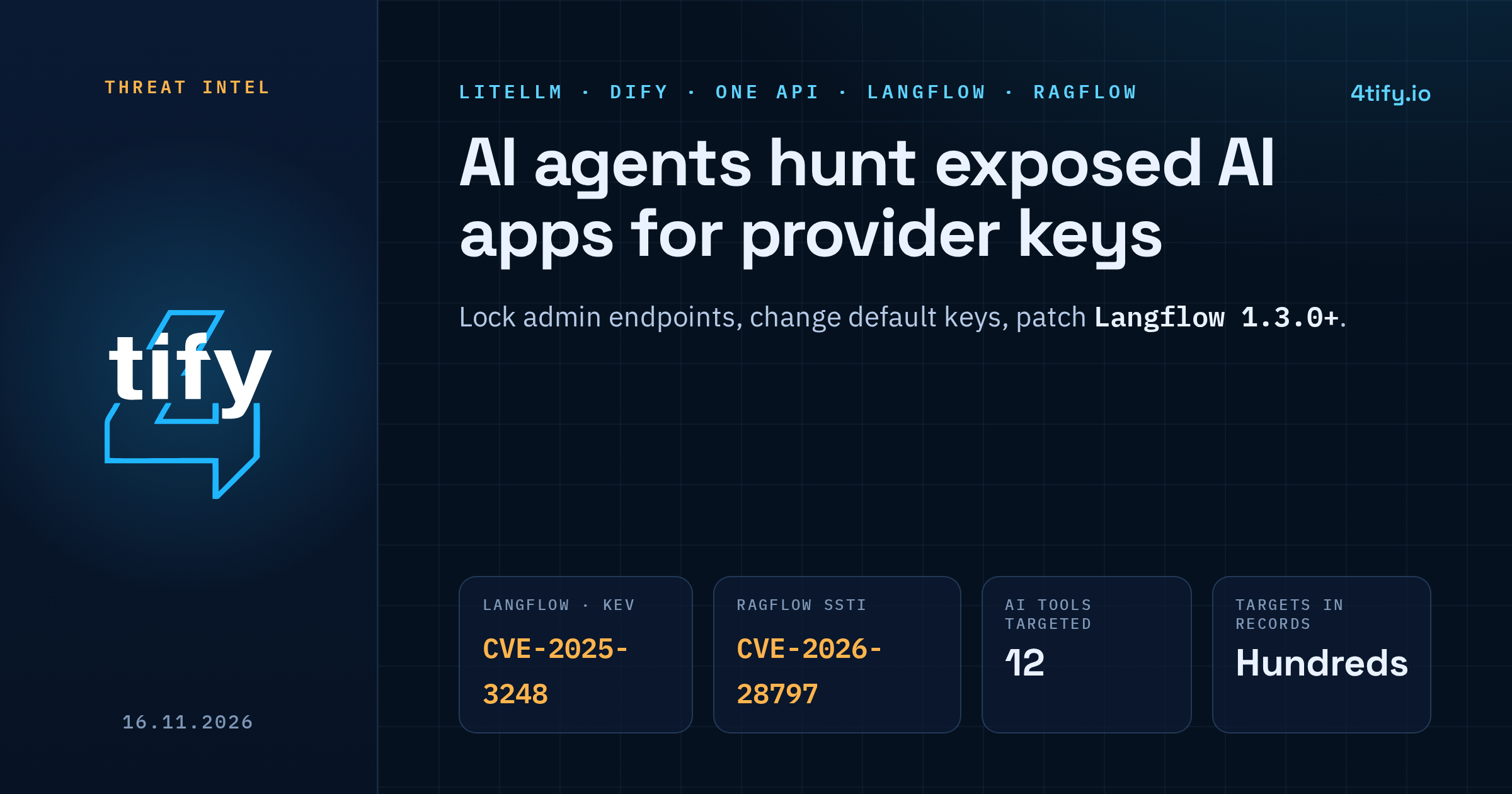
AI agents are hunting exposed LiteLLM, Dify and One API servers for provider keys
Attackers are running AI agents that search the internet for self-hosted AI tools, pull out the AI provider API keys stored inside, and then use those stolen keys to pay for the models that keep the search going. Amazon published the details on 13 November 2026 after its decoy network recorded the agents at work between 3 October and 5 November.
What happened
Amazon's MadPot sensors were set up to look like popular LLM chat-completion APIs. The agents that connected to them sent requests that carried their own working memory: the operator's instructions, the plan, and what the agents said they had already found elsewhere.
Amazon assesses with moderate confidence that the agents ran on ARTEX, an open-source agentic penetration testing framework, and that the operators were several separate China-linked groups. The evidence includes prompts written in simplified Chinese and China time zone settings. The instructions also told the agents to stay away from targets in mainland China and from government domains.
One caveat matters. The records describe work on systems the decoys never saw, and Amazon says it cannot verify the outcomes the agents reported. What the records do show is intent and method across hundreds of targets. Amazon has notified AWS customers it believes may have been affected.
Who is affected
Anyone running one of these tools on the open internet without solid authentication:
- LLM gateways and proxies: One API, New API, Veloera, Sub2API and LiteLLM.
- AI app builders: Dify, FastGPT, Langflow, RAGFlow, Open WebUI, LobeChat and Ollama.
Gateways were the favourite target. A single gateway often holds keys for many model providers and many downstream accounts, so one weak admin page can hand over all of them.
How the attack works
The agents followed a playbook of known ways in for each product:
- installs that were never finished, so an outsider could complete the setup and claim the admin account;
- management and provider-settings endpoints that answer without a login;
- default administrator credentials, such as LiteLLM's default master key;
- an authentication bypass through the
isCliRequestheader in One API family systems (no affected versions or fix have been published); - CVE-2025-3248 in Langflow, a missing-authentication flaw that lets a remote attacker run code on versions before 1.3.0. It is in CISA's Known Exploited Vulnerabilities catalog since 5 May 2025 and is marked as used in ransomware campaigns;
- CVE-2026-28797 in RAGFlow 0.24.0 and earlier, a template injection that lets any logged-in user run operating system commands. Self-registration is on by default, so "logged-in" can mean anyone who signs up;
- server-side request forgery through URL-fetch features to reach cloud metadata services;
- secrets left in client-side JavaScript, source maps, debug routes and environment files.
To find more keys, the agents also went through internet scanning services, certificate transparency logs, GitHub repositories and event archives, npm and PyPI packages, container image layers, notebooks, model-hosting spaces, paste sites and Telegram channels. Every working key was checked and added to a shared pool. When cloud credentials turned up, the agents went after managed AI model services, secret stores and application identities, and put access to premium models ahead of general cloud access.
The same decoy records describe a second campaign that tried to get past identity checks at two cryptocurrency exchanges with deepfake video. The verification vendor's server rejected the deepfake on every recorded attempt.
Separately, the FBI warned on 13 November that attackers have been abusing ARTEX since at least August. The original repository was taken down on 8 October, but forks remain in circulation.
What to do now
Amazon's own summary is blunt: none of the techniques were new. The agents won where basic controls were missing. If you run any of the products above:
- Take admin and management interfaces off the public internet, or put them behind SSO or a VPN. Check that provider-settings and model-list endpoints refuse anonymous requests.
- Change default credentials. On LiteLLM, set your own master key. Finish the setup of every new install before it is reachable from outside.
- Patch. Langflow must be on 1.3.0 or later; the NVD entry for CVE-2025-3248 has the details. For RAGFlow, the GitHub advisory for CVE-2026-28797 lists no patched release, but version 0.25.0 (21 April 2026) switched template rendering to Jinja2's sandbox. Upgrade, and turn off self-registration (
REGISTER_ENABLED=0) unless you need it. - Rotate every provider key a gateway holds if it was ever exposed, and stop keeping keys in front-end code, source maps or
.envfiles that get deployed. - Block access to cloud metadata from AI apps that fetch URLs, for example by enforcing IMDSv2 on AWS.
- Watch the bill. Set spend alerts and usage limits with each model provider. A sudden jump in tokens or calls to models you don't use is often the first sign a key is gone.
If you are not sure which AI tools your teams have put online, start there. Shadow deployments of Dify, Open WebUI or Ollama are exactly what these agents look for. Our Attack Surface Management service maps internet-facing hosts and subdomains continuously and flags exposed admin panels and unauthenticated endpoints like these, so you can close them before an automated scanner finds them.