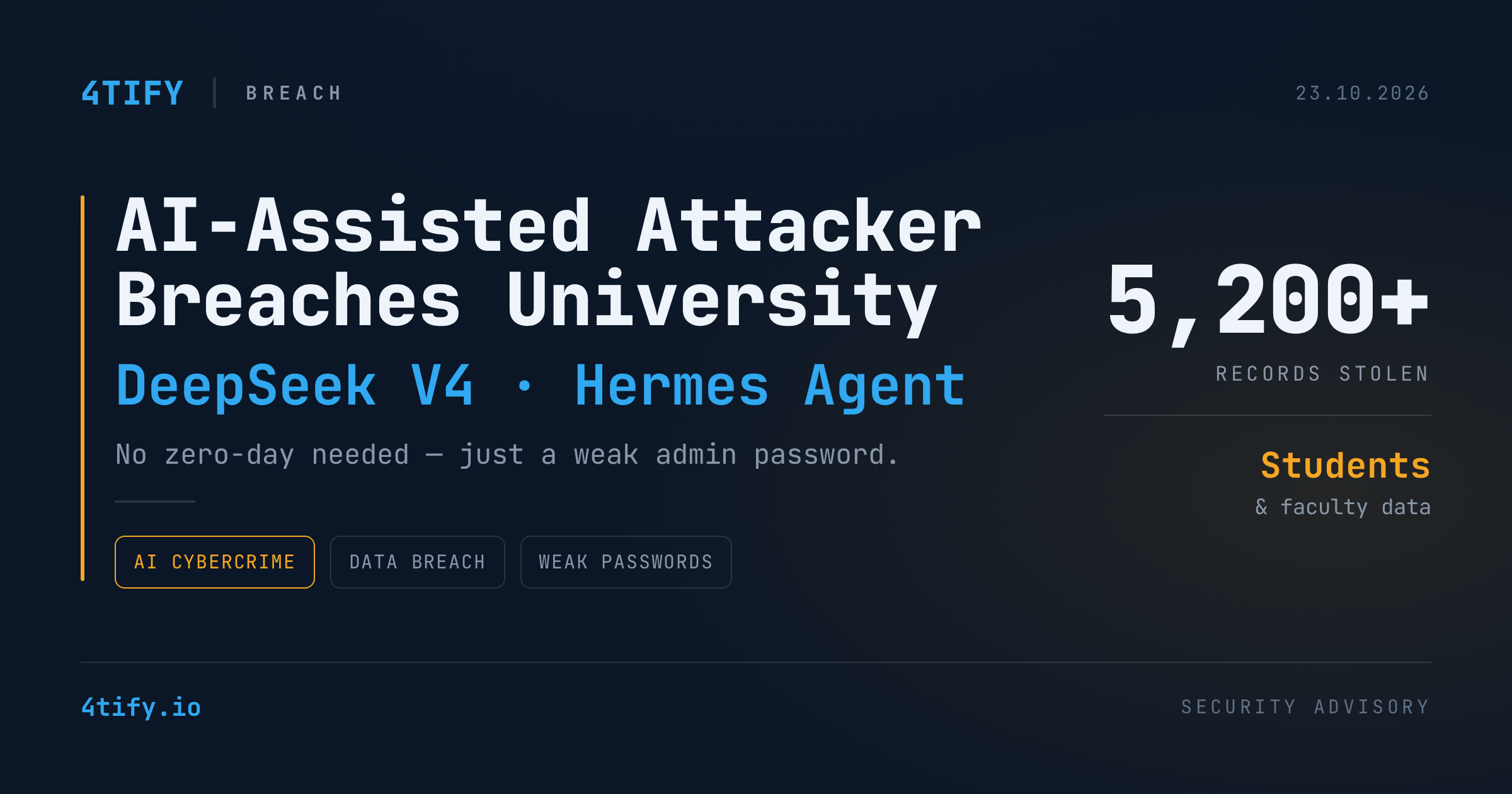
An AI-Assisted Attacker Breached an Indian University and Took 5,200+ Records — No Zero-Day Required
A threat actor operating as BUGSTER, who appears to have limited hands-on skills, leaned on an off-the-shelf AI stack to target Indian organizations — including two universities. In one confirmed intrusion, the actor walked away with a MongoDB database holding more than 5,200 records of student and staff personal data. The universities have not been named.
The headline isn't that AI "hacked" anyone. It's that AI lowered the bar enough for a modest operator to exploit the oldest problems in the book: weak passwords and over-exposed services.
What happened
Researchers reconstructed the operation by examining the actor's own environment, tooling and notes. The setup combined three pieces:
- Hermes Agent, an AI assistant framework, as the orchestrator
- DeepSeek V4 as the reasoning model
- Cursor as the coding tool
The actor reportedly disabled the tools' safety controls and relied on AI-written scripts and AI-generated reports to plan and organize the work.
University #1 — reconnaissance and password guessing. The AI-assisted research mapped an online education platform: a WordPress site, a learning platform, a student portal and an admin dashboard. One generated report flagged a fully exposed WordPress REST API (/wp-json/) leaking user IDs and real names for 13 active accounts. The actor then tried passwords against accounts and found one working login. Importantly, this activity has not been linked to the 5,200-record theft.
University #2 — the data theft. The records came from a separate intrusion: a public university database protected only by an administrator account with a weak password. The stolen MongoDB data covered diploma, undergraduate and postgraduate students plus faculty. The actor's notes also contained details of parts of the university's cloud and database setup.
Beyond the universities
The same environment showed a broader, AI-supported side business:
- A large credential-scanning toolkit hunting for cloud keys and private keys left in files and logs.
- Separate AI "profiles" for separate tasks — one sought advice on VoIP fraud, another researched phone carriers. Researchers found planning material but no evidence the phone-fraud operation went live.
- An automated Wi-Fi password-cracking workflow, which requires physical proximity — suggesting local access to target locations.
- Research on large cryptocurrency holders, with no observed follow-up against them.
Two infrastructure indicators were shared: 162.243.3[.]92 (actor infrastructure hosting several services) and 104.238.38[.]202 (commercial proxy).
Why it matters
None of this needed a novel vulnerability. Reconnaissance, an exposed API, a guessable admin password and secrets left lying around were enough. AI's contribution was speed and structure — turning a low-skill operator into one who can map targets, write scripts and document findings like a much more experienced one. Expect more of this: the defender's margin for "we'll fix basic hygiene later" is shrinking.
What to do
- Audit admin accounts. Remove weak and reused passwords and enforce MFA on every administrative and remote-access login.
- Lock down databases. MongoDB and similar stores should never be reachable from the internet; restrict access to approved hosts and users.
- Reduce public exposure. Review internet-facing portals and dashboards; restrict or disable unauthenticated WordPress REST endpoints such as
/wp/v2/users. - Hunt for leaked secrets. Keep API keys and cloud credentials out of public files and logs; rotate anything that may have leaked and review access logs for misuse.
- Monitor behaviour. Alert on password-guessing patterns, unusual logins and bulk reads of large record sets.
- Govern your own AI agents. Limit their permissions, keep safety and approval controls switched on, and review what they do.
- Block the IOCs above at the perimeter and search logs for past contact.
Most of these gaps are visible from the outside long before an attacker finds them. Our Attack Surface Management service continuously maps your internet-facing assets — forgotten portals, exposed APIs and databases, admin panels — so you can close them before someone with an AI assistant goes looking.
Source: this article summarizes research by Palo Alto Networks Unit 42, as reported by Cyber Security News.