

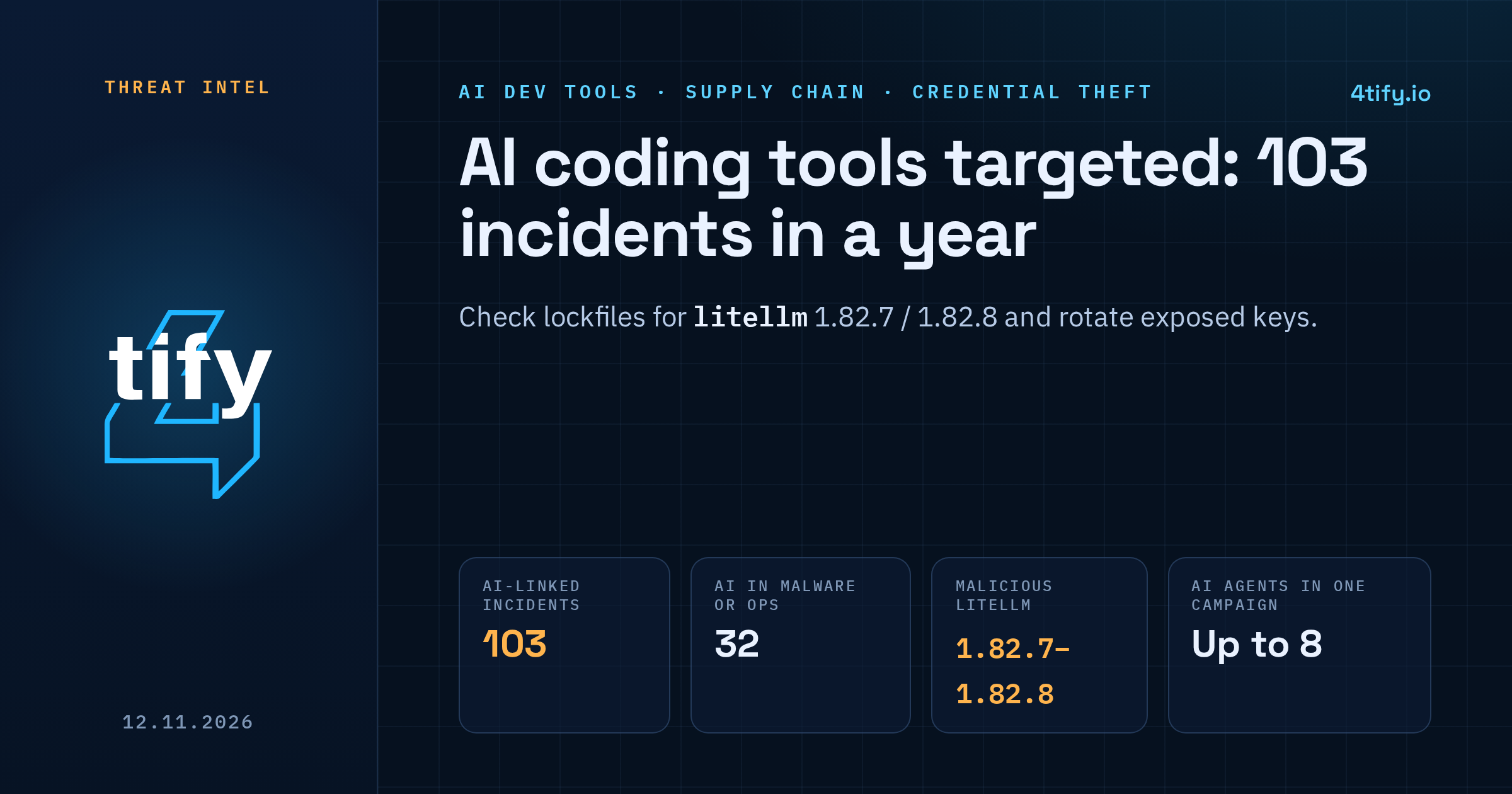
AI coding tools are now a way in: 103 AI-linked incidents in a year
Between 31 July 2025 and 31 July 2026, 103 documented incidents used AI somewhere in a malicious campaign. Very few of them involved machines hacking on their own. Most were familiar methods such as poisoned packages, phishing and extortion, made faster with AI, and a growing number went after the tools developers use to write code with AI.
What happened
The incidents fall into two groups. In 32 of them, AI was part of the malware itself or helped run the operation, and nine of those 32 were state-sponsored intelligence collection. The other 71 were attacks on AI systems and data, AI-themed lures used to deliver malware, AI-assisted fraud and deception, and abuse of legitimate AI services and agents.
The total is not 103 autonomous attacks, nor 103 breaches of AI providers. Fully automated operations stayed rare. The clearest exception was a campaign against government entities in Asia that used up to eight AI agents with limited human involvement.
For development teams, three supply chain incidents stand out.
- LiteLLM, March 2026. On 24 March, versions 1.82.7 and 1.82.8 of LiteLLM, a widely used Python library that connects applications to different large language models, were published to PyPI with credential-stealing malware. The attackers had obtained the project's publishing credentials through a compromised build tool. The payload harvested secrets, moved laterally through Kubernetes and left a backdoor. Both versions have been pulled, and the details are in the GitHub security advisory.
- AI tool packages on npm, April 2026. Packages tied to Namastex.ai, including
@automagik/genie, ran malware at install time. It stole secrets, browser data, cryptocurrency wallet data and npm tokens, then tried to spread by republishing other packages the victim had rights to. - Mini Shai-Hulud, May 2026. A new wave of the Shai-Hulud worm, starting on 11 May, hit about 170 npm and PyPI packages, AI libraries among them. It wrote itself into Claude Code's hook configuration so it would run again whenever a developer opened the project. Uninstalling the package did not remove it.
Outside the supply chain, AI-themed lures rose sharply after March 2026: fake landing pages for AI developer tools, ClickFix pop-ups on hacked sites and poisoned search results. Ransomware crews also use language models once they are inside. The Gentlemen group, for example, uses them to sort stolen data and size its ransom demands.
Who is affected
Any team that installs AI libraries, coding assistants or editor add-ons on developer machines and in CI pipelines. These tools usually sit next to source code, cloud keys, SSH keys and API tokens for model providers, so one bad dependency can expose all of them at once.
If you ran LiteLLM 1.82.7 or 1.82.8, there is no fixed version of those releases to move to. The advisory says to treat every credential in that environment as exposed.
How it works
None of this needs a new kind of attack. The attackers borrow access the tools already have. A coding assistant that can read the repository and run commands, or a package that runs code when it is installed, does whatever its code says. Once attackers control that code, through a stolen publishing token or a lookalike download page, they get the same access.
Stolen AI access is worth money on its own. Developer API keys, corporate OAuth tokens and paid AI subscriptions show up in infostealer logs next to passwords, so an incident response that only resets passwords leaves a door open.
What to do now
- Search lockfiles and build images for
litellm1.82.7 or 1.82.8, and look for a file namedlitellm_init.pthin site-packages. If you find either, rebuild from a clean image, pin 1.82.6 (the last clean release before the attack) and rotate every key the environment could reach. The project's March 2026 security update lists the steps. - Compare your npm and PyPI dependencies with the published lists of packages hit by Mini Shai-Hulud. On developer machines, check Claude Code hook settings and MCP server entries for anything nobody on the team added.
- Limit what coding agents can touch. Keep them away from production credentials, require a person to approve consequential actions, and log their activity somewhere they cannot edit.
- Treat model-provider API keys, OAuth tokens and AI subscriptions as credentials. Keep them in a secrets manager and watch for them in stealer logs.
- Get AI tools only from the vendor's own site or the official package registry. Be wary of any page that asks you to paste a command into a terminal.
A malicious version in a dependency tree is the kind of problem a source review catches before it reaches production. Our AI-assisted code review checks your dependencies, lockfiles and committed secrets, and flags known-malicious package versions and exposed keys while they are still cheap to fix.