

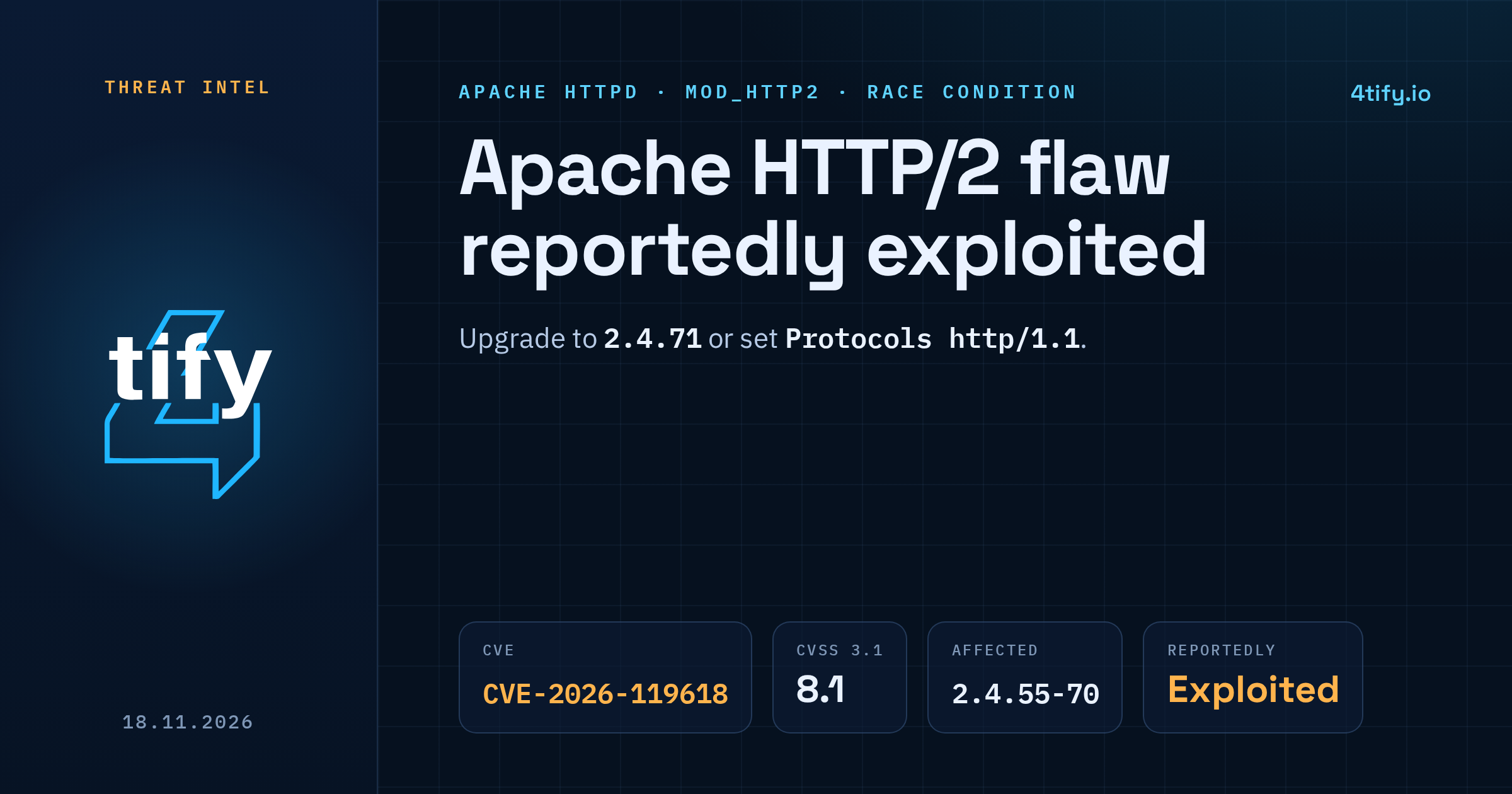
Apache HTTP/2 flaw CVE-2026-119618 reportedly exploited, patch to 2.4.71
Singapore's Cyber Security Agency warned on 17 November that attackers are reportedly exploiting CVE-2026-119618, a remote code execution flaw in the HTTP/2 module of Apache HTTP Server. Apache shipped the fix in version 2.4.71 on 11 November. Any server that runs an affected version with HTTP/2 switched on should be upgraded now.
What happened
The bug sits in assign_headers(), a function inside mod_http2, the module that lets Apache speak HTTP/2. Apache describes it as a race condition: several threads touch the same piece of memory without proper locking, and the heap can end up corrupted. An attacker who wins that race reliably can turn the corruption into code execution with the privileges of the web server process. No login is needed.
Apache rates the issue critical. The CVSS 3.1 score published with the NVD entry is 8.1, lower mainly because the attack is marked as hard to pull off. Red Hat scores it 9.8.
Two separate teams reported the flaw to Apache, on 26 October and 3 November. When the patch came out, nobody had reported attacks. That changed on 17 November, when the Singapore alert said the vulnerability is reportedly being exploited and that a proof-of-concept exploit is public. The alert gives no details about victims or the scale of the activity. As of its 17 November update, CISA had not added the CVE to its Known Exploited Vulnerabilities catalog.
Who is affected
- Apache HTTP Server 2.4.55 through 2.4.70, when mod_http2 is loaded and HTTP/2 is enabled.
- The standalone mod_h2 module from GitHub, versions 2.0.8 through 2.0.42. That repository is archived and has no fixed release, so the way out is the module bundled with httpd 2.4.71.
- Servers that only speak HTTP/1.1 are not exposed. Apache's own default is
Protocols http/1.1, so HTTP/2 has to be turned on by an administrator or a distribution's config.
Red Hat says RHEL 8 and older do not contain the vulnerable code. On RHEL 9 and 10 it rates the issue Important rather than Critical, because the way those builds allocate memory for each HTTP/2 stream makes exploitation much harder.
The same 2.4.71 release also fixes two smaller bugs: CVE-2026-106023, a crash in mod_md, and CVE-2026-109163, a one-byte stack overwrite in mod_vhost_alias.
What to do now
- Find your Apache servers and their versions. Run
httpd -vorapache2 -v. Anything from 2.4.55 to 2.4.70 is in range. - Check whether HTTP/2 is on.
apachectl -M | grep http2shows whether the module is loaded. Then search the configuration forProtocolslines that includeh2orh2c, both globally and inside every virtual host. - Upgrade to 2.4.71 or later, or install the package your OS vendor marks as fixed for CVE-2026-119618. The version list and patch are in the Apache security advisory.
- If you cannot patch today, set
Protocols http/1.1, make sure no virtual host still allowsh2orh2c, and reload Apache. Confirm from outside that the server no longer negotiates HTTP/2, for example withcurl -sI --http2 -o /dev/null -w '%{http_version}\n', which should print1.1. - Look back, too. Patching closes the hole but says nothing about what happened before. Keep the access and error logs from internet-facing servers that ran an affected version with HTTP/2, and check for unexpected child crashes, new processes started by the web server user, and unusual outbound connections.
Start with servers exposed to the internet, then move to internal ones, reverse proxies and appliances that embed Apache.
Our vulnerability scanning service checks internet-facing hosts for outdated web server builds and for protocol settings like HTTP/2, so a version in the 2.4.55 to 2.4.70 range with h2 enabled shows up on the report before an attacker finds it.