

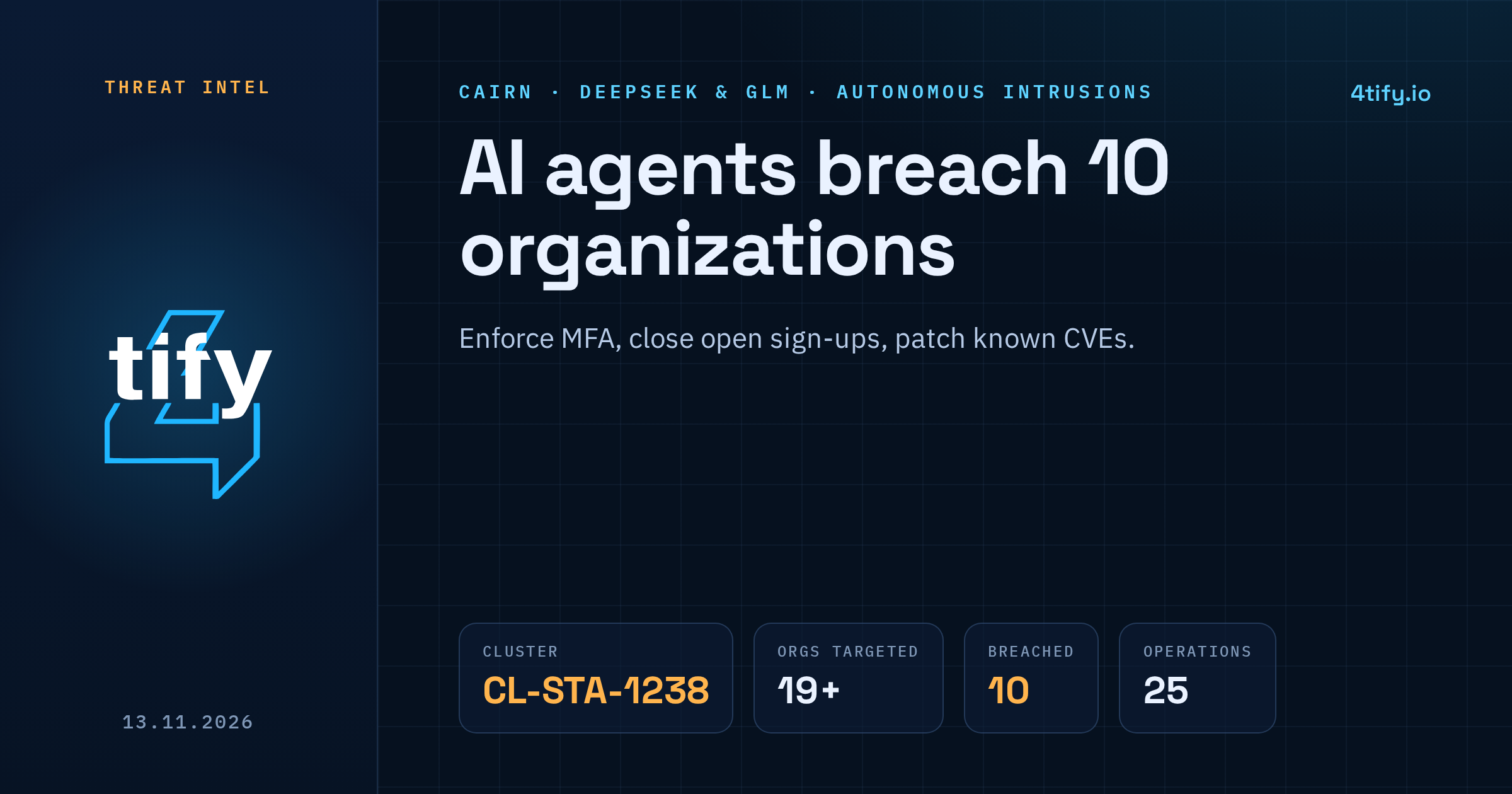
An attacker group running an open-source AI penetration testing framework called Cairn, wired to Chinese language models, carried out 25 intrusion operations against at least 19 organizations in August and September 2026. Unauthorized access or data retrieval is confirmed at 10 of them.
The activity is catalogued as CL-STA-1238 and assessed, with moderate confidence, as China-nexus intelligence collection. That judgment rests on Chinese-language tasking files, the exclusive use of Chinese AI models and the choice of targets. No specific government body has been named.
What happened
Cairn was built as a legitimate tool for authorized testing. The operators ran their own modified fork with an extra exploitation skill pack, hosted on a server in Hong Kong, and pushed traffic out through a staging node in the United States.
For most targets they typed in little more than a root domain and a one-line objective, often in Chinese. The model then wrote its own plan of three to seven stages and worked through it: reconnaissance, web application attacks, credential harvesting, privilege escalation and lateral movement. In one case the task arrived preloaded with VPN gateway addresses, group names and shared group passwords, which points to reconnaissance done beforehand.
The model split across the 25 operations was:
- Zhipu GLM 5.2: 13 operations
- DeepSeek V4 Flash: 8 operations
- DeepSeek V4 Pro: 4 operations, apparently brought in for second attempts where Flash had failed
Runs lasted anywhere from 20 minutes to more than 50 hours, with no time limit set. The evidence points to one operator or a very small team.
Model safeguards did not slow them down. Cairn's default prompts already tell the model never to refuse a task. The operators added a Chinese-language preamble claiming the work was authorized security testing and had each operation generate an AUTHORIZATION.md file saying the client had approved it. Neither GLM nor DeepSeek refused.
Who was hit
Of the targeted organizations, seven sit in the semiconductor and advanced-manufacturing supply chain, three in defense or defense policy, and four in human rights and civil society. Confirmed outcomes include:
- An industry standards body: password spraying produced dozens of valid credentials and access to non-public directory data. A live standards-ballot document was overwritten.
- A semiconductor company: a brute-forced production credential led to new, unauthorized administrator accounts and a persistent API token.
- A U.S. teachers' union: more than one million member records, about 31,000 CRM contacts and staff password hashes.
- A defense-policy program: an open registration endpoint exposed roughly 500 user records, some with .mil and .gov addresses.
- Employee data at a semiconductor-lithography manufacturer, about 150,000 internal documents at an industrial-automation company, and student data at an education nonprofit.
Why it matters
None of this needed a zero-day. The weaknesses were old and familiar: authentication bypasses, insecure direct object references, mass-assignment privilege escalation, weak or default passwords, exposed cloud APIs and dated public CVEs.
What the AI changed was scale. A single operator could keep many intrusions running at once, each one patiently trying the obvious things across every exposed system. Expect more of this as open models with weak guardrails keep getting better.
What to do now
- Kill weak and shared passwords. Enforce unique, strong passwords and roll out phishing-resistant MFA, as described in CISA's guidance on phishing-resistant MFA. Start with VPN gateways, admin panels and cloud consoles.
- Close open doors. Look for self-registration endpoints that should not be public, storage buckets and APIs that answer without authentication, and forgotten staging or test hosts.
- Patch the old stuff first. Prioritize anything listed in the CISA Known Exploited Vulnerabilities catalog on internet-facing systems.
- Check your APIs for authorization flaws. Test whether one user can read another user's records by changing an ID, and whether extra fields in a request can raise privileges.
- Watch for tireless, noisy clients. An agent that runs for hours keeps sending requests long after a human would stop. Rate-limit and alert on sustained, high-volume traffic from a single address, and audit for new admin accounts and API tokens nobody asked for.
- Hunt for the published indicators in firewall and proxy logs:
154.44.31[.]4(Cairn hosting server, Hong Kong) and82.29.129[.]54(staging and egress node, United States).
Every flaw in this campaign was sitting on the internet, waiting to be found. Our Attack Surface Management service maps the domains, subdomains, login pages, open registrations and exposed APIs an organization actually presents to the outside world and keeps watching them, so a forgotten endpoint gets fixed before an automated agent finds it.