

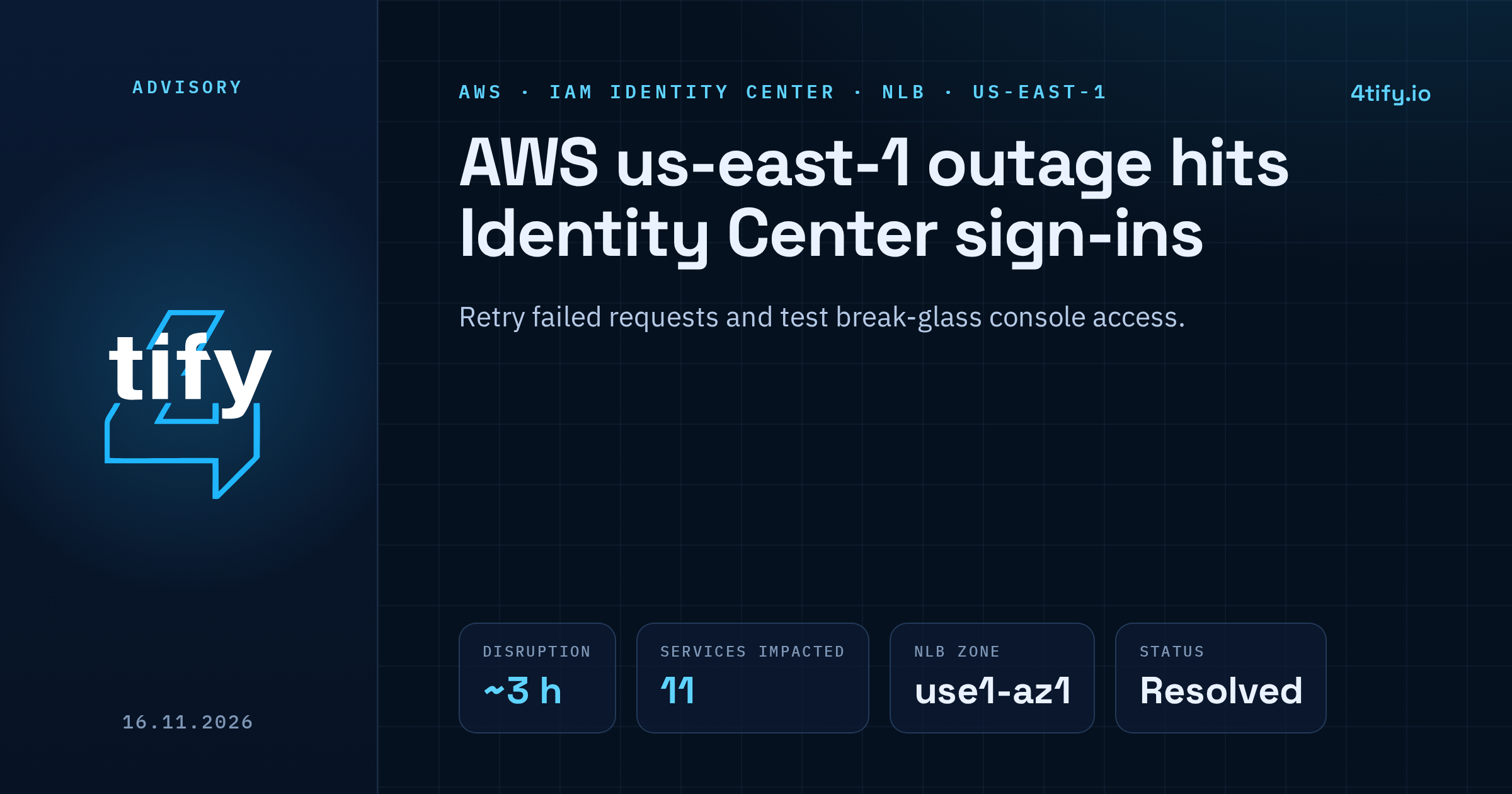
AWS us-east-1 outage: Identity Center sign-ins, sign-ups and load balancers down for three hours
Amazon Web Services had a three-hour disruption in its US-EAST-1 (Northern Virginia) region on Sunday, 15 November 2026. Between 3:05 and 6:10 AM PST, customers saw failed sign-ins through IAM Identity Center, errors on new AWS account sign-ups and network connectivity problems. One group of Network Load Balancer customers was affected until 6:21 AM. AWS marked the event resolved at 6:53 AM PST.
What happened
AWS says its engineers were paged automatically at 3:10 AM, five minutes after the problems started. The first public notice on the AWS Health Dashboard appeared at 4:38 AM PST, reporting connectivity issues in the region along with failing IAM Identity Center sign-in requests and AWS Sign Up.
At 5:15 AM AWS confirmed that authentication was failing for anyone using Identity Center, and for any service that relies on it. It also said there was no workaround for affected customers. Recovery for Identity Center and Sign Up started showing about seven minutes later. By AWS's own summary, the authentication problem was fully mitigated at 5:20 AM, and most services recovered then.
Networking took longer. A subset of Network Load Balancers in a single cell of one Availability Zone (use1-az1) kept losing connectivity. AWS told customers who could not wait to create a new NLB with targets in more than one Availability Zone. The underlying fault was fixed at 6:21 AM.
Who was affected
The dashboard lists 11 services as impacted in US-EAST-1:
- AWS IAM Identity Center and AWS Sign Up
- Amazon Connect and Kiro, through their dependence on Identity Center sign-in
- Amazon Elastic Load Balancing, AWS NAT Gateway and Amazon VPC Lattice
- Amazon CloudWatch, Amazon OpenSearch Service, AWS Step Functions and AWS IoT Device Management
The practical effect was that teams signing in to the AWS Management Console through Identity Center were locked out for up to two and a quarter hours, while their workloads may have kept running. AWS said Kiro users who log in with social sign-in methods were not affected.
What we know about the cause
Very little so far. AWS has not published a root cause, has not named a failed component and has not said whether the sign-in failures and the load balancer problem came from the same event. Nothing in its updates points to an attack or a security breach. This was an availability incident, and there is no CVE or patch involved.
What to do now
- Retry failed work. AWS recommends retrying any requests that failed during the window. Check scheduled jobs, Step Functions executions and deployments that ran between 3:05 and 6:21 AM PST.
- Check your load balancers. If you replaced an NLB during the incident, decide whether to keep the new one or go back, and update DNS and target groups to match.
- Set up emergency console access now. AWS publishes emergency access guidance for IAM Identity Center: a direct IAM federation path or break-glass roles that work when Identity Center is down. It has to be in place and tested before the next outage, because you cannot create those roles while you are locked out.
- Spread NLB targets across Availability Zones. Single-AZ targets are the setup AWS itself told customers to move away from during this event.
- Know where things run. Keep a current list of which internet-facing services sit behind which load balancers, regions and zones, so you can tell within minutes what an outage like this touches.
That last point is the part a security team can own. Our Attack Surface Management service keeps an up-to-date map of a company's internet-facing hosts and the infrastructure behind them, which makes it much quicker to see what is exposed when a provider has a bad morning.