

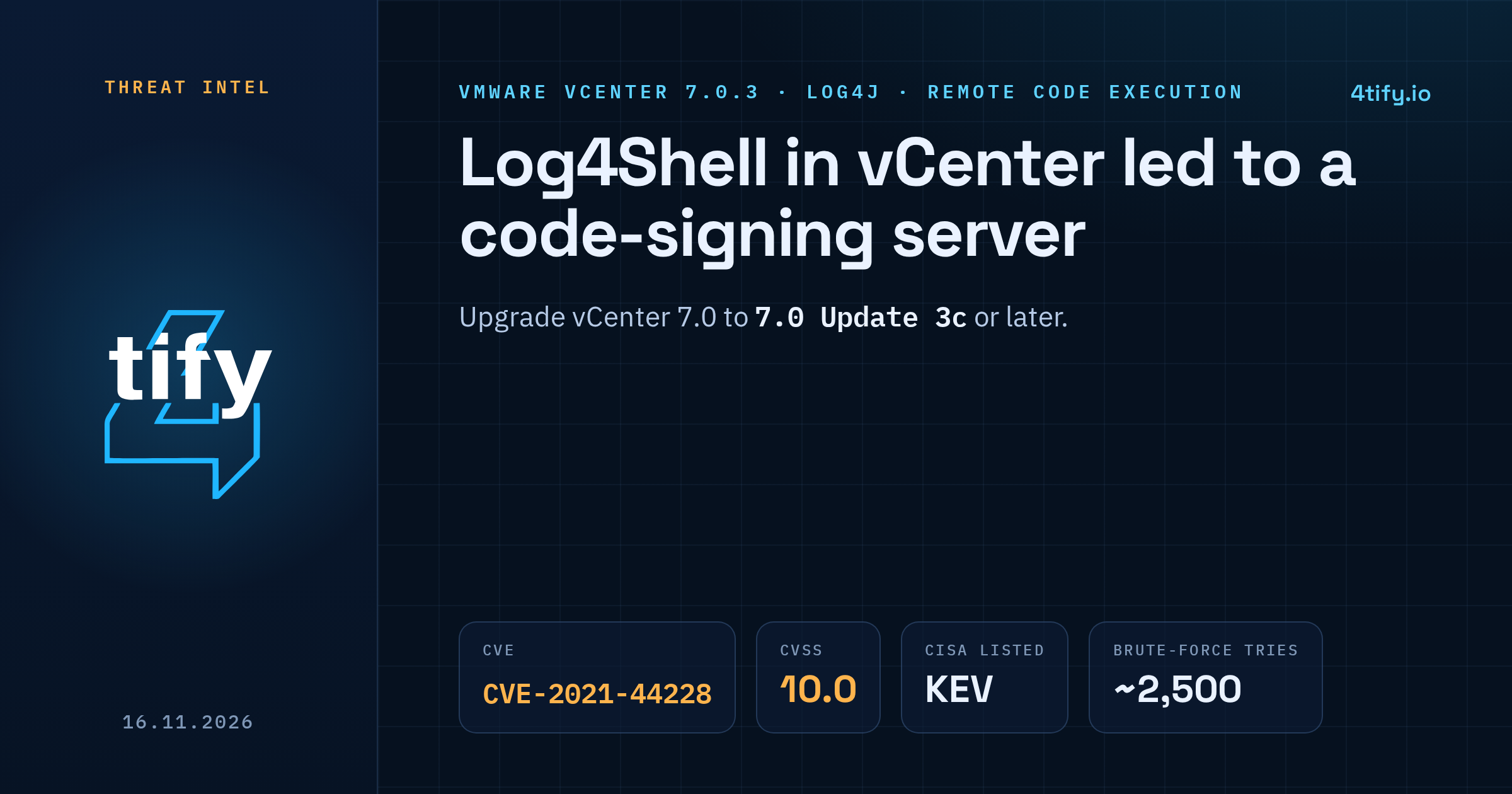
BO Team used Log4Shell in vCenter to reach a code-signing server
A hacking group known as BO Team, which has a record of attacks on Russian organizations, spent several months inside the network of a Russian software developer in 2025, and one of the systems it went after was the server that signs the company's commercial software builds. The way in was a VMware vCenter appliance that still ran a version exposed to Log4Shell, a flaw that has had a patch since December 2021.
The incident response report on the case was published on 5 November 2026. The company is not named. It operates in Russia and makes software used by industrial enterprises.
What happened
The company raised the alarm in June 2025 after noticing SMB connection attempts on system administrators' machines from accounts that had no business being there. The investigation that followed found an intrusion that had reached almost every part of its IT estate: Windows and Linux servers, workstations, hypervisors, backup servers, security management consoles and network equipment.
The first foothold was a Linux terminal server with SSH open to the internet and a service account that accepted a plain username and password. From there the attackers mapped the internal network and moved to the virtualization layer.
Attempts to sign in to the vCenter web interface failed. What worked, according to the investigators, was the appliance itself: it ran vCenter Server 7.0.3, which ships a vulnerable Log4j library (CVE-2021-44228, CVSS 10.0). The report calls the exploitation likely rather than proven. The commands matched a public proof of concept, and the responders reproduced the attack on an identical build in a lab. The result was a root shell, an SSH private key and access to the hypervisor.
How they stayed in
On the hypervisor the attackers dropped a script called pgcache in /etc/cron.hourly/, named to pass for a PostgreSQL component and backdated to look like an old file. Every hour it looked up a domain on a free dynamic DNS service. While that record pointed to 127.0.0.1 the backdoor stayed quiet. Changing a single DNS record was enough to make it download and run the next stage, which later turned out to be a GSocket remote shell.
The same trick was repeated on a second virtualization cluster. After that the intrusion spread through ordinary admin tooling:
- a GitLab server, giving them some source code repositories and the server's private key;
- the Ansible server, reached with that key, and through it the VPN, backup and SIEM servers;
- the domain controllers, after an LSASS memory dump and a copy of the Active Directory database. One administrator password was reused across domains, so every domain fell;
- an admin's own terminal server, where the root password was brute-forced after roughly 2,500 failed attempts because root login over SSH was allowed.
They also patched a login binary on one Linux host so that it wrote user credentials to a file in shared memory.
The code-signing server
The server that signs the company's builds was the clear prize. Whoever controls it can slip code into a release just before it is signed, or take the signing key and use it on malware later. The investigators believe the group was preparing a supply chain attack against the company's customers. That is an assessment based on where the attackers spent their time. Their attempts on the signing server were blocked by a security product, and the report does not say that any tampered build reached a customer.
After defenders cut off access, the group tried to get back in with a phishing email at the end of July 2025, subject "Account disconnected from the mail server". It passed SPF and carried a valid DKIM signature, which points to a stolen mail signing key. It was detected and stopped.
Who is affected
Directly, one company and potentially its customers. The broader lesson applies to anyone still running vCenter Server 7.0 below Update 3c, or any other appliance with an old Log4j inside. CISA added CVE-2021-44228 to its Known Exploited Vulnerabilities catalog on 10 December 2021 and marks it as used in ransomware campaigns.
What to do now
- Check vCenter. Version 7.0 is fixed from 7.0 Update 3c (build 19234570) under VMware advisory VMSA-2021-0028; anything older needs upgrading.
- Inventory appliances and internal tools that bundle Java. Log4j 2.0-beta9 to 2.15.0 is the vulnerable range.
- Close internet-facing SSH where you can. Elsewhere, disable password and root logins and use keys plus MFA.
- Look for persistence the way this group hides it: unfamiliar scripts in
/etc/cron.hourly/, backdated files, and hosts resolving DNS names that point to 127.0.0.1. - Treat build and signing servers as tier-zero assets: separate them, limit who can reach them and alert on any new login.
- If you find a compromise, reset every password and key, including the
krbtgtaccount twice, and stop reusing admin passwords across domains.
Most of this chain started with a known, years-old vulnerability on a box nobody had patched. Regular vulnerability scanning of internal infrastructure, hypervisors and management appliances included, is how our team finds exactly that kind of forgotten Log4Shell exposure before someone else does.