

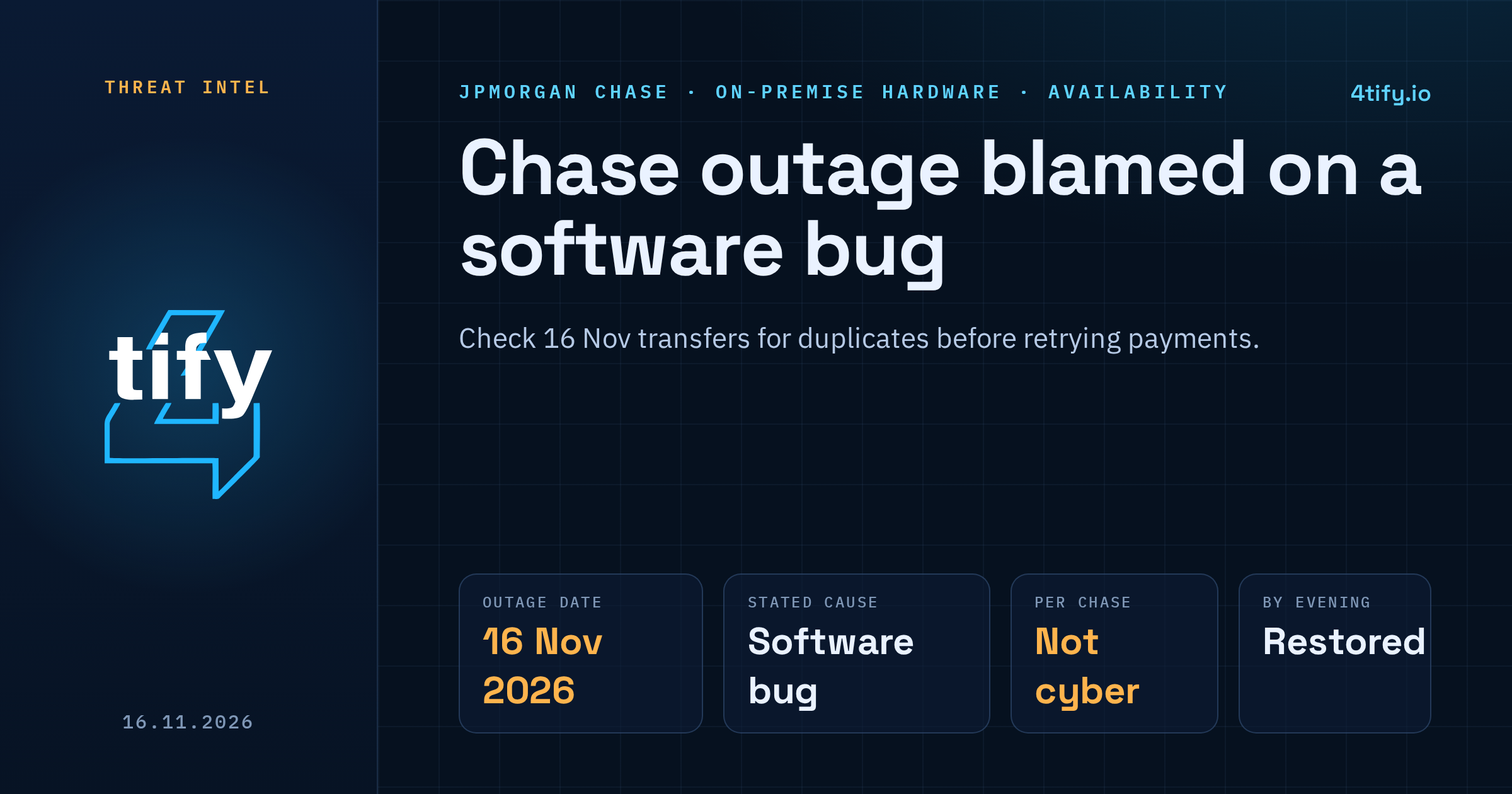
JPMorgan Chase customers across the United States had trouble reaching their money on Monday, 16 November 2026. The bank blamed a software bug in its own on-premise hardware and said the problem was not cyber-related. By Monday evening, Chase said transactions were posting normally again.
What happened
Thousands of customers reported problems with Chase online and mobile banking during the day. Some saw an in-app message saying that some services were unavailable and asking them to try again later. People described failed or slow balance checks, transfers and payments, and the delays reached branch transactions as well as digital channels.
Chase said it "experienced a temporary issue related to a software bug in on-premise hardware systems." In other words, the fault sat in equipment the bank runs itself, not with a cloud provider or an outside partner. The bank said customers kept access to their accounts and funds, although some requests took longer than usual to complete.
Chase has not said how many accounts were affected and has not published a technical breakdown of the fault. What exactly failed, and what will be changed to prevent a repeat, is not yet public.
Why other banks showed up in the complaints
Customers of Bank of America, Wells Fargo, U.S. Bank and others also reported trouble, which made the event look like a sector-wide failure. Chase said it was "a Chase-only issue" and not a systemic one. Other banks could see slower processing only when Chase was on one side of the transaction.
U.S. Bank said its own systems were not directly affected, but Zelle payments involving another institution could be delayed. Zelle's operator, Early Warning Services, said the network itself was working and that problems at financial institutions could be delaying some customers' payments. Early Warning Services is owned by seven large US banks, Chase among them. When a participant that large slows down, people at other banks who send money to Chase customers, or receive it from them, feel it too.
Was it an attack?
Chase said there was no indication of a cyberattack. Nothing published so far points to a data breach. This was an availability incident: services were slow or unreachable, and there is no sign that data was exposed.
What to do now
If you are a Chase customer:
- Check your recent activity for duplicate or missing transfers made on 16 November. A payment you retried during the outage may have gone through twice once processing caught up.
- If a Zelle payment to or from a Chase account is still pending, contact your bank before sending it again.
- Be careful with messages that mention the outage. A genuine bank will not ask for your password or one-time codes by text, email or phone. Outages are a common hook for fake "refund" or "account verification" messages, so open the official app yourself instead of following links.
If you run IT for a bank or payments business:
- Treat changes to on-premise infrastructure with the same rigour as application releases: staged rollout, a tested rollback path and clear ownership for the decision to stop.
- Map which customer journeys depend on a single internal system, and which partners (payment networks, processors) will feel it when that system slows down.
- Prepare status messages for customers and partners in advance. On Monday, much of the confusion came from people at unaffected banks trying to work out whether their own bank was down.
- US financial institutions can find sector resilience resources on CISA's Financial Services Sector page.
Knowing your own dependencies is half the work. Our Attack Surface Management service keeps an up-to-date inventory of a company's internet-facing systems and the third-party services they rely on, which makes it faster to see what is exposed when one piece fails.