

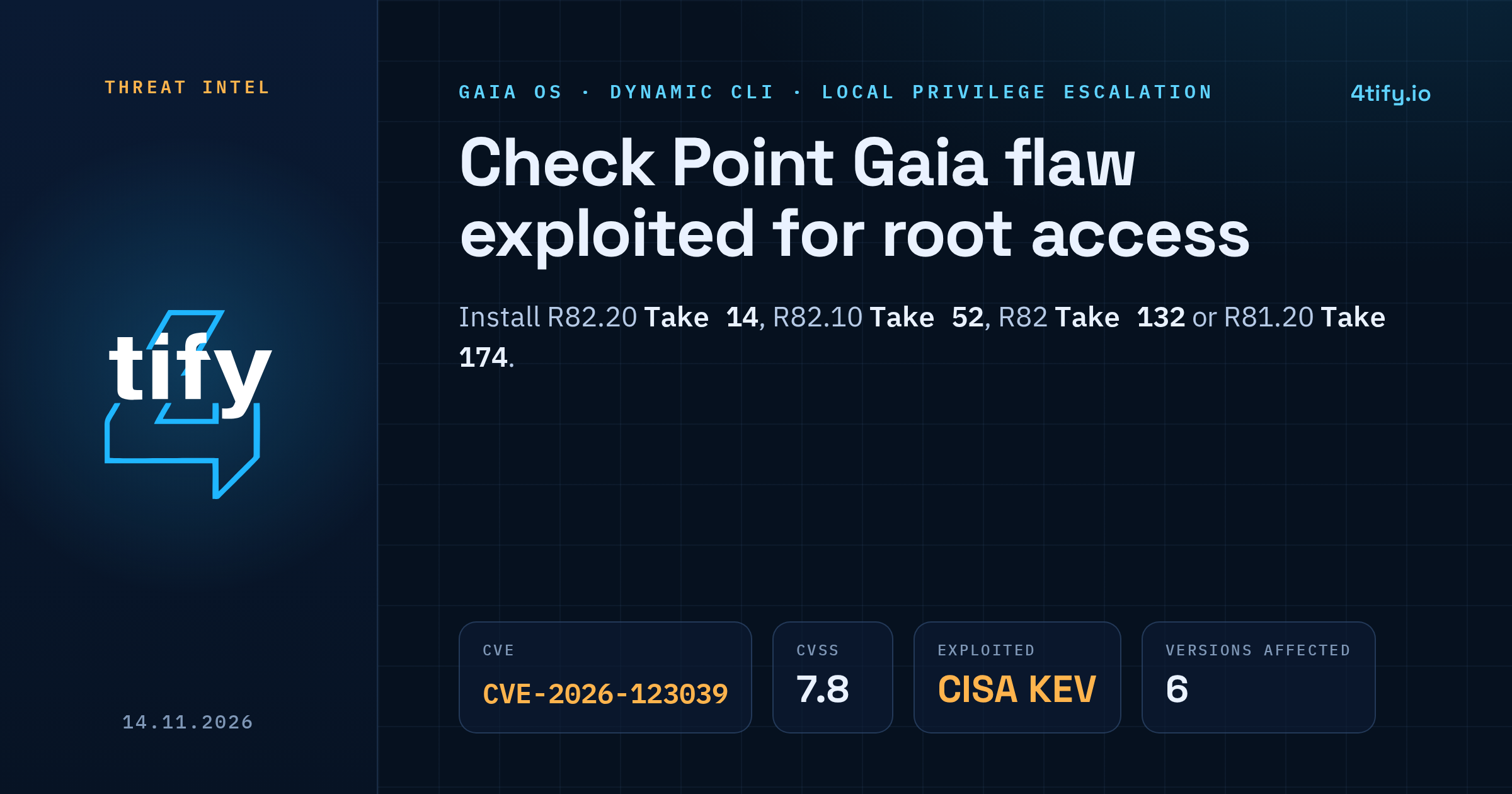
Check Point Gaia flaw used to get root on firewalls, now on CISA's exploited list
Attackers have been using a local privilege escalation bug in Check Point's Gaia OS to take full control of firewalls and management servers. The flaw, CVE-2026-123039, lets anyone who already runs code on an appliance turn that foothold into root. CISA added it to its Known Exploited Vulnerabilities catalog on 13 November 2026 and gave US federal agencies until 16 November to act.
Check Point says it has seen the bug exploited against a couple of dozen customers. Fixes are out for the supported releases.
What happened
Gaia's Dynamic CLI feature is served by a process called dynamic_server, which runs as root. It takes commands over a local socket, /tmp/dynamic_socket. On affected versions that socket is created world-writable (permissions 0777), and the daemon never checks who is connecting. It simply runs the command string it receives, as root.
That means any local user, including a low-privileged service account or a web process an attacker has hijacked, can write one request to the socket and get root. Check Point rates it 7.8 (High) under CVSS 3.1. The score is lower than a remote bug would get because an attacker needs a way onto the box first.
In the attacks Check Point has described, that first step came from PHP2Shell (CVE-2026-109618 and CVE-2026-109619), a pair of PHP flaws that hit the Mobile Access portal on Security Gateways. Attackers used that for remote code execution, then used the Dynamic CLI bug to become root and stay on the device. The vendor says the activity ran from 30 October to 4 November, against unpatched systems, and in a few cases included destructive actions. No threat actor has been named.
Who is affected
According to Check Point's advisory, the vulnerable products are:
- Check Point Force Firewalls
- Management and Log Servers
- Multi-Domain Security Management and Multi-Domain Log Server
- Maestro Orchestrator
Affected versions are R82.20, R82.10, R82 and R81.20, plus R81.10 and R81, which are end of support. Spark Firewalls and Smart-1 Cloud are not affected.
What to do now
- Install the fixed Jumbo Hotfix Accumulator. The fix ships in R82.20 Take 14, R82.10 Take 52, R82 Take 132 and R81.20 Take 174, or any later take. There is no fix listed for R81.10 or R81, so those systems need an upgrade to a supported release. The details are in Check Point's advisory sk1000362.
- Patch the way in as well. Since the attacks started with PHP2Shell on the Mobile Access portal, apply the November Jumbo Hotfix to gateways and management servers and treat internet-facing Mobile Access deployments first.
- If you can't patch today, switch the daemon off. In Expert mode, run
dbset process:dynamic_serverand thendbset :save. This stops the commands that depend on Dynamic CLI from working, so plan for it. Rundbset process:dynamic_server tanddbset :saveto turn it back on later. - Confirm the fix. After patching,
ls -l /tmp/dynamic_socketshould showsrw-rw----owned byrootand groupconfig(0660), notsrwxrwxrwx. - Look for signs you were hit. The daemon logs every command it receives in
/var/log/dynamicCli.log. Legitimate requests come wrapped in Gaia's Clish profile script. AnyReceived =line without that wrapper needs a closer look, as do entries containing#return_value#or commands such aswhoami,wget,curl,base64,useraddor changes toauthorized_keys. On patched systems, lines readingRejected connection from unauthorized uidshow an attempt that was blocked.
US federal agencies also have to follow CISA's forensic triage requirements for this entry, which is a good hint for everyone else: if a gateway ran a vulnerable build with Mobile Access exposed during the attack window, check it for compromise rather than just patching it. The NVD entry lists the CVE's technical details.
How we can help
This campaign worked because an internet-facing portal on the firewall itself was the entry point. Our Attack Surface Management service keeps track of what your organisation exposes to the internet, including management interfaces and VPN or Mobile Access portals, and flags them when a known exploited flaw lands, so you know which boxes to patch first.