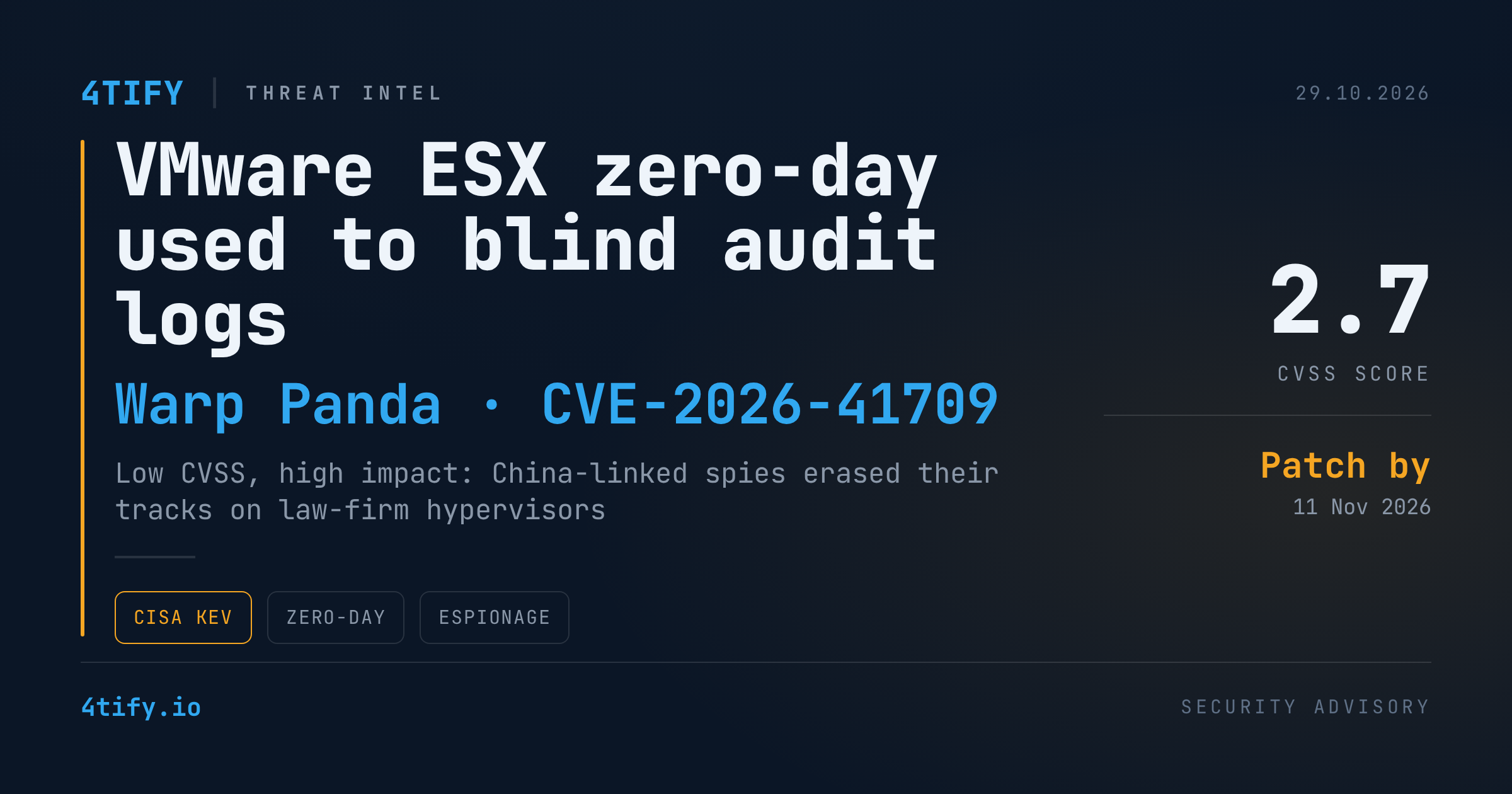
China-Linked Warp Panda Exploited a VMware ESX Logging Flaw to Hide Its Tracks
A vulnerability that scores just 2.7 on the CVSS scale has been added to CISA's Known Exploited Vulnerabilities (KEV) catalog. CVE-2026-41709 is an insufficient-logging weakness in Broadcom's VMware ESX hypervisor, and on paper it looks harmless. In practice, a China-linked espionage group known as Warp Panda used it as a zero-day in early 2026 to carry out actions on compromised hosts without leaving a trace in the audit log.
What happened
- The flaw. CVE-2026-41709 lets an attacker who already holds administrative access to an ESX host perform certain operations without those operations being recorded. It does not grant access by itself, which is why the CVSS score is so low.
- The fix. Broadcom patched the issue in July 2026. Fixed builds include ESXi 9.1.0.0-25370933 and ESXi 9.0.2.0100-25595025 for VMware Cloud Foundation and vSphere Foundation, ESXi80U3j-25429389 for VMware ESX and VMware Telco Cloud Platform, and VMware Cloud Foundation 5.2.4.
- The exploitation. Warp Panda weaponised the bug months before the patch existed, in intrusions aimed at the US legal sector. The stated goal was simple: reduce audit-trail visibility so defenders would not see what the intruders did on the hypervisor.
- The deadline. US Federal Civilian Executive Branch agencies are required to apply the fix by 11 November 2026. Private organisations should treat that date as a reasonable bar for their own patching.
Who is behind it
Warp Panda is a China-nexus cyber-espionage actor that overlaps with activity tracked under the names Armory Castle (formerly UNC5221), Clay Typhoon and VerdantBamboo. The group has a long record of zero-day exploitation against internet-facing edge devices, including Citrix NetScaler and Ivanti Connect Secure appliances. Earlier this month it was also tied to zero-day attacks on a critical improper-origin-validation flaw in BeyondTrust Remote Support (CVE-2026-102764, CVSS 9.3), used to deliver the SAWFLY and BARECLAW malware families.
The playbook is consistent. The group breaches an edge appliance, pivots into VMware vCenter, and plants custom backdoors such as BRICKSTORM and SharpStorm to maintain quiet, long-term access. In some cases it extends the intrusion into the cloud: stolen user session tokens give it access to Microsoft 365 without triggering credential-based alerts, and in at least one case the attackers registered their own multi-factor authentication device on a compromised account so that access survived a password change.
Why it matters
- Low CVSS does not mean low risk. This bug is an anti-forensics tool. Its value lies in combining it with access the attacker already has, and in that context it can be the difference between an intrusion that is detected and one that runs for months.
- The hypervisor sits below your endpoint tooling. EDR agents inside virtual machines do not see what happens on the ESX host. If audit logging on that layer is unreliable, an entire tier of your infrastructure becomes a blind spot.
- Law firms are a deliberate target. Client communications, merger and acquisition materials, litigation strategy and access to many clients at once make legal-sector networks a rich collection target for a state-directed adversary.
- Identity persistence is part of the kit. Rogue MFA registrations and token theft mean a password reset alone will not evict this actor.
What to do
- Patch now. Upgrade ESX, VMware Cloud Foundation, vSphere Foundation and Telco Cloud Platform to the fixed builds listed above, regardless of the low severity score.
- Harden hypervisor administration. Review who holds admin rights on ESX and vCenter, remove stale accounts, enforce MFA on management access, and keep management interfaces off the public internet.
- Make logging tamper-evident. Forward ESX and vCenter logs to a central collector in real time, and alert on gaps or silence from a host, not only on suspicious events.
- Hunt for persistence. Look for BRICKSTORM and SharpStorm indicators on vCenter, and check edge devices such as NetScaler, Ivanti Connect Secure and BeyondTrust Remote Support for missing patches and signs of tampering.
- Check your cloud identity layer. Audit recent MFA device registrations in Microsoft 365, revoke suspicious sessions, and investigate token use from unfamiliar locations.
Flaws like this one are easy to dismiss because the number next to them is small. The attackers who matter read the KEV list, not just the CVSS score. 4tify's vulnerability scanning service flags KEV-listed CVEs and exposed management interfaces across your estate, so that a low-scored but actively exploited bug is surfaced and prioritised before someone else finds it for you.