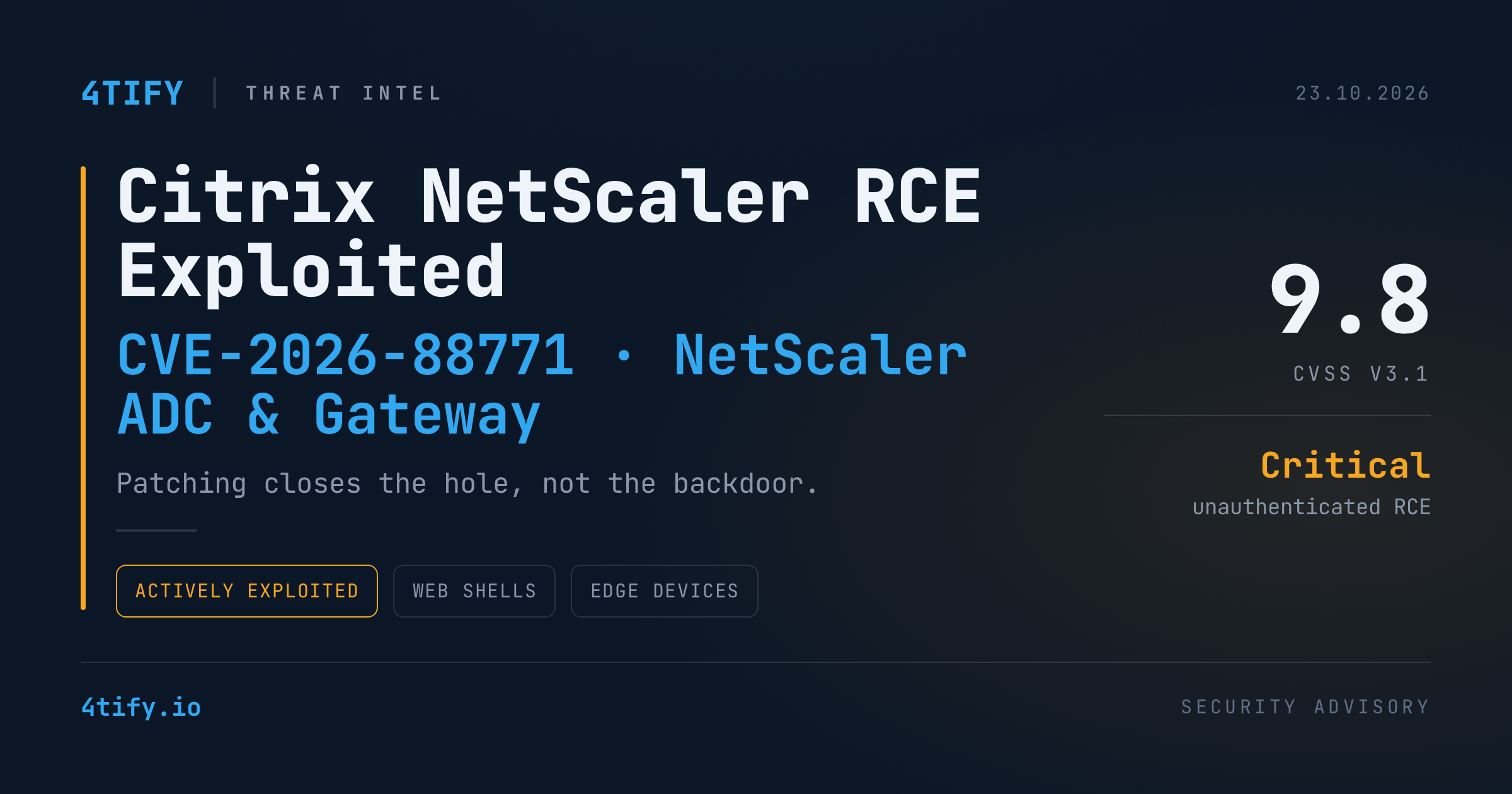
Citrix NetScaler CVE-2026-88771: Patching Isn't the Finish Line
Attackers are actively exploiting CVE-2026-88771, a critical unauthenticated remote code execution flaw in Citrix NetScaler ADC and NetScaler Gateway. Compromised appliances are being used to plant web shells and drop a FreeBSD malware implant. Because NetScaler sits at the network edge and handles remote access, a single unpatched box can give an attacker a privileged foothold.
What happened
Citrix disclosed the vulnerability on September 27, 2026 and confirmed exploitation against appliances that hadn't been updated. It scores 9.8 on CVSS v3.1 and 9.5 on CVSS v4.0.
Zscaler ThreatLabz analysed the attacks and found the exploitation is staged, not a single request:
- Log poisoning. Requests to common NetScaler paths carry an
INDEX:marker and encoded content in the User-Agent. The goal is to get attacker-controlled data written into the web access logs. The request itself doesn't trigger the payload. - Crafted logins. The attacker then sends authentication requests containing text made to look like a Packet Processing Engine failure message (the forged "pitboss PPE" string).
- Delayed execution. A Perl diagnostic script on the appliance later processes the matching log entries. It doesn't sanitise attacker-controlled characters, so commands appended to the poisoned entry run with the script's privileges.
Once they have execution, the attackers try to create web-accessible files, enable PHP or Perl handling in the web server, and drop web shells. They also try to pull down and run a 64-bit FreeBSD binary.
The download infrastructure has also appeared in earlier activity against Magento / Adobe Commerce (CVE-2026-75650, "StyleSmuggler"). That overlap is an investigative lead, not proof that the same actor is behind both campaigns.
Why it matters
Each step of this chain looks ordinary on its own: a slightly odd web request, then a failed login. Defenders who only watch for obvious exploit payloads can miss it. Patching also has a limit. Updating closes the hole but doesn't remove a web shell or implant that's already there. Any appliance that was exposed before it was patched should be treated as possibly compromised until proven otherwise.
What to do
- Upgrade now. Fixed builds are NetScaler ADC and Gateway 14.1-73.46+ and 13.1-64.29+, 14.1-73.46 FIPS+ for 14.1-FIPS, and 13.1.37.283+ for 13.1-FIPS and 13.1-NDcPP. Check Citrix's advisory for the right build for your product.
- Preserve evidence first. Before you update, collect remote syslog data, technical support bundles and any core dumps.
- Hunt in the logs. Look in web and authentication logs for
INDEX:User-Agent values, forged "pitboss PPE" failure messages, and unexpected requests to/logon/LogonPoint/tmindex.html,/logon/LogonPoint/index.html,/vpn/index.html,/logon/tmindex.html,/nf/auth/doAuthentication.doand/cgi/login. - Check the appliance itself. Look for
Nx_7508.php,Nx_7508.pl,Nx_7508.html,/var/kw2s11or akw2-freebsd-x64-s11binary. Also look for unapproved web files, changed web-server config, unfamiliar processes, and outbound connections to unknown hosts, including the reported download server209.141.43[.]95. ThreatLabz has published a longer list of attacker source IPs. - If you suspect compromise, isolate the appliance while keeping the evidence intact. Then rotate every credential, token and certificate it could reach.
Edge appliances like NetScaler are easy to lose track of. A box goes unpatched, or a forgotten instance stays exposed. Our vulnerability scanning service regularly checks your internet-facing perimeter for known-exploited flaws and outdated appliance builds like this one, so you know which systems need attention before an attacker finds them.
Technical details based on research by Zscaler ThreatLabz, as reported by Cyber Security News.