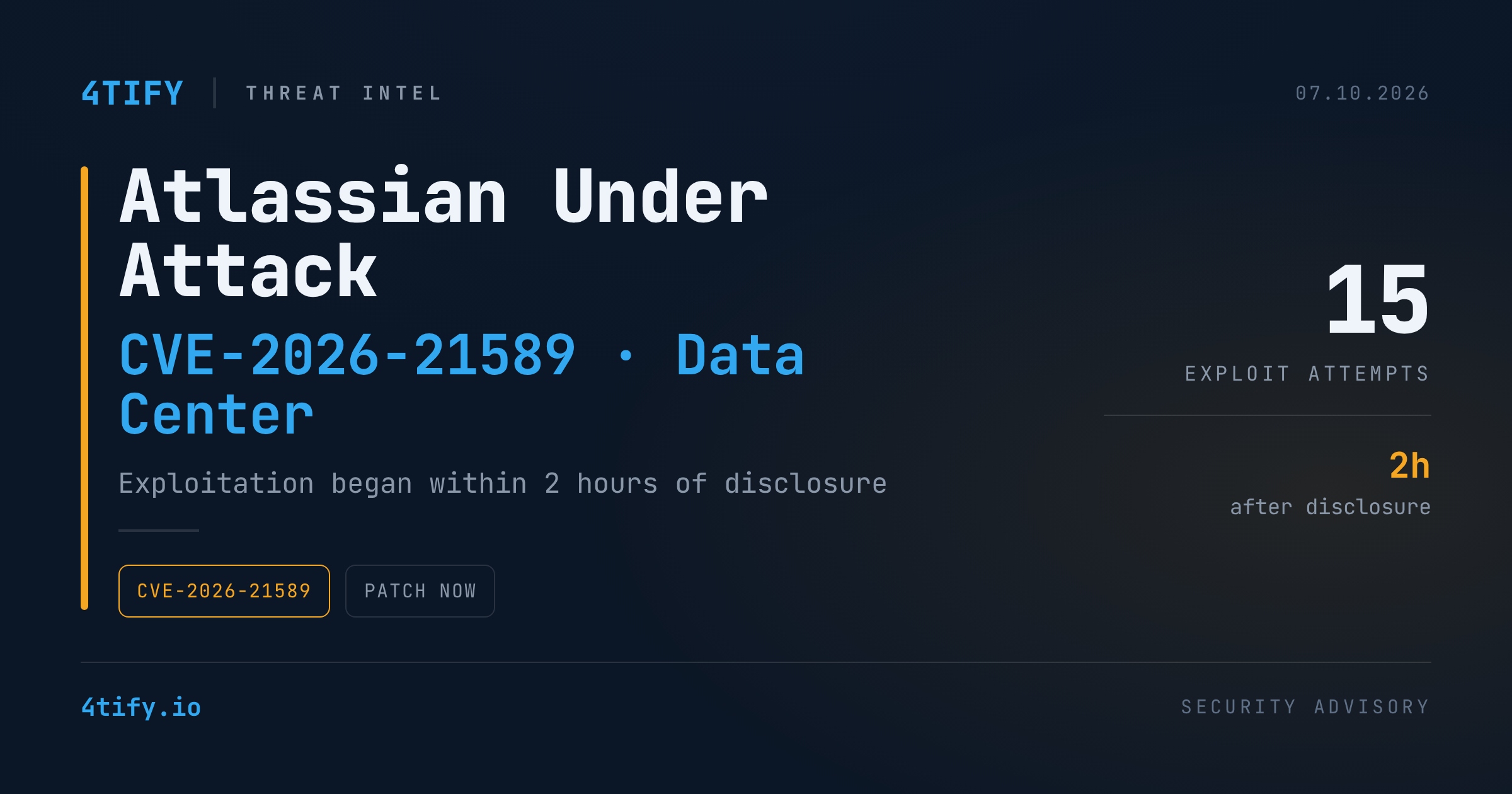
A newly disclosed, maximum-severity file-access vulnerability in Atlassian's Data Center product line is no longer theoretical — threat actors began probing for it within two hours of technical details reaching the public, and exploitation attempts have already hit monitoring networks.
What happened
Tracked as CVE-2026-21589 and rated 9.3 on the CVSS scale, the flaw allows an unauthenticated attacker to retrieve specific files from inside the web application root of affected products, provided they already know the exact file name and path. It cannot be used to browse or list directory contents, but in certain configurations it can expose sensitive files on its own.
The vulnerability is rooted in how Atlassian's web-resource handling resolves file paths: a specially encoded string pointing to a resource bundled with a legitimate interface component (such as a color-picker plugin) can be manipulated with trailing path segments to escape into protected directories, including the application's WEB-INF folder. From there, an attacker can pull configuration files that store credentials and authentication tokens.
Affected products span Atlassian's self-hosted catalog: Bitbucket Data Center, Confluence Data Center, Jira Software and Jira Service Management Data Center, Bamboo Data Center, Crowd Data Center, Crucible, and Fisheye. Atlassian Cloud customers are already protected — the company has shipped patched releases for every affected Data Center product and says cloud instances were never exposed.
In Jira and Crowd deployments specifically, the exposed file can include Crowd's stored credentials. Security researchers warn that an attacker who retrieves them could authenticate, create new accounts, and escalate a freshly created user to full Jira Administrator — turning a file-read bug into a path toward complete application takeover.
Why it matters
Monitoring networks logged roughly 15 exploitation attempts from three distinct IP addresses within hours of public technical write-ups going live. Researchers expect that volume to climb sharply once automated scanning templates for the vulnerability circulate, since authentication is not required and the attack itself is a single crafted HTTP request.
What to do
- Patch immediately to the fixed release for your product line — Atlassian has published updated builds for every affected Data Center product.
- If patching isn't immediately possible, take the instance off the public internet and apply a Web Application Firewall rule blocking the malicious request pattern.
- Add the vendor-recommended rewrite rule to your reverse proxy or application server configuration as an interim mitigation.
- Rotate any credentials that may have been stored in exposed configuration files, particularly Crowd application passwords, if you suspect exposure.
- Review access logs for requests touching plugin resource paths with unusual traversal sequences.
Given the speed of exploitation and the credential-harvesting potential in Jira/Crowd environments, treat patching Atlassian Data Center products as an immediate priority rather than a routine maintenance item.