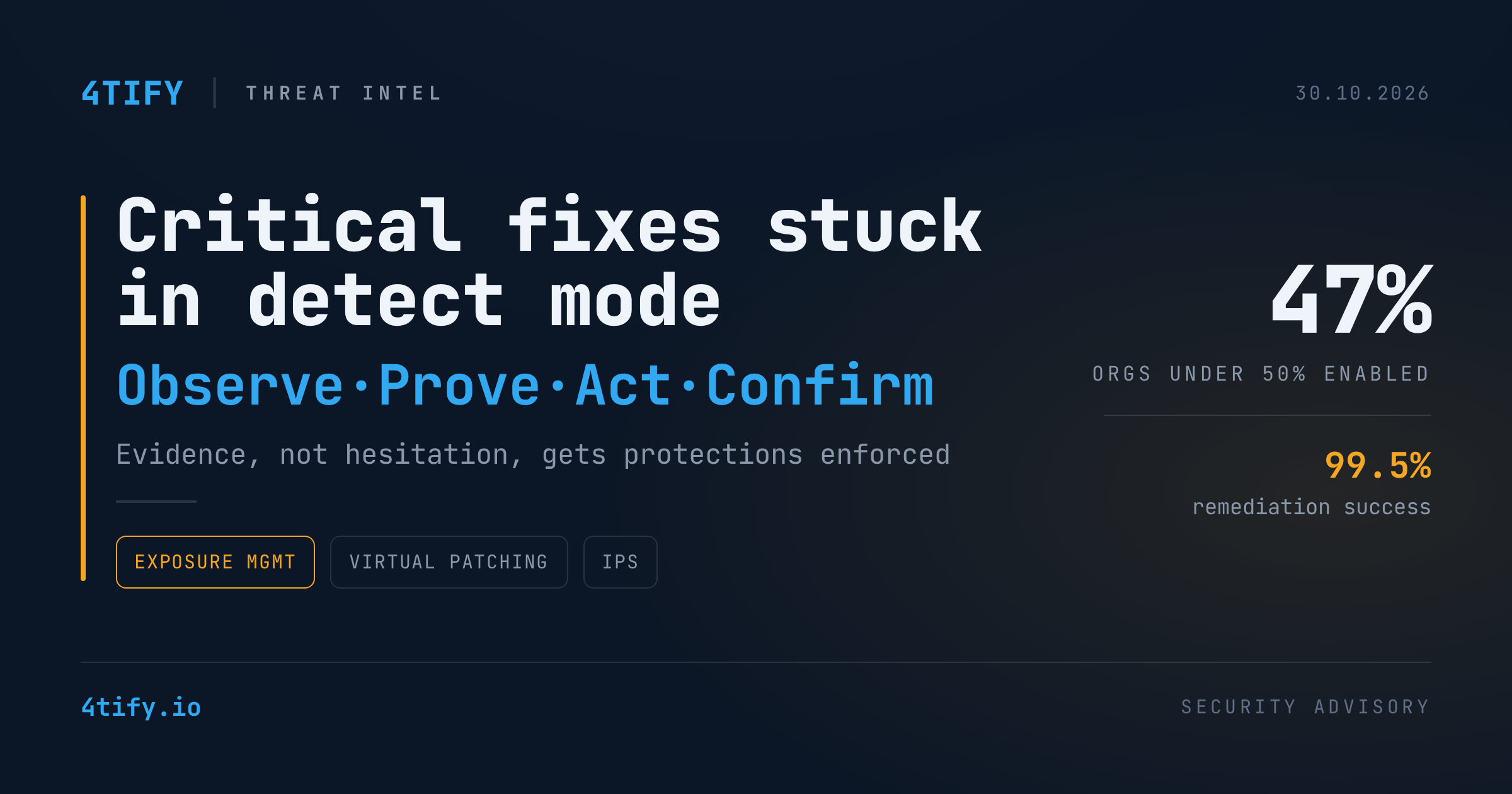
Critical Fixes Stuck in Detect Mode? A Four-Step Loop Gets Them Enforced
A critical alert lands, the fix is already known, and the ticket still sits in a queue for days. The blocker is rarely the security team. It is the operations side asking for proof that the change will not take down something the business depends on.
The problem: protection you own but do not enforce
Most organisations already own more protection than they use. Intrusion-prevention signatures sit disabled or in detect-only mode, endpoint hardening policies wait for a change window, and operating-system baselines drift while teams weigh false positives, inspection capacity and business continuity. In one measurement across a broad set of corporate environments, nearly half of the organisations had enabled less than 50 percent of the protections they already had available.
The hesitation is reasonable. An IPS rule can block legitimate traffic. A firewall change can interrupt a service. An endpoint policy can break the one application nobody dares to touch. Without evidence, "leave it in detect" is always the safe answer for today. And the policy drifts: a configuration tuned to the threats and traffic of its first week looks very different after five years of new applications, new segments and exceptions that never expired, until nobody still on the team remembers why a rule exists.
The Observe, Prove, Act, Confirm loop
Safe remediation replaces that hesitation with evidence, carried through four stages with a review gate where the organisation requires one.
- Observe. Start from data the security and IT stack already produces: vulnerability findings, IPS traffic, device utilisation, endpoint policy states and configuration snapshots. Together they show what surrounds the proposed change.
- Prove. Validate the change in the way that fits the technology. Run an IPS signature in detect mode on production traffic to measure false positives and load before switching it to prevent. Roll an OS hardening change to a pilot group and recheck every host afterwards. Compare endpoint settings against the vendor's own hardening baseline.
- Act. After review and approval, push the change through the system that already owns the control: the security management server for IPS, the existing patch infrastructure for hardening, the vendor API for supported endpoint settings. No new tooling, just the technologies already deployed.
- Confirm. Verify the protection is actually live. A successful policy installation proves an IPS rule reached enforcement. A host check proves the hardening change stuck. Execution records show who ran what, when, against which exposure, and which actions failed or are still pending.
The decision becomes specific to your environment. Security explains the protection it expects. Infrastructure and application owners judge the effect on the systems they run. Both sides decide together, on facts rather than on fear.
Why it matters
Patching fixes the underlying vulnerability, but testing, coordination and deployment schedules can leave a window of days or weeks before a patch reaches production. An existing IPS signature or virtual patch can close the relevant exploit path during that window, provided someone knows it exists and whether it is inactive, in detect mode or already enforced. Correlating vulnerability data with control coverage answers that question and splits the backlog into two clear queues: protections that are candidates for validation and activation, and exposures with no compensating control that need urgent patching or another action.
The measured outcomes make the case. Across the organisations observed, remediation actions recorded a 99.5 percent success rate. Over a single month, protections applied this way went on to block more than 700 million attacks, with 21 million of them stopped within 24 hours of the change.
One caveat belongs in every remediation record: an interim compensating control is not a permanent fix. A blocked exploit path reduces exposure, but the vulnerability is still there and still needs follow-through.
What to do
- Inventory the protections you already own and classify each one as off, detect-only or enforced. The gap is usually larger than expected.
- Map open vulnerabilities to the controls that can cover them, so every critical finding has either a compensating control in place or an explicit patch deadline.
- Prove before you enforce: detect-mode measurement for network controls, pilot groups for hardening, baseline comparison for endpoints.
- Keep approval and execution in the same workflow, with a record of user, timestamp and affected exposure.
- Treat "confirmed" as evidence, not a ticket status. Measure what the control blocked after enforcement.
- Record interim protections separately from permanent fixes and keep the patch task open until it is done.
This is also where regular vulnerability scanning earns its place in the loop. An independent scan before and after the change shows whether the exposure was actually closed, not just whether a ticket was marked resolved. Our team runs this kind of scanning as a continuous service, so the confirm step never depends on someone remembering to check.