

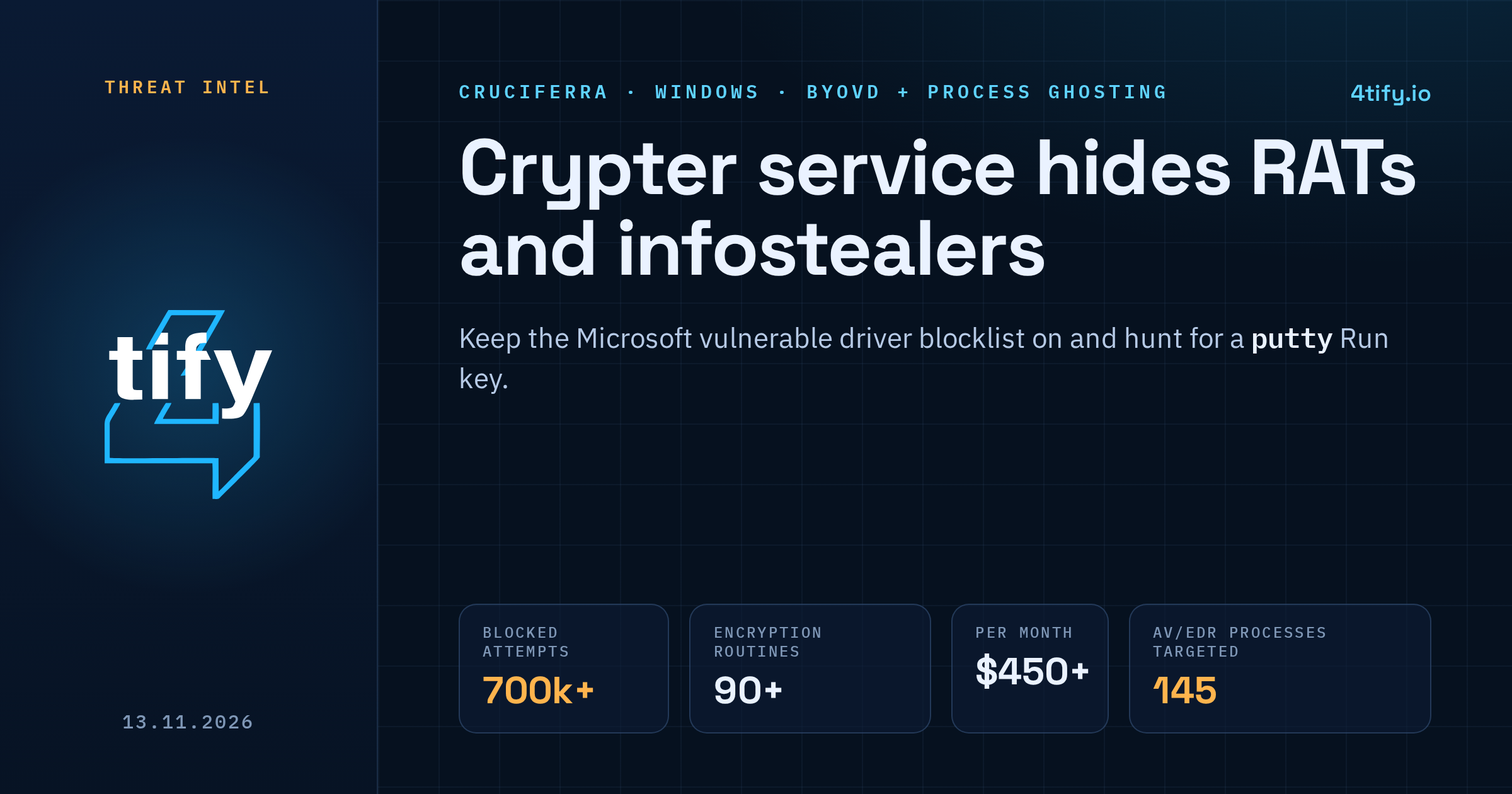
Crypter service Cruciferra hides RATs and infostealers from Windows defences
A rented crypter called Cruciferra has become a common wrapper for commodity Windows malware in 2026. Criminal groups pay a monthly fee to have their remote access trojans and infostealers encrypted, loaded through trusted programs and shielded from endpoint security. Antivirus telemetry counts more than 700,000 blocked infection attempts linked to it since January 2026. Türkiye, Greece and Spain saw the most activity.
What happened
Cruciferra has been advertised on underground forums since late 2025. Subscriptions run from $450 to $2,000 a month, and the more expensive tiers add features such as an EDR killer. One analysed package sold for $1,200 a month and a cheaper executable-only option for $650. The name works as an umbrella for several crypters sold together. Because it is a service and not one gang's private tool, it has turned up in dozens of unrelated campaigns.
The payloads it carries are familiar: Agent Tesla, AsyncRAT, DarkCloud Stealer, Formbook, XLoader, Phantom Stealer, Remcos, Snake Keylogger, ValleyRAT, XWorm and zgRAT. Most of these steal passwords, browser sessions and files, or give the attacker remote control of the machine.
Who is affected
Targeting is opportunistic. Campaigns ranged from a few hundred to several thousand emails each. Financial services took the largest share (34%), followed by healthcare (25%) and government (10%).
Some of the lures seen in 2026:
- India: between late April and early June, a Chinese-speaking crime group tracked as TA4922 sent emails posing as the Income Tax Department. Fake portals served ZIP files that ended in AsyncRAT.
- United States: in May, emails posing as the Social Security Administration delivered XWorm.
- Hotels and travel: in late June, fake "guest complaint" messages delivered zgRAT.
- Compromised websites: in late July, hacked WordPress sites showed fake CAPTCHA or error pages that told visitors to paste a command into Windows, a trick known as ClickFix. That chain installed Cruciferra and then the Remus infostealer.
How it works
The victim opens a ZIP archive that holds a legitimate executable and a malicious DLL. Running the executable loads the DLL (DLL side-loading), so the first process on screen looks clean. Before anything else, the code checks whether it is running in a sandbox or an analyst's virtual machine.
The payload is locked with one of more than 90 encryption routines, most of them stitched together from parts of known algorithms. Each batch of samples looks different, which is why signature-based detection struggles. The DLLs are also padded with hundreds or thousands of fake exported functions to waste an analyst's time.
Next comes the attack on defences. Cruciferra removes the hooks that security products place in Windows functions, hides console windows and switches off Windows notifications. It drops a signed but vulnerable kernel driver, most often GoFlyDrv.sys (Core64.sys and others are alternatives), and uses it to terminate EDR processes. This is the "bring your own vulnerable driver" technique. In the ClickFix chain a different signed driver, DCRCVDrv.sys, was configured to kill 145 antivirus and EDR processes by default.
Without admin rights, it tries a UAC bypass. It persists through a Run registry key with the value name "putty". The payload is then started with a modified form of Process Ghosting: the file is written, marked for deletion and mapped into memory, so nothing remains on disk for a scanner to check. Cruciferra also tampers with memory-query and hot-patch functions that could otherwise expose the trick.
What to do now
- Keep the vulnerable driver blocklist on. It has been on by default since the Windows 11 2022 update, but check it under Windows Security > Device security > Core isolation, and turn on memory integrity where hardware allows. Microsoft notes that the in-box list is less complete than the downloadable one, and explains how to apply that version in its recommended driver block rules.
- Enable the ASR rule "Block abuse of exploited vulnerable signed drivers" in Microsoft Defender (rule reference). DCRCVDrv.sys was not on public blocklists when it was analysed in August 2026, so also block it by hash in your EDR.
- Hunt for the behaviour. Look for new kernel driver services that appear right after an archive is opened, executables run from ZIP or user temp folders that load a DLL from the same folder, and a Run key value named "putty".
- Turn on PowerShell script block logging and alert on PowerShell started from Explorer's Run dialog, which is how ClickFix lures get users to run code.
- Brief staff on unexpected tax, benefits and complaint emails, and tell them plainly: no real website asks you to paste a command into Windows to prove you are human.
If a machine was infected, treat every password and session token saved on it as stolen. Infostealer logs are traded quickly, which is where our Deep/Dark Web monitoring helps: it watches the markets and log channels where stolen company credentials surface, so you can reset accounts before someone logs in with them.