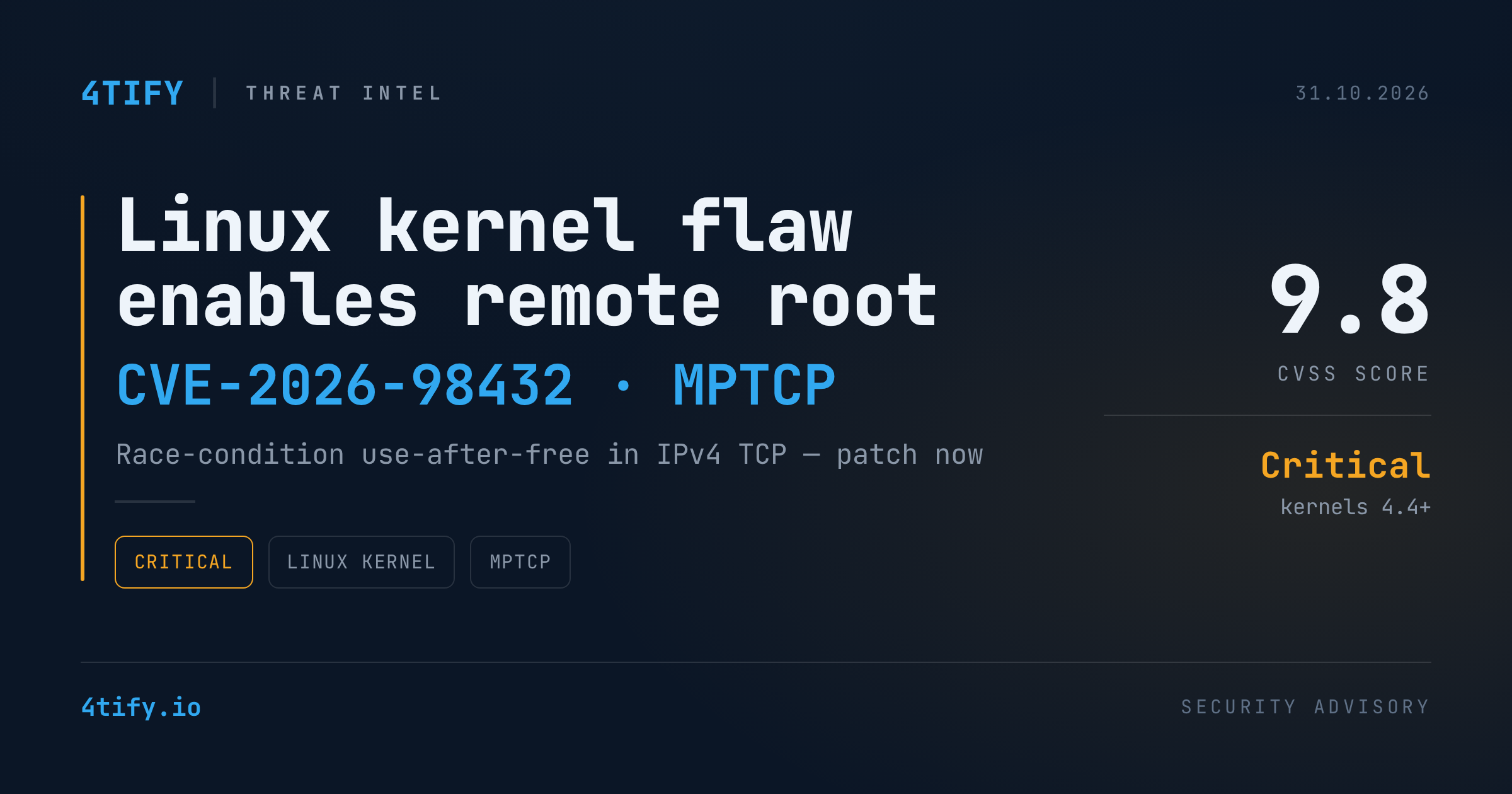
CVE-2026-98432: Linux Kernel TCP Flaw Opens the Door to Remote Root on MPTCP Servers
A critical use-after-free in the Linux kernel's IPv4 TCP stack, tracked as CVE-2026-98432, can be turned into unauthenticated remote code execution as root on servers that accept Multipath TCP (MPTCP) connections. A working exploit has already been demonstrated, and patches are still rolling out unevenly across major distributions.
What happened
The bug is a race condition in how the kernel processes incoming TCP connection requests. While a connection is being promoted from a pending request to a full socket, the kernel hands the IP options buffer over to the new socket without making its own copy. If a retransmitted SYN for the same request is being handled on another CPU core at the same moment, that second code path can keep reading memory that has already changed hands — a classic use-after-free. A similar window exists during request-socket migration, when net.ipv4.tcp_migrate_req is enabled or a BPF_SK_REUSEPORT_SELECT_OR_MIGRATE program is in use.
Key facts:
- Affected: Linux kernels from 4.4 onward, including Ubuntu, Red Hat Enterprise Linux and Rocky Linux builds.
- Severity: rated 9.8/10 by the Linux kernel CVE team. Red Hat scores it lower, at 5.9, treating it mainly as a kernel-crash (denial-of-service) risk because winning the race is difficult.
- Proven RCE: a demonstration exploit — produced by a not-yet-released AI model — defeated kernel address space layout randomization (KASLR) and ran arbitrary commands as root on a server with an MPTCP listener, under specific conditions, in roughly 53 minutes.
- Plain TCP is affected too, although remote code execution has not been publicly shown against servers without an MPTCP listener.
- No confirmed in-the-wild exploitation at the time of writing.
- Not affected: macOS (different kernel) and RHEL 7 (the vulnerable code isn't present).
Why it matters
MPTCP lets one connection spread across several network paths at once — Wi-Fi and cellular, for example — and is usually off unless an application asks for it. The catch: since Go 1.24, TCP listeners on Linux opt into MPTCP by default whenever the kernel supports it. Any Go-based service could therefore be exposing an MPTCP listener without its operators ever having switched it on.
The gap between the two severity scores is also worth noting. A difficult race is not an impossible one, and a public demonstration that turns a "crash bug" into remote root inside an hour shows how quickly exploitation timelines are shrinking — especially as AI-assisted exploit development matures.
Patch status (as of 30 October 2026)
- Upstream kernel: fixed and backported to maintained stable branches.
- Debian: fixed in kernel
6.1.190-1(Debian 12 "Bookworm") and6.12.113-1(Debian 13 "Trixie"); testing and unstable are also fixed. - Ubuntu: 22.04 LTS, 24.04 LTS, 26.04 LTS and 26.10 still vulnerable, with kernel fixes in progress.
- RHEL 8, 9, 10 / Rocky Linux 8, 9, 10: affected; fixes are planned for upcoming updates.
- Oracle Linux, Amazon Linux, SUSE: fixes available for some kernel versions.
What to do
- Patch first. Track your distribution's security advisories and install updated kernel packages as soon as they land — then reboot, or confirm your live-patching covers this CVE.
- Find your MPTCP exposure. Run
ss -Mtlnto list MPTCP listeners and checksysctl net.mptcp.enabled. Pay particular attention to services built with Go 1.24 or later. - Don't rely on disabling MPTCP alone. The underlying flaw can still be reached over ordinary TCP, so turning MPTCP off reduces the proven RCE path but does not close the bug.
- Filter where you can't patch yet. Restrict exposed services to trusted networks or IP ranges. As a temporary measure, drop inbound IPv4 TCP packets that carry IP options at the host or perimeter firewall (for example with nftables) — legitimate traffic almost never uses them. Test before rolling out broadly.
- Review migration settings. If you don't need it, leave
net.ipv4.tcp_migrate_reqdisabled and audit any reuseport BPF programs. - Watch for crashes. Unexplained kernel panics or oops messages in TCP code on internet-facing hosts deserve investigation, not just a reboot.
Knowing which of your internet-facing hosts still run a vulnerable kernel — and which quietly expose services you didn't expect — is exactly the kind of gap our vulnerability scanning service is built to surface, so patching effort goes where the real exposure is.