

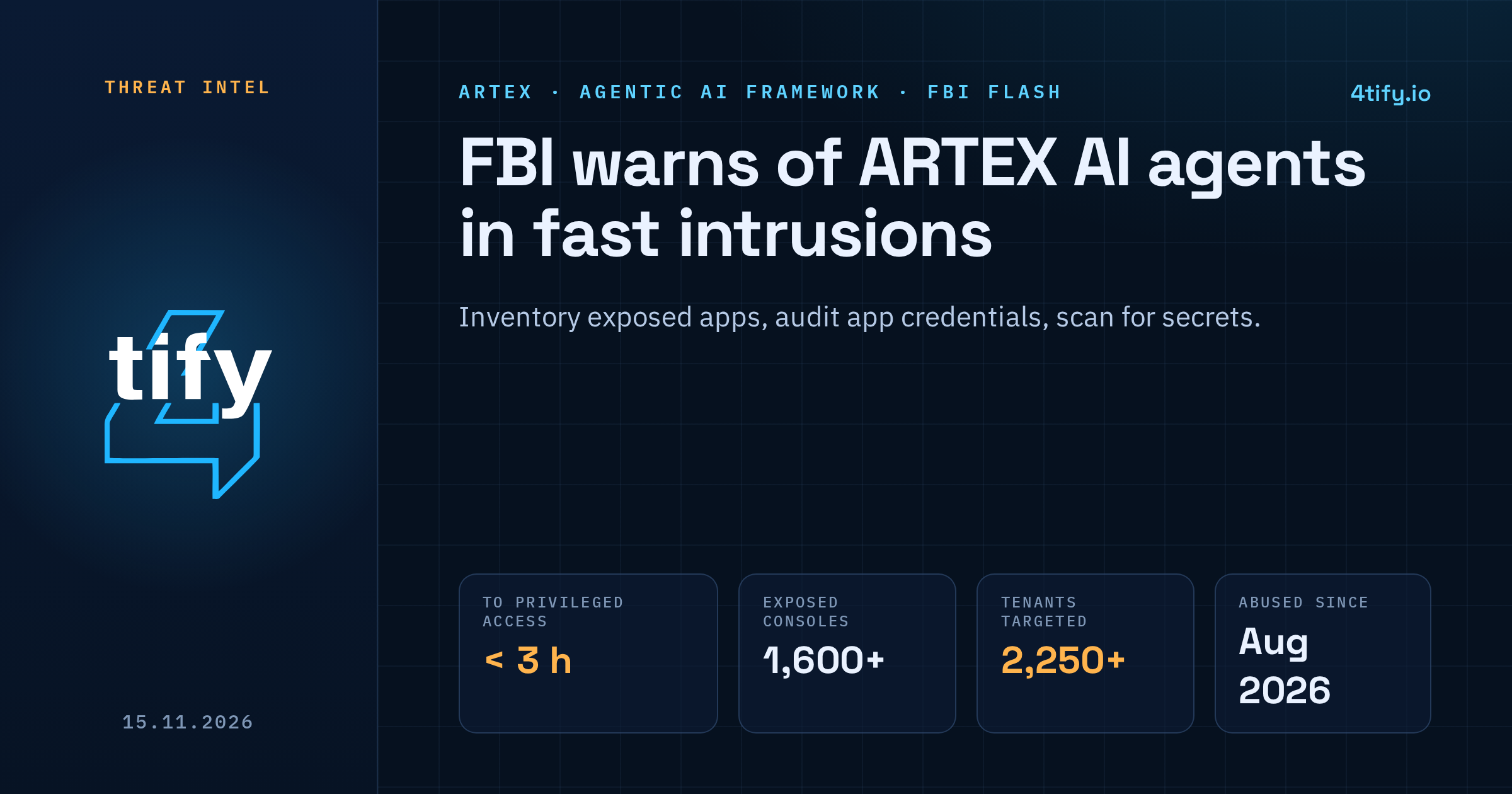
FBI warns attackers are using ARTEX AI agents to reach privileged access in under three hours
The FBI has published a FLASH alert on ARTEX, an open-source framework that uses AI agents to run much of a network intrusion on their own. Criminal and state-aligned groups have been using it since at least August 2026. In some of the intrusions the FBI describes, attackers went from first contact to privileged access in under three hours.
What happened
On 13 November 2026 the FBI released FLASH-20261113-001, a TLP:CLEAR threat overview of ARTEX with tactics, indicators and recommended mitigations. ARTEX was built as an autonomous penetration testing tool. It is written in Go and does not ship its own AI model. Instead it plugs into external large language model providers, takes a goal written in plain language, and splits it into commands that a set of agents carry out with little human help. The FBI says Chinese-origin models are the most common choice in attacker-run instances.
The developer published the project on GitHub in July 2026 and pulled the repository on 8 October 2026 after reports of abuse. That did not stop it. Forks, mirrors, archived copies and a paid edition called ARTEX PRO are still in circulation. As of early November, more than 1,600 ARTEX consoles were reachable from the internet, and the FBI expects the real number of installations to be higher.
Who is affected
The FBI lists targets in financial services, government, technology, defence, semiconductors, energy, healthcare, manufacturing, telecoms and legal services, in several countries. Two campaigns stand out:
- South Korean financial institutions. Personal data on about 67,000 people was stolen.
- ConnectWise Cloud Backup customers. A supply chain compromise opened a path to more than 2,250 downstream Microsoft 365 tenants. Microsoft attributes this campaign to Storm-0940, a group it describes as China-state-aligned. Microsoft says most of that targeting failed, though several organisations still saw privileged cloud access.
Different groups use the same tool. Shared use of ARTEX does not mean these campaigns are run by the same people, and neither the FBI nor Microsoft links them.
How it works
ARTEX does not depend on a new zero-day. It strings together old, ordinary weaknesses quickly: an exposed application, a password left in a JavaScript bundle or config file, an over-privileged cloud app, a trusted connection to a supplier. The FBI's technique table includes exploiting public-facing applications, abusing valid cloud accounts, dropping web shells, adding credentials to existing OAuth applications, Kerberoasting, and hunting for Windows machines that have no endpoint protection.
The FBI says the framework is especially good at finding systems that get less attention than the main website: partner and supplier portals, mobile backends, employee apps, sales-support tools, legacy services and third-party integrations. Its traffic is noisy and often trips alerts. The problem is speed. By the time someone looks at the alert, the agents may already be done.
What to do now
The FLASH and Microsoft's guidance come down to a short list:
- Inventory everything you expose. That means the forgotten portals, legacy services and mobile APIs as well as the main site. Restrict admin panels, cloud management, Kudu/SCM publishing endpoints and backup platforms to trusted networks.
- Tighten identity. Apply least privilege to multi-tenant app permissions and consent grants. Alert on new credentials added to applications, new role assignments and unusual app-only activity.
- Clean out secrets. Scan repositories, container images, build pipelines and front-end bundles for embedded credentials and rotate anything you find.
- Harden your APIs. Enforce authorisation on the server, rate-limit lookup endpoints, alert on sequential record access, and stop sending stack traces or SQL errors to unauthenticated users.
- Watch for the tell-tale signs. Look for unexpected outbound calls to LLM API endpoints, bursts of automated enumeration against login or search pages, and new .aspx or .jsp files in odd web paths.
- If you use ConnectWise integrations, keep the affected connections disabled until ConnectWise issues restoration instructions. Preserve logs before you change anything, don't delete the enterprise applications as a first step, and review activity from at least 1 October 2026.
Report suspected ARTEX activity to your local FBI field office or to IC3.
Attackers now map an organisation's perimeter as fast as a script can run, so defenders need an inventory that keeps up. Our Attack Surface Management service continuously maps the domains, subdomains, portals and exposed services an organisation actually has online, including the ones nobody remembers deploying, so they can be closed or secured before an automated agent gets to them.