

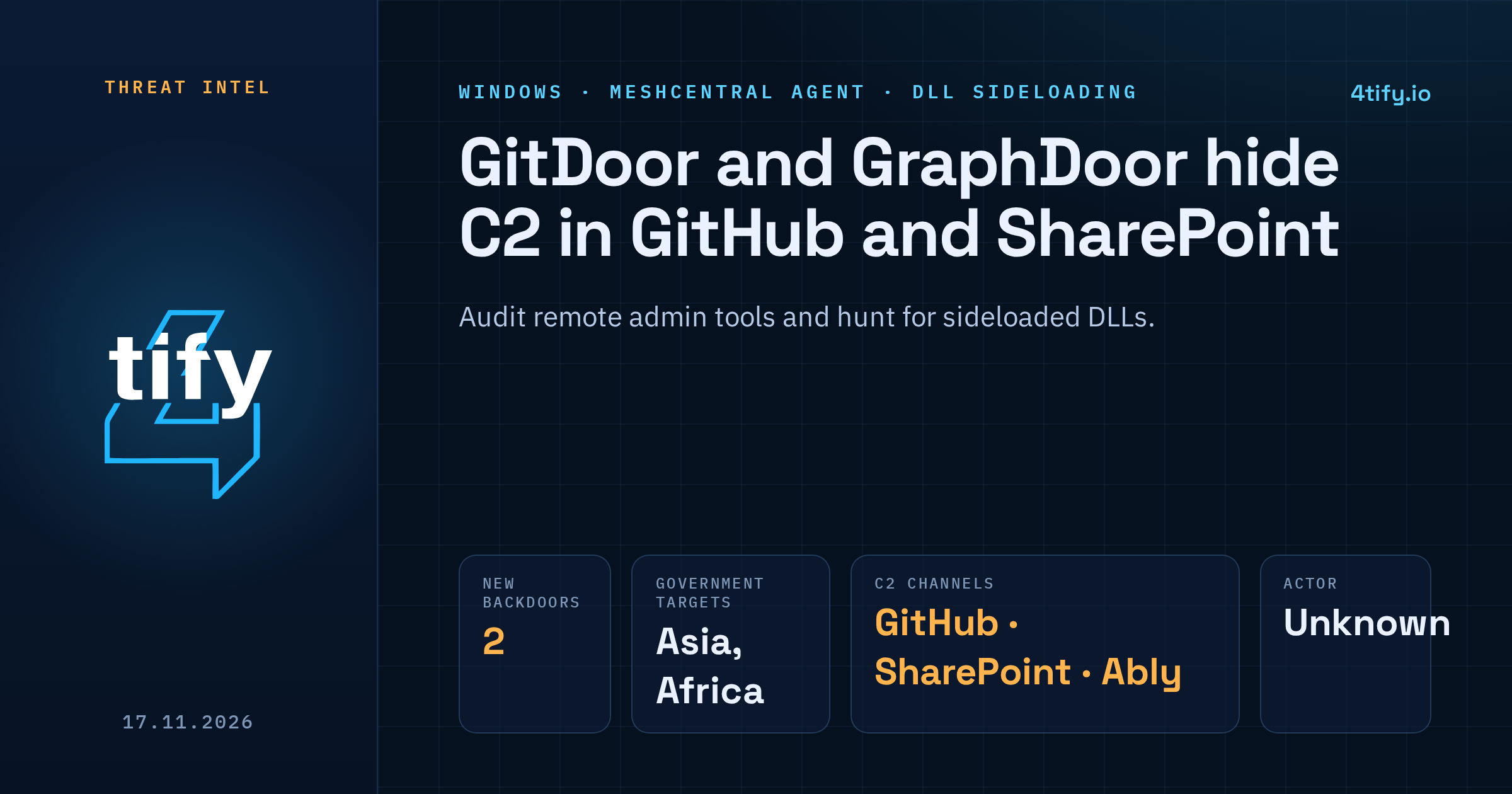
GitDoor and GraphDoor: espionage backdoors that hide their commands in GitHub and SharePoint
A cyber-espionage campaign aimed mainly at government organisations in Asia and Africa is using two previously undocumented Windows backdoors, GitDoor and GraphDoor. Neither one talks to an obvious attacker server. GitDoor takes its orders from GitHub repositories, GraphDoor exchanges data through Microsoft SharePoint, and both can relay traffic through the Ably real-time messaging service. The activity, tracked as Operation ShadowCloud, was first identified in early 2026, and the analysis became public on 17 November 2026.
What happened
The attackers did not exploit a new software flaw to get in. They used MeshCentral Agent (MeshAgent), a legitimate open-source remote administration tool, as their delivery channel. In one Taiwanese organisation, two MeshAgent instances were found connecting to a server controlled by the attackers. How the agent got onto those machines is still unknown; the evidence points to an older infection that was already on the network and was reused.
Through MeshAgent, the operators dropped three files on each target: a legitimate program, a malicious DLL with the name that program expects to load, and an encrypted payload. When the legitimate program starts, it loads the rogue DLL (a technique called DLL sideloading), which decrypts the backdoor and runs it directly in memory. Programs abused this way include Sandboxie's start.exe and a Python launcher, pythonw.exe.
GitHub account creation dates tied to the campaign show that preparation began no later than the end of 2024.
How the two backdoors work
GitDoor uses the GitHub API with a personal access token. A public repository holds commands and plug-ins; a private one collects host details and command output. The implant toggles labels on GitHub issues as part of its polling loop and stores victim data in files that look like ordinary JavaScript source maps.
GraphDoor signs in to Microsoft's identity service as an application, not as a user, with a client ID and secret embedded in the malware. It uses the token it receives to call Microsoft Graph, writes host information to a SharePoint document library as files named main.<code>.js.map, and pulls plug-ins and commands from SharePoint lists. On disk it creates a folder under C:\ProgramData\Intel_Log.
Both backdoors load extra modules on demand and run shellcode in memory, so new features arrive without new files on disk. The documented functions cover:
- logging keystrokes and taking screenshots
- managing files, processes, services, scheduled tasks and the registry
- running commands through
cmd.exeand changing firewall rules - dumping credentials from memory with Mimikatz and stealing browser cookies
- extracting the key that decrypts WhatsApp's local database
- proxying traffic through a modified build of the open-source Erfrp reverse proxy or through Ably
Because the traffic goes to Microsoft Graph, GitHub and Ably, it looks like normal business use on the network. Blocking a domain or IP address does little here.
Who is behind it
The operators have not been identified. On several victim machines, implants belonging to FamousSparrow and CopperTurtle, two Chinese-speaking threat groups, sat in the same staging folders as GitDoor and were installed within a day of it. That overlap suggests a connection, but it does not prove one, and nobody has formally attributed the campaign.
What to do now
- Inventory remote administration tools. Any MeshCentral Agent, or other remote management software, that IT did not deploy should be treated as a security incident. Find out when it arrived and what it installed. CISA's advisory on malicious use of remote monitoring and management software covers application allowlisting and auditing for these tools.
- Hunt for sideloading. Look for
start.exe,pythonw.exeor other legitimate binaries running from unusual folders next to DLLs such asSbieDll.dll,python39.dllorjli.dll, plus an encryptedconfig.ini. Check forC:\ProgramData\Intel_Logand for%APPDATA%\Microsoft\SystemCertificates\Cache\logs.dat. - Watch who talks to cloud APIs. A background process calling
login.microsoftonline.comand Microsoft Graph,api.github.comorrest.ably.iois worth a look if it is not a browser, an Office app or a known developer tool. SharePoint sites outside your own tenant deserve particular attention. - Load the published indicators. File hashes, GitHub accounts, SharePoint sites and IP addresses for this campaign have been released. Add them to your EDR and proxy blocklists, and search past logs as well.
- Do not just block GitHub or SharePoint. It disrupts real work and leaves the original foothold in place. Contain the affected hosts, reset credentials that may have been dumped, and work out how the first infection got in.
Our penetration testing team can run this kind of scenario against your network: drop an unapproved remote-management agent, sideload a DLL, send traffic out to GitHub or SharePoint, and show you which of those steps your monitoring catches and which it misses.