

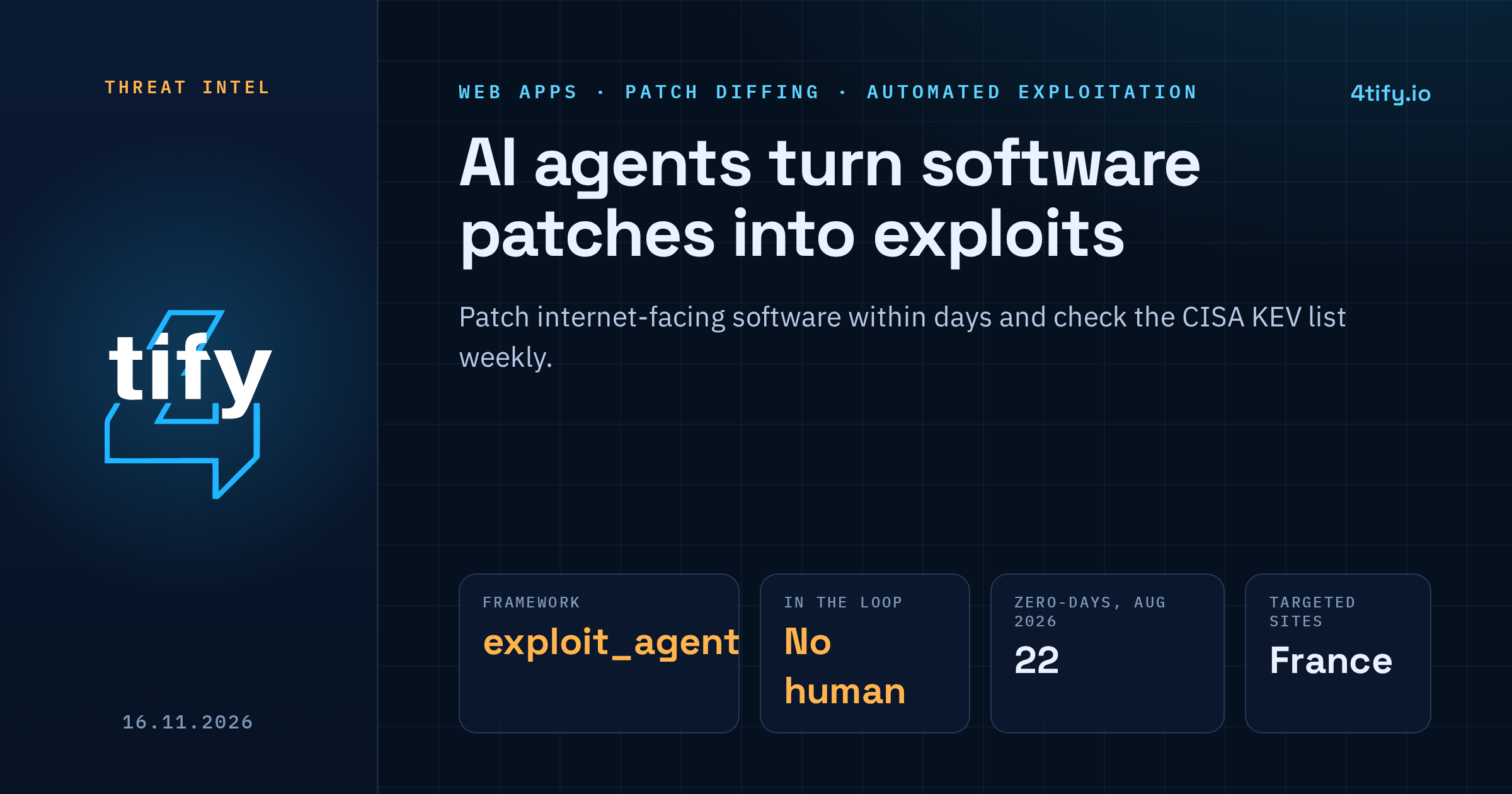
Google finds attackers using AI agents to turn patches into working exploits
Google Threat Intelligence Group (GTIG) reported on 16 November 2026 that it found an attack framework that reads software patches, works out the bug each one fixes, writes an exploit and runs it against live websites. No person approves any of those steps. GTIG says this is the first time it has seen vulnerability discovery and exploitation fully automated by attackers.
What happened
GTIG came across an exposed staging server hosting a multi-agent framework it calls exploit_agent. The tool connects to several commercial and locally hosted large language models (LLMs). It keeps comparing versions of popular web application software, checking the code before and after each patch is announced. When a change looks like a security fix, the agents analyse it, draft an exploit and launch it.
The server also held data taken from victims and scripts for later stages of an intrusion: internal reconnaissance, brute-forcing, installing web shells and removing web shells left by other attackers. Comments in a configuration file were written in Russian. GTIG has not linked the operator to a named group.
Who is affected
Victim data on the server points to French websites in media and entertainment and in education. The wider problem affects any organisation running internet-facing web software, because the tool picks its targets from public patches, and those reach everyone.
The report also describes how quickly the time to patch has shrunk elsewhere. Two PaperCut NG/MF flaws, an authentication bypass (CVE-2026-81578) and an unsafe class loading bug (CVE-2026-82078), were chained for unauthenticated remote code execution and exploited as zero-days in late August. CISA added both to its Known Exploited Vulnerabilities catalog on 31 August 2026. GTIG's figures show zero-day exploits rising from an average of 8 a month in 2025 to 11 a month in 2026, with a spike to 22 in August.
How it works
Comparing a patched release with the previous one is an old technique called patch diffing. A fix is a small, finite piece of code, so it suits an LLM: the model reads the diff and the release notes, guesses what the missing check was, and writes code that hits the unpatched path. Once that loop runs on its own, the gap between "patch published" and "exploit in use" depends mostly on how fast the server can work.
GTIG lists other agent frameworks it has seen in real intrusions or in testing: ARTEX, CAIRN, CyberStrikeAI, HexStrike AI and PentAGI. CAIRN was used against targets including US aerospace companies, and a customised PentAGI build scanned organisations across Asia between late August and early October 2026. Users include financially motivated criminals and suspected China-linked espionage groups.
These tools are fast but noisy. GTIG notes that they produce a lot of traffic and leave recognisable identifiers and code traces, which gives defenders something to detect.
The report covers two more trends. In LLMjacking, criminals steal cloud and AI credentials and resell the access, and some victims were billed more than $100,000 in a single day. The second is a Chinese-language phishing kit called Jieyou, which added a chatbot in June 2026 so customers can build phishing pages by typing plain instructions.
What to do now
- Shorten your patch window for internet-facing software. Plan for an exploit within days of a security release, not weeks. Treat CMS cores, plugins, VPNs and print or file servers as top priority.
- Know what you expose. Keep an up-to-date list of public hosts, their software and versions, so a new advisory maps to real systems straight away.
- Check the KEV catalog weekly and patch anything listed that you run, starting with PaperCut NG/MF if you use it.
- Watch for agent-style scanning. Bursts of requests that walk through a recently patched endpoint, followed by web shell uploads, are the pattern to alert on.
- Protect AI and cloud keys. Rotate API keys, set billing alerts and spending caps, and look for new service accounts you didn't create.
Continuous vulnerability scanning is how our team helps clients close this gap: it re-checks public assets against new advisories as they come out, so an unpatched plugin is flagged before an automated exploit finds it. The full details are in Google's report.