

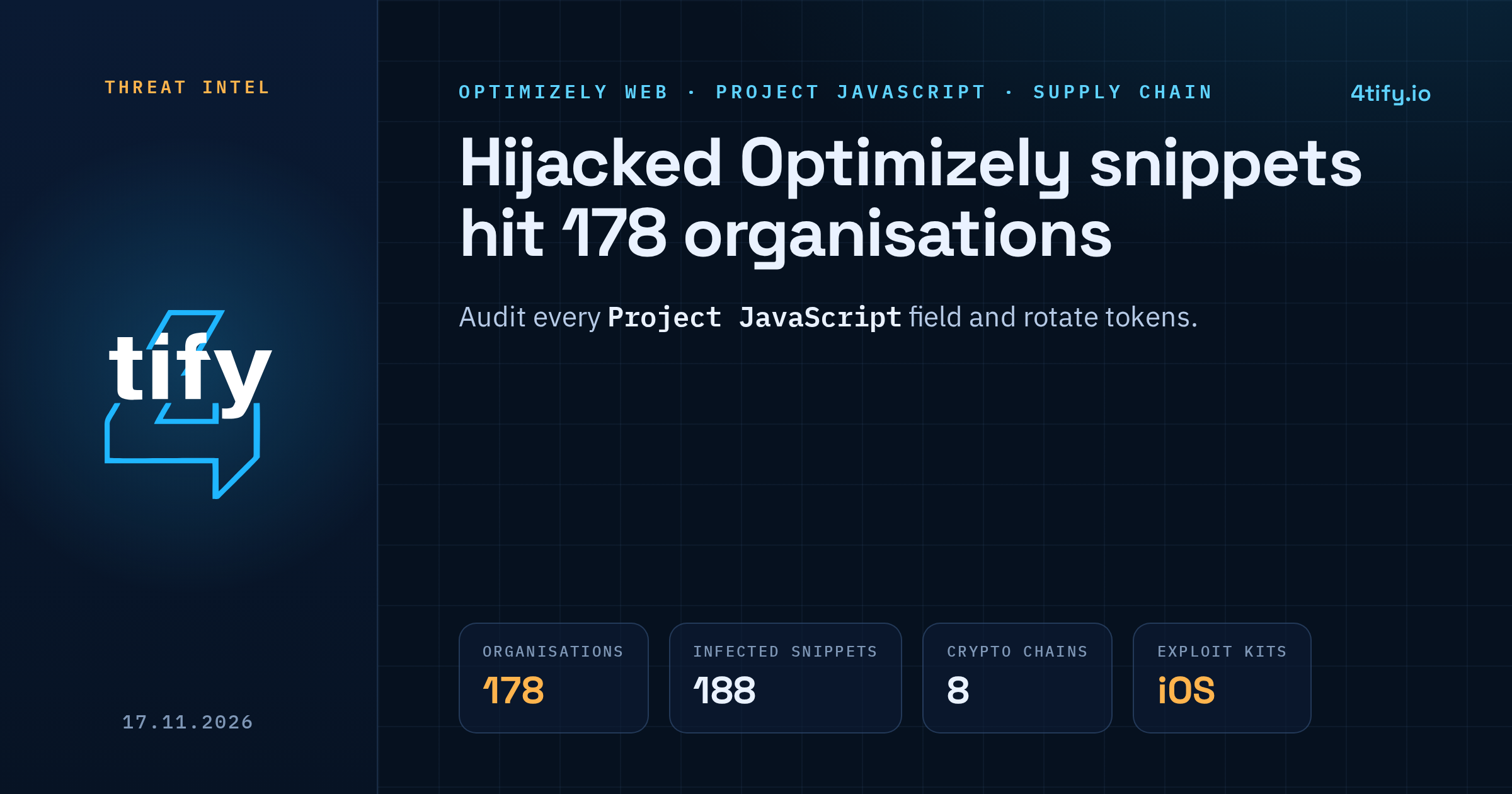
For most of 16 November 2026, visitors to some of the web's biggest sites were served malicious JavaScript through Optimizely Web Experimentation, the A/B testing service many companies load on every page. The code swapped cryptocurrency wallet addresses, skimmed payment cards from on-page forms and pushed iOS exploit kits to iPhones and iPads. Optimizely says it has fixed the flaw and removed the code.
What happened
Optimizely confirmed on its status page that an unauthorized party exploited a vulnerability in Experimentation and used it to add malicious JavaScript to some customer projects. In a later statement the company placed the flaw in the Experimentation account signup flow. It says it blocked that path, ended active sessions, revoked tokens, reset access for affected accounts and blocked delivery of the code. How a signup bug turned into write access across many unrelated customer projects has not been explained.
The first injection appeared at about 04:21 UTC on 16 November. Cleanup ran through the evening, and by 21:52 UTC only one infected snippet remained. Optimizely posted its incident notice at 01:02 UTC on 17 November.
Who is affected
Of 1,611 Optimizely snippets examined, 188 carried the malicious code, belonging to 178 organisations. The real number may be higher. Sites that served it include Zoom, the BBC, CNN, Fox News, HSBC, Salesforce, GitLab, KLM and Air France, IKEA and Equifax, as well as Optimizely's own website. Salesforce says it has disabled Optimizely scripts across its preview and production instances while it investigates.
None of these companies had their own servers breached. The code arrived inside a script they already trusted.
How it worked
Every Optimizely Web customer loads a snippet that holds Optimizely's code, the customer's experiments and an optional field called Project JavaScript, which runs on every page. The attacker wrote a small loader into that field and left the rest alone. The file was still served from cdn.optimizely.com with a valid certificate, and the CDN cache was not poisoned. Companies that host the snippet on their own domain were hit too, because the content came from the same project.
The loader pulled a script called track.js from 1688360[.]cc. Some versions hid that address in base64 and decoded it with atob(). Another carried a full inline copy of the payload and ran it with eval if the remote domain was blocked, so searching for the domain name alone will miss it.
The payload did several things at once:
- Crypto clipper. It looked for wallet addresses on eight chains (Bitcoin, Ethereum, TRON, Solana, TON, Litecoin, Bitcoin Cash, Dogecoin) and replaced them with the attacker's. The attacker's wallets had received about $7,000 by the evening of 16 November, although some of them were active before the attack, so the exact amount stolen is unclear.
- Card skimmer. It read card numbers, expiry dates and security codes typed into a site's own form fields and sent them to the attacker's server. Cards entered inside hosted, cross-origin payment frames were out of its reach.
- Data collection. It sent page URLs, cookies readable by JavaScript and screenshots of the page. Cookies marked HttpOnly were safe.
- iOS exploits. On iPhones and iPads it loaded the Coruna and DarkSword exploit kits. Coruna chains 23 exploits against iOS 13 to 17.2.1, as described in Google's analysis, and DarkSword uses six bugs against iOS 18.4 to 18.7. Devices on iOS 26 were only fingerprinted.
What to do now
If you run Optimizely Web:
- Open every project's Project JavaScript field and every experiment's custom code. Look for 1688360[.]cc,
atob(,evaland any script nobody on your team wrote. - Check your project's change history for Project JavaScript edits made on 16 November.
- Review users, API tokens and integrations, remove anything you don't recognise and rotate credentials.
- Block 1688360[.]cc at your proxy or DNS filter and search logs from 16 November for requests to it.
- Treat secrets held in non-HttpOnly cookies as exposed and reissue them. Keep third-party tags off checkout pages and take card data through hosted payment fields.
- Ask Optimizely which of your projects changed, when and through which account.
If you visited an affected site on 16 November: check any crypto transfer you made that day against an address you got independently, and watch your card statements. Update iPhones and iPads to the newest release for the device. Apple's security releases page lists iOS 26.7.3 and iOS 18.7.12 as the current versions.
The wider lesson
A tag added for marketing tests sits in the same browser as your checkout and login forms, with the same privileges. Each third-party script on your pages deserves the same scrutiny as your own code. Our Attack Surface Management service keeps an inventory of the scripts and external domains your pages load and flags new ones when they appear. That is how an injected loader like this one gets spotted while it is still live.