

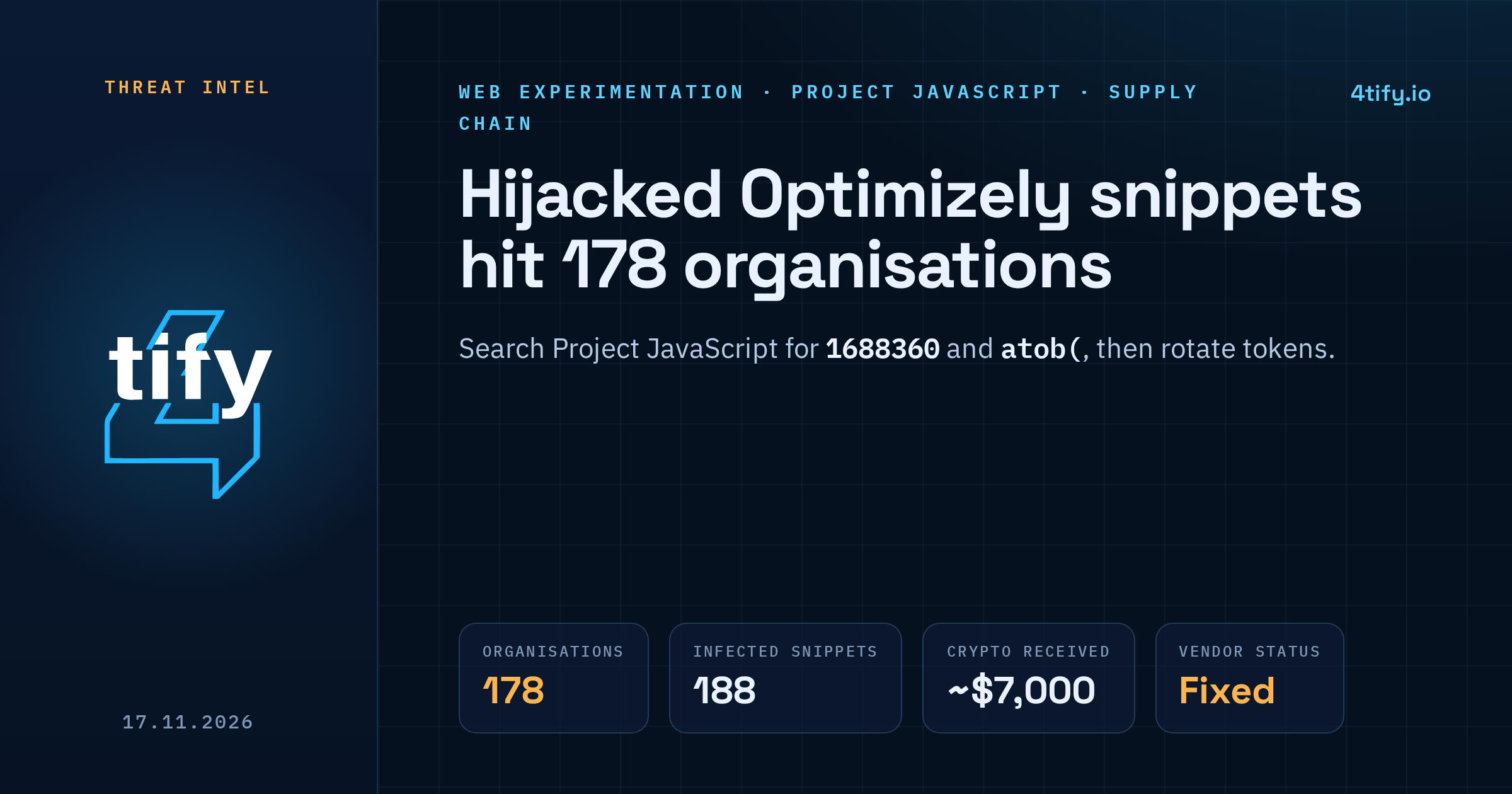
Hijacked Optimizely snippets hit visitors of 178 organisations
For most of Monday, 16 November, the JavaScript that thousands of websites load from Optimizely carried a card skimmer, a crypto address swapper and a loader for iPhone exploit kits. Optimizely confirmed in its incident notice that an attacker exploited a vulnerability in its Web Experimentation product and used it to add malicious code to some customer projects. Visitors of at least 178 organisations, including CNN, the BBC and Zoom, were served the code.
What happened
Sites that run A/B tests with Optimizely Web Experimentation embed a small script, the snippet, which is delivered from cdn.optimizely.com. Each project has a field called Project JavaScript that runs on every page load. The attacker wrote a short loader into that field for many unrelated customer projects. Because the snippet still came from Optimizely's own CDN with Optimizely's certificate, browsers had no reason to treat it as suspicious.
Optimizely says it has fixed the vulnerability, removed the injected code, secured the affected user accounts and added protections against unauthorised code delivery. The public notice does not explain how the flaw worked, how many projects were changed or what customers should do.
The timeline, in UTC:
- 04:21, the first injection appears, in the BBC's snippet.
- 13:43, a card skimmer is added to the payload.
- around 20:40, a mass cleanup begins; by 21:52 only one snippet still carries the code.
- 01:02 on 17 November, Optimizely posts its notice.
Snippets served from a customer's own domain were affected as well, since their content comes from the same project.
Who is affected
Of 1,611 Optimizely snippets examined, 188 contained the loader. They belong to 178 organisations. Names reported so far include CNN, the BBC, Zoom, Salesforce, GitLab, IKEA, HSBC, Equifax, Air France-KLM, Ledger, Peacock and Smartsheet. Optimizely's own website carried the code too. The real number is probably higher, because only snippets found in time were checked.
A site that delivered the code has not necessarily had its own servers breached. The risk sat with the people who visited those pages on 16 November.
How the payload worked
The loader pulled a file named track.js from 1688360[.]cc. It came in three forms: a plain reference to the domain, the same address hidden in base64, and a full inline copy that runs even if the domain is blocked.
track.js did several things:
- Crypto address swapping. It replaced valid wallet addresses in page text, forms, links, the clipboard and outgoing requests with the attacker's, but only when the address sat near payment wording. An address copied from an affected page may already have been swapped.
- Card skimming. It captured card number, expiry date and CVV typed into the site's own form fields and sent them to the attacker. Cards entered in a payment provider's cross-origin iframe were out of reach.
- Data theft. It sent cookies without the HttpOnly flag and a screenshot of the page.
- iPhone exploits. On iPhones and iPads it loaded the Coruna and DarkSword exploit kits in a hidden frame. Coruna targets iOS 13.0 to 17.2.1 and DarkSword targets iOS 18.4 to 18.7. Devices on iOS 18.6 or earlier saw the page reload every 60 seconds as the kit retried.
No compromise of a real iPhone has been confirmed so far. The attacker's wallets received roughly $7,000 during the day, though some of those addresses were active before the attack, so it is unclear how much came from victims. Nobody yet knows how many card numbers were taken.
The same loader had already shown up earlier through other third-party scripts, including Kissmetrics, StorifyMe and Minute Media. No group has been publicly named as responsible.
Why Content Security Policy mostly failed
Only 24 of the affected organisations (about 15%) had a Content Security Policy strict enough to stop the payload. 68 had no policy at all. Allow-listing cdn.optimizely.com did not help, because that is where the malicious code came from. Policies with 'unsafe-eval' or 'strict-dynamic' let the inline copy run.
What to do now
If your sites use Optimizely Web Experimentation:
- Open the Project JavaScript of every project and the custom code of every experiment. Search for
1688360,atob(and any script nobody on your team wrote. - Review which users, API tokens and integrations can write to your Optimizely account, and rotate their credentials.
- If your own forms take card details, treat cards entered on 16 November as possibly exposed and tell your payment processor.
- Treat session tokens and other secrets stored in cookies without HttpOnly as exposed, and rotate them.
- Ask Optimizely which of your project IDs were changed, and when. Search proxy and web logs for requests to
1688360[.]ccand to.icudomains from 16 November onward. - Keep third-party tags off checkout pages and take card data only through the payment provider's own hosted fields. Tighten
script-srcandconnect-src, and drop'unsafe-eval'where you can.
If you visited an affected site on 16 November:
- Update iPhones and iPads. Install the latest release from Apple's security updates page; iOS 18.7.3 or later and iOS 26.3 or later are not vulnerable to the chains seen.
- Compare any crypto payment you made that day with the address you meant to pay.
- Watch your card statements if you paid by card.
A clean snippet today does not prove it was clean on Monday. This incident is a good reason to keep an inventory of every third-party script your public sites load and to watch it for changes. Our Attack Surface Management service tracks the hosts, scripts and external dependencies exposed on your domains and flags new or changed ones, so a tag that starts calling an unknown domain gets noticed early.