

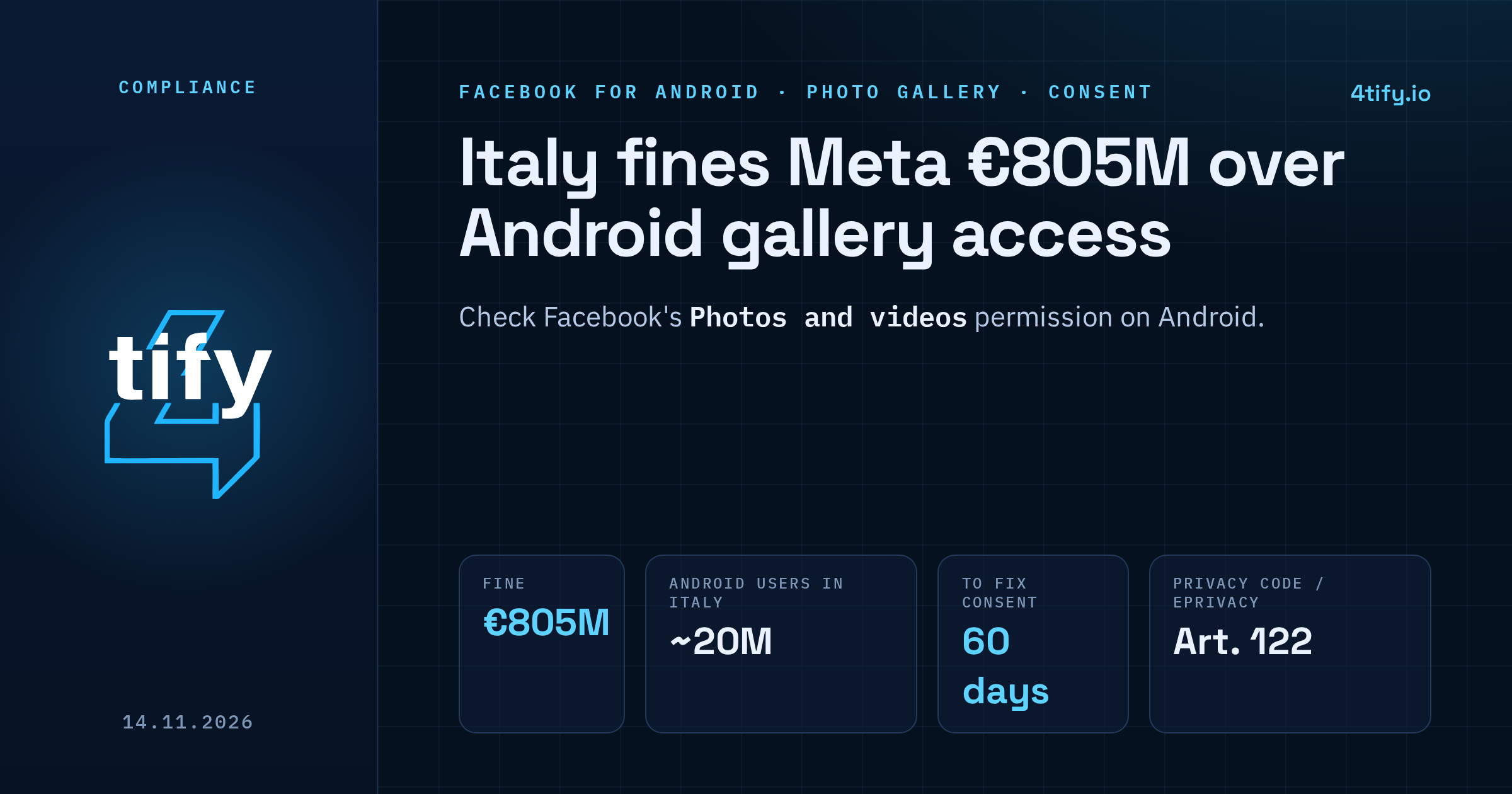
Italy's data protection authority, the Garante, has fined Meta Platforms Ireland Limited €805 million. The regulator found that the Facebook app for Android accessed photos, videos and their metadata on Italian users' phones without asking for specific consent and without telling people clearly what was happening. The decision was announced in Rome on 14 November 2026, and Meta has said it will appeal.
What happened
The case concerns a Facebook feature called "Get camera roll suggestions when you're browsing Facebook". It has been available since 2023 and, while you scroll, it proposes pictures and videos from your phone's gallery as ideas for new posts.
The Garante opened its investigation in July 2025 after a complaint from the Centro Tutela Consumatori Utenti, a consumer protection centre in Bolzano, and ran its own technical analysis of the app. It found several problems:
- Gallery access was requested through a single permission that covered the whole app and several features with different purposes.
- Before the system prompt, the app showed a generic message about enabling "other features". It did not say that the user was switching on gallery suggestions.
- The feature was on by default.
- Once full access was granted, the app could read the entire photo library, usually for good. Neither users nor the regulator could check which data was actually used.
The full decision summary is in the Garante's press release.
Who is affected
The Garante put the number of Android users in Italy at about 20 million and counted that among the aggravating factors. It also weighed the fact that the violation is still ongoing for people who have not updated the app or who granted access earlier, a previous 2019 decision against the company, and what it called poor cooperation during the investigation. Meta changed the feature after the complaint, which the regulator accepted as a mitigating factor, but it judged the change late and limited to users who update. The fine works out to about 0.47% of the group's global turnover.
The legal argument
The decision rests on Article 122 of the Italian Privacy Code, which transposes the EU ePrivacy Directive. Under that rule a smartphone is part of a person's private sphere, and reading what is stored on it requires free and informed consent. That holds whether or not the data leaves the device and whether or not anyone is harmed.
Meta argued that Ireland's regulator should handle the case, since its EU headquarters are there. The Garante rejected this: the GDPR's one-stop-shop mechanism does not apply to ePrivacy rules, so national authorities can act directly.
Two questions sit outside this decision. The Garante did not examine whether gallery content was used to train AI models, which Meta denies. It also said it may look separately at a newer feature, launched in 2026, that processes camera roll content in the cloud.
Meta told Italian media it strongly disagrees with the regulator's reading of the facts, considers the fine disproportionate and intends to appeal.
What Meta must change
- Within 60 days, ask for consent through a separate, specific request that explains the purpose, the gallery access involved and how to turn the feature off.
- Keep the feature off by default, including for people who already gave permission.
- If it misses the deadline, the feature cannot be enabled for anyone without valid consent.
- Report its first steps to the Garante within 30 days and the measures adopted within 90 days.
What to do now
If you use Facebook on Android: open the app's settings and look for the camera roll or gallery suggestions option, then switch it off if you don't want it. Separately, go to your phone's Settings, then Apps, Facebook, Permissions, and check "Photos and videos". On recent Android versions you can limit access to selected photos or deny it entirely.
If you build mobile apps: this decision is a useful checklist. Ask for each sensitive permission at the moment a feature needs it, explain that specific purpose in plain words, keep optional features off until the user turns them on, and don't let one broad grant quietly serve unrelated functions. Bundled SDKs count too, so check what they request. In the EU, the ePrivacy consent rule applies to any app that reads data stored on a device, regardless of company size.
Permission requests and consent flows are written in code, and that is where they are easiest to catch. Our AI-assisted code review looks at how an app requests device permissions and which features rely on them, so over-broad access shows up before release instead of in a regulator's report.