

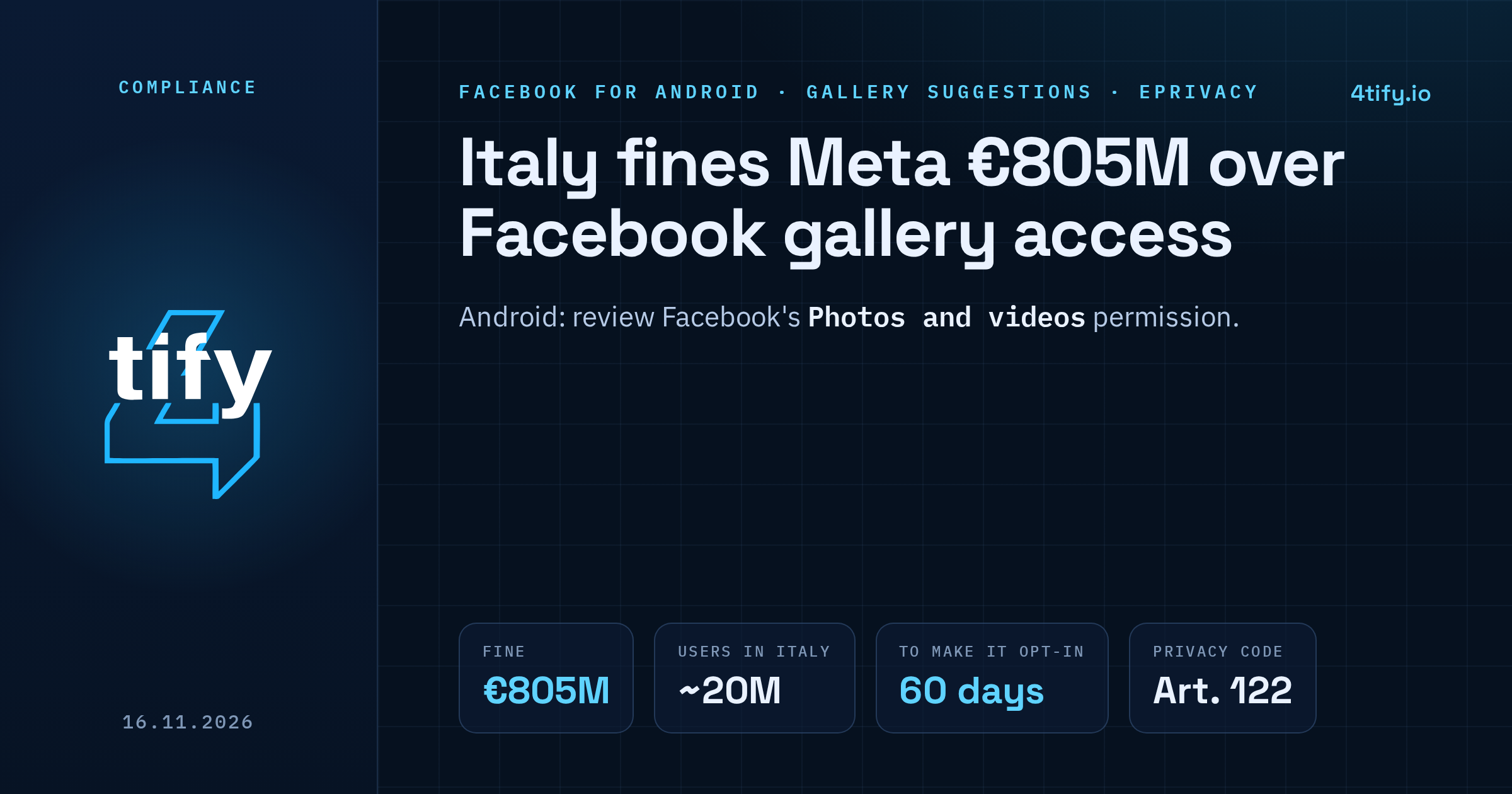
Italy fines Meta €805 million over Facebook's Android gallery access
Italy's data protection authority, the Garante, has fined Meta Platforms Ireland €805 million over a Facebook for Android feature that reads the phone's photo gallery to suggest posts. The regulator announced the decision on 14 November 2026. It found that the app reached users' photos, videos and their metadata without the specific consent Italian law requires.
What happened
Since 2023, the Facebook app on Android has offered gallery suggestions: while you scroll, it proposes photos and videos from your camera roll as things you might want to post. The feature was switched on by default.
To work, it needs access to the device gallery. The Garante found that Facebook asked for that access through a single Android permission covering several features at once. The notice shown before the system prompt talked in general terms about enabling other functions and did not say clearly that gallery suggestions were part of the deal. Once full access is granted, the app can read the whole photo library on an ongoing basis.
The case started with a complaint from the Centro Tutela Consumatori Utenti, a consumer protection group in Bolzano, which published advice for users on 11 July 2025. The Garante opened its investigation that month and ran its own technical analysis of the app.
The legal point
The decision rests on Article 122 of the Italian Privacy Code, which transposes the EU ePrivacy Directive. That rule treats a phone as part of a person's private sphere. Reading information stored on it needs free, informed consent, whether or not anything is uploaded and whether or not anyone is harmed.
Meta argued that Ireland's Data Protection Commission should handle the case, since its EU base is in Dublin. The Garante disagreed: the one-stop-shop mechanism belongs to the GDPR, and the ePrivacy rules have no equivalent. That reasoning matters well beyond this case, because it lets national regulators act on device-access questions in their own countries.
The fine and the orders
The Garante says €805 million is about 0.47% of the group's worldwide turnover. In setting it, the authority weighed:
- roughly 20 million Android users in Italy affected;
- a violation that is still ongoing for people who have not updated the app or who had already granted access;
- a previous decision against the company in 2019;
- limited cooperation during the investigation.
Changes Meta made after the complaint counted in its favour, though the Garante judged them late and limited to users who install the update.
Meta must also change the feature:
- within 60 days, ask for consent through a separate, specific request that explains what gallery suggestions do, why they need the gallery and how to turn them off, and keep the feature off by default, including for people who already granted permission;
- within 30 days, report the steps it has started;
- within 90 days, report the measures it has taken.
If the 60-day deadline passes, the feature cannot be enabled for anyone who has not given valid consent.
Meta called the fine disproportionate, said it strongly disagrees with the Garante's reading of the facts and the law, and plans to appeal. The company says the feature only works after users grant permission on their device and that the permission can be changed at any time.
The investigation did not look at whether gallery content was used to train AI models, which Meta denies. The Garante has kept the option to examine separately a newer feature, launched in 2026, that processes gallery content in the cloud.
The full press release and decision are on the Garante's website, with the text of the decision published separately.
What to do now
If you use Facebook on Android. Open Settings, then Apps, Facebook, Permissions, Photos and videos, and choose the most limited option you are comfortable with. Inside the Facebook app, look for the gallery suggestions setting and turn it off if you don't use it. Update the app so you get Meta's later changes.
If your company ships a mobile app. Treat this decision as a checklist item. A permission that serves several features needs a separate, clear request for each sensitive purpose, and anything that reads the gallery, contacts or files should be off until the user says yes. Check what your app actually requests in its manifest, what each permission is used for in code, and whether the consent text matches. Our team's AI-assisted code review covers exactly this: it maps the permissions an app declares to the code paths that use them, so over-broad access shows up before a regulator or a user finds it.