

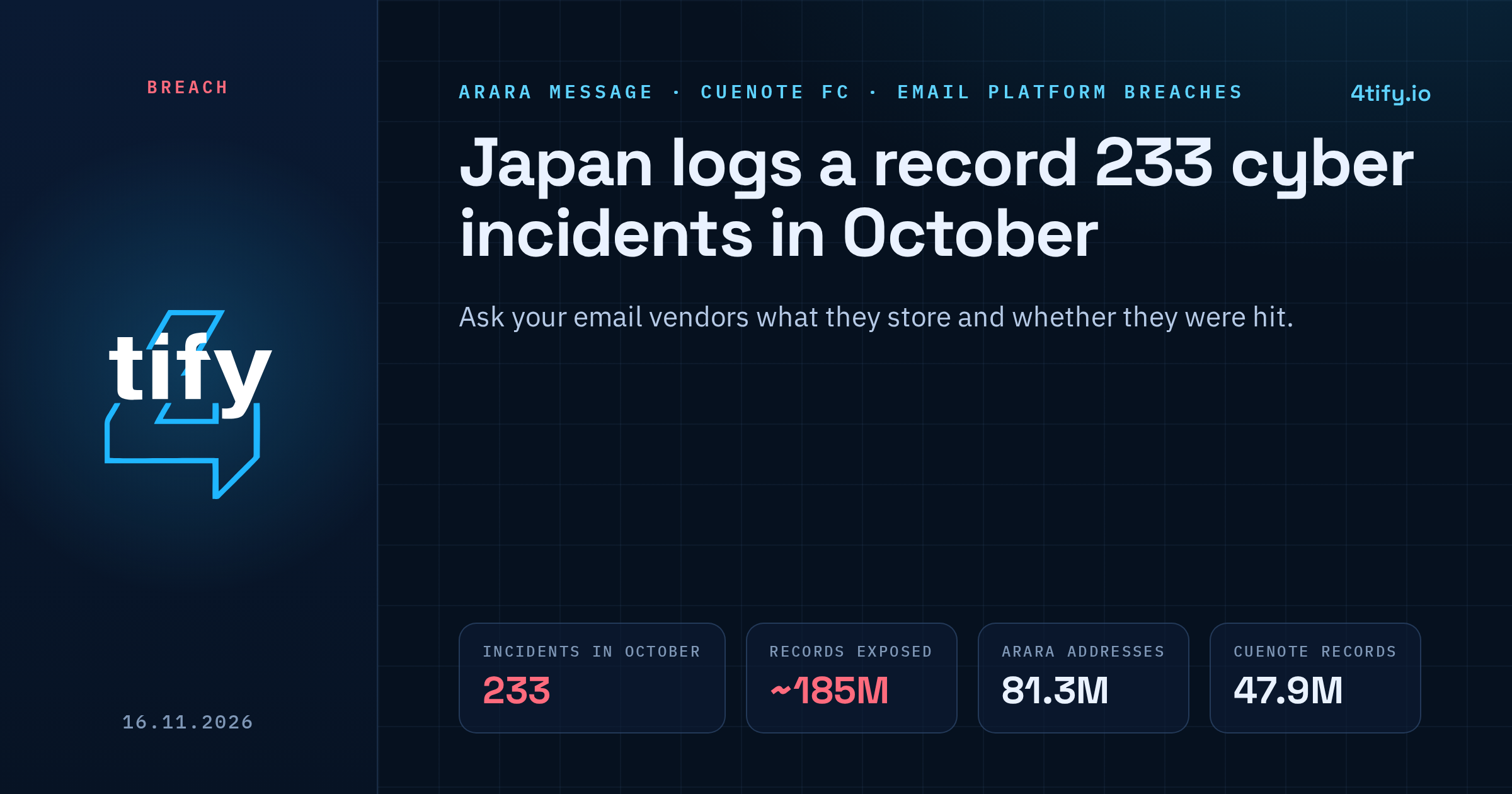
Japan logs a record 233 cyber incidents in October as email platforms leak over 100 million addresses
Japanese organisations publicly disclosed 233 cybersecurity incidents in October 2026, the highest monthly count on record. Industry tallies put the number of personal records leaked or possibly leaked that month at about 185 million. That is roughly 3.7 times the 49.5 million counted for the whole of 2025.
What happened
The rise was already visible before October. Japan recorded 594 publicly disclosed incidents in all of 2025, and by the end of September 2026 it had already reached 607. October then added a record month on top. Thirty of October's incidents involved a million records or more each. By the end of the month the year's running total stood at about 376 million records.
These numbers count records, not people. One person can appear several times across different breaches, and the figures use the largest exposure each organisation reported, including data that was only "possibly" taken. Late disclosures may still change them.
Two email platforms at the centre
Much of the volume came from shared marketing email services. A single intrusion at one of these services exposes every client company that uses it.
Arara Message. Arara Inc. 01 million addresses had leaked after a web server vulnerability was exploited. By its 6 November update, after removing duplicates, the count had grown to 81,329,467 email addresses, with up to 380 client companies possibly affected. For some clients, names, phone numbers, dates of birth and home addresses were also stored. The attackers used the platform itself to send millions of fraudulent emails. SEGA said 2,196,044 newsletter addresses leaked through the service.
Cuenote FC. Ymirlink confirmed unauthorised access to 81 Cuenote FC systems, with data exported from 49 of them. Its 11 November report put the total at 47,864,147 recipient records, down from an earlier estimate of about 51.6 million. The company described a mix of methods: exploitation of a vulnerable library, stolen support-staff credentials, planted malicious code and bulk export from the database. No payment card data has been found in the leak so far.
The government response
On 6 November Prime Minister Sanae Takaichi announced a 10 billion yen (about $63 million) emergency package. It creates a public-private "cyber rescue team" to give companies first help after an attack. It also sets up an expert team that will use AI to find weaknesses in networks and pays for AI-assisted vulnerability checks on government systems. The Prime Minister said AI-generated attacks make a fast response essential. How much AI actually contributed to October's surge has not been established.
Earlier, on 9 October, Japan's National Cybersecurity Office issued guidance for organisations holding large volumes of personal data. It focused on three areas: web systems, contractors and data handling.
Who is affected
Any company that sends newsletters or campaign mail through a third-party platform should check whether that provider has disclosed an incident. Customers of those companies should expect convincing phishing. Attackers now hold real email addresses together with the names of brands those people trust, and in Arara's case they sent mail through the legitimate service.
What to do now
- List your email and marketing vendors. Ask each one directly whether it was affected, and which of your data fields it stores.
- Cut what you share. Contractors should hold only the fields they need, and data should be deleted once a campaign or contract ends.
- Patch internet-facing web systems quickly. Retire unsupported products and shut down systems nobody uses any more. The Arara intrusion started with a web server vulnerability.
- Protect support and admin accounts. Use multi-factor authentication, limit who has administrator rights and remove accounts that are no longer needed. Stolen support credentials played a part in the Cuenote case.
- Watch for bulk exports. Alert on unusually large downloads or CSV exports from customer databases.
- Warn your customers. If a provider you use was breached, tell customers what leaked and how to recognise fake messages that use your name.
Most of these intrusions began on web systems that were exposed to the internet and often forgotten. Our Attack Surface Management service maps what an organisation has online, including subdomains and hosts run by vendors, so that an old login page or an unpatched server is found and fixed before an attacker finds it.