

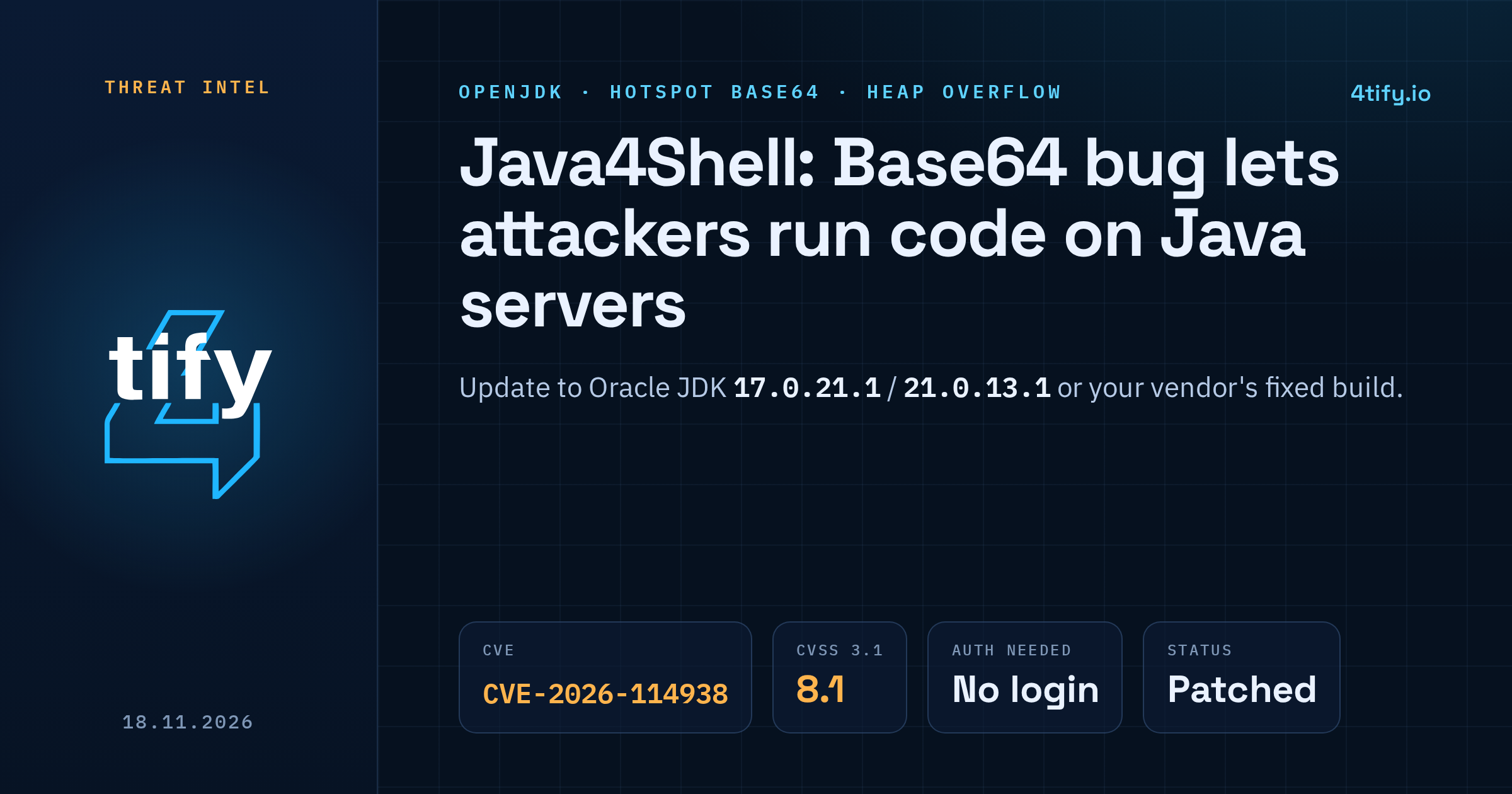
Oracle and the OpenJDK project shipped fixes on 17 November 2026 for CVE-2026-114938, a memory-corruption bug in the Java virtual machine that can let an attacker run code on a server without logging in. The flaw has been nicknamed "Java4Shell". CISA published an alert the same day asking organisations to patch immediately.
What happened
The bug sits in the HotSpot JVM's optimised Base64 decoder on x86-64 processors. To speed up decoding, the JIT compiler swaps the normal Java code for hand-written machine code that uses AVX-512 VBMI instructions. That code mishandles the last few characters of certain malformed inputs and writes past the end of the output buffer on the heap.
A Base64 string as plain as 64 letters "A" followed by "=" is enough to trigger the corruption. Depending on what sits next to the buffer, the result is a JVM crash, a leak of data held in memory, or, with careful heap preparation, remote code execution.
Oracle scores it 8.1 under CVSS 3.1: network attack, no credentials, no user interaction, full impact on confidentiality, integrity and availability. The "high" attack complexity reflects that a working exploit has to be built separately for each target application. A small reproducer that shows the corruption is public. Full exploit chains have not been released.
As of 18 November the CVE is not in CISA's Known Exploited Vulnerabilities catalog, and CISA's own assessment records no exploitation so far.
Who is affected
Three conditions have to line up:
- A vulnerable JDK. Oracle lists Java SE 17.0.21, 21.0.13, 25.0.5 and 27.0.1, the 8u511 Performance Pack, and GraalVM for JDK 17.0.21 and 21.0.13, plus GraalVM Enterprise Edition 21.3.20. The affected OpenJDK range starts at 17.0.6 (January 2023). Builds from other vendors that come from OpenJDK, such as Amazon Corretto, Eclipse Temurin, Azul Zulu and the Microsoft Build of OpenJDK, carry the same code.
- An x86-64 CPU with AVX-512 VBMI. That covers recent Intel Xeon generations from Ice Lake onward and AMD Zen 4 or newer. ARM servers are not affected.
- Attacker-controlled Base64 reaching the decoder. Base64 is everywhere in server software: tokens, authentication headers, SAML and JSON payloads, file uploads. Any Java service that decodes Base64 from an untrusted request is a candidate.
The same Oracle update fixed ten other Java SE flaws, all of them reachable over the network without credentials, as part of a release with 655 new security patches across Oracle products. The full list is in Oracle's November 2026 Critical Security Patch Update.
What to do now
- Find every Java runtime. Include JDKs bundled inside vendor products, appliances and container images. They often don't show up as separate entries in a software inventory. Run
java -versionand note the vendor and build. - Update. Oracle JDK users should move to 17.0.21.1, 21.0.13.1, 25.0.5.1 or 27.0.1.1. Amazon Corretto shipped 17.0.21.1.2, 21.0.13.1.2 and 27.0.1.1.4. For other distributions, check that the vendor's notes list CVE-2026-114938, and use the OpenJDK vulnerability advisory to match versions. Rebuild and redeploy container images rather than patching running containers.
- Check the CPU if you can't patch yet. On Linux, run
grep -m1 '^flags' /proc/cpuinfo | tr ' ' '\n' | grep -E '^(avx512f|avx512bw|avx512vbmi|bmi2)$'. If all four flags appear, the host can hit the vulnerable code path. - Use the stopgap flag. Starting the JVM with
-XX:-UseBASE64Intrinsicsturns off the hardware-accelerated decoder, at some cost to Base64 speed. Test it first, because an option the runtime doesn't recognise can stop it from starting. - Limit what reaches the decoder. Put size limits on Base64 fields, reject malformed input at the edge, and cut unauthenticated access to Java services that don't need it. Watch for unexpected JVM crashes and
hs_err_pidfiles, which can be a sign of probing. CISA's alert lists the same steps.
Internet-facing Java applications go first, especially login, single sign-on and API gateways, where Base64 input arrives before any authentication check.
Knowing which of your services run a JVM is the hard part of a bug like this. Our vulnerability scanning maps exposed Java services and the runtime versions behind them, so the hosts still on an affected build stand out and can be patched first.