

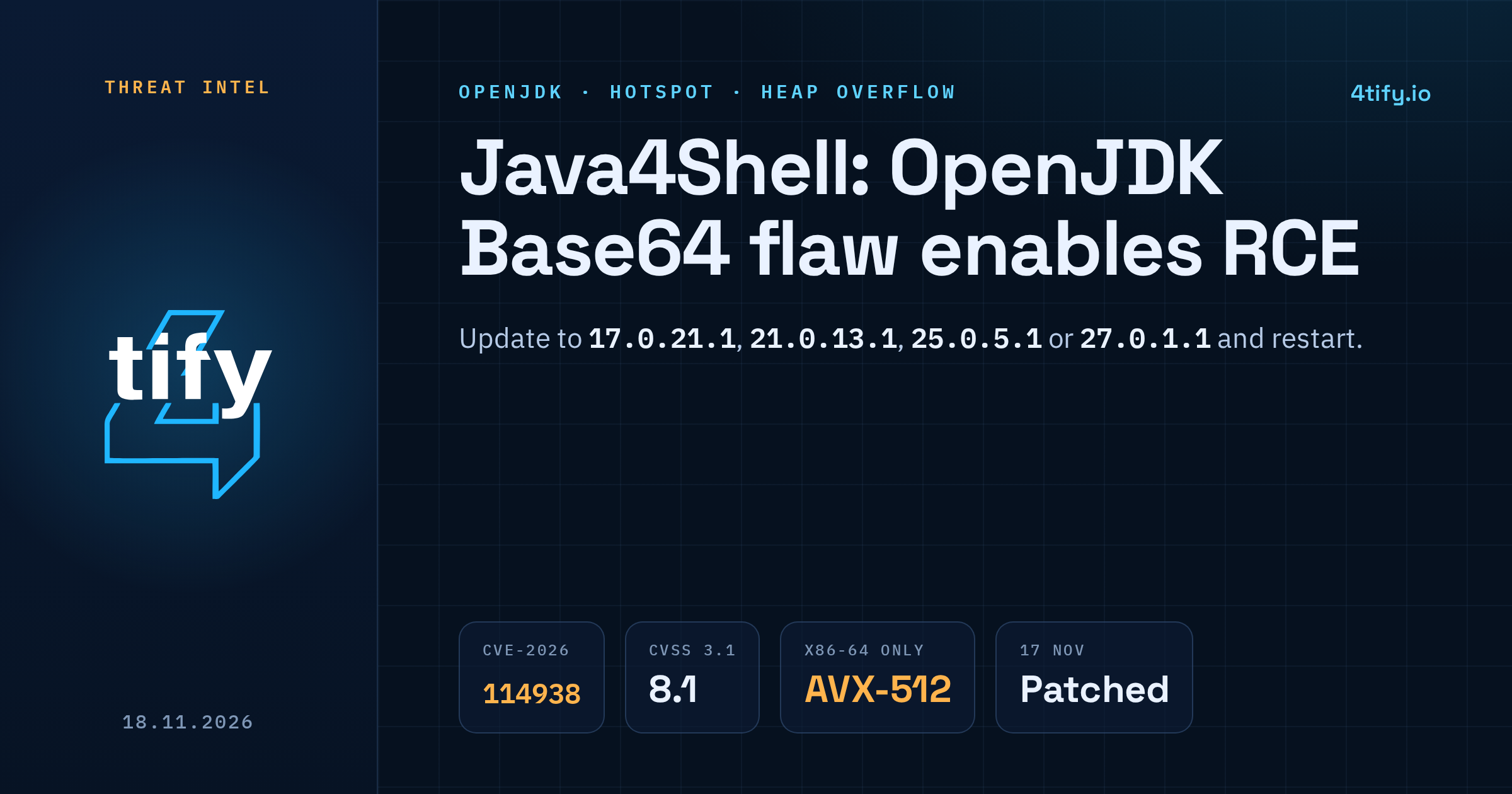
Java4Shell: OpenJDK Base64 flaw allows unauthenticated code execution
Oracle and the OpenJDK project shipped fixes on 17 November 2026 for CVE-2026-114938, a memory-corruption bug in the Java virtual machine that has been nicknamed "Java4Shell". On servers with certain recent x86-64 processors, a specially crafted Base64 string can crash the JVM, leak data from its memory or, in the worst case, let an attacker run code without logging in. CISA published an alert the same day asking organizations to patch immediately.
What happened
The flaw sits in HotSpot, the JVM at the heart of most OpenJDK-based Java runtimes. To speed up Base64 decoding, HotSpot uses a hand-optimized routine on processors that support AVX-512 VBMI instructions. That routine can write past the end of its heap buffer when it receives malformed input. Java still rejects the bad data afterwards, but the memory damage has already happened.
Base64 shows up everywhere: login tokens, file uploads, API payloads, certificates. That is why a bug in a low-level decoder matters to so many applications at once. Oracle classifies it as a heap-based buffer overflow that an unauthenticated attacker can reach over the network through "multiple protocols".
Who is affected
The OpenJDK advisory lists the Java 17, 21, 25 and 27 release lines. The vulnerable code path has been present since OpenJDK 17.0.6. Oracle names these builds as affected:
- Oracle Java SE 17.0.21.0.3, 21.0.13.0.3, 25.0.5.0.3 and 27.0.1.0.3
- Oracle Java SE 8u511b33-perf (the Enterprise Performance Pack build)
- Oracle GraalVM for JDK 17.0.21.0.3 and 21.0.13.0.3, and GraalVM Enterprise Edition 21.3.20.0.3
Every runtime built from the same OpenJDK code inherits the bug, including Amazon Corretto, Eclipse Temurin, Microsoft Build of OpenJDK, Azul Zulu, BellSoft Liberica, SAP SapMachine and Red Hat's OpenJDK builds.
The hardware matters as much as the version. Only x86-64 machines with AVX-512 VBMI use the vulnerable routine: Intel Xeon Ice Lake, Sapphire Rapids, Emerald Rapids and Granite Rapids, and AMD EPYC or Ryzen chips from Zen 4 onwards. ARM64 servers are not affected. On Linux you can check a host with:
grep -m1 '^flags' /proc/cpuinfo | tr ' ' '\n' | grep -E '^(avx512f|avx512bw|avx512vbmi|bmi2)$'
If all four flags come back, the CPU can take the vulnerable path.
How serious is it
Oracle scores the bug 8.1 (High) under CVSS 3.1, with high attack complexity. The team that found it rates it 9.2 (Critical) under CVSS 4.0, and Red Hat's preliminary score is 9.8. The numbers differ, but nobody disputes that a successful attack means full control of the JVM.
The researchers showed code execution without authentication against default installs of Keycloak, Atlassian Jira and Confluence, JFrog Artifactory, Jenkins and PingFederate. Against Apache Kafka, Apache Solr, Elasticsearch, Gerrit and Spinnaker it worked only after logging in. Sample apps built on Apache Struts and Spring Boot were also compromised. Those results apply to the setups that were tested, not to every installation, and there is no single exploit that works against every Java application. Each target needs its own way of getting hostile Base64 into the decoder.
Two other details widen the risk. The same bug can be used to read heap memory, which may hold session tokens or private keys. And a Java client can be hit too, for example when it opens a TLS connection to a malicious server.
A proof of concept that only triggers the crash is public. The product-specific exploit chains have not been released. As of 18 November 2026 the CVE is not in CISA's Known Exploited Vulnerabilities catalog and no attacks in the wild have been reported.
What to do now
- Update the runtime, not just your libraries. Oracle's fixed builds are 17.0.21.1, 21.0.13.1, 25.0.5.1 and 27.0.1.1, all dated 17 November and listed in Oracle's November 2026 Critical Security Patch Update. Amazon has released Corretto 17.0.21.1.2, 21.0.13.1.2, 25.0.5.1.2 and 27.0.1.1.4. For Temurin, Zulu, Microsoft, Red Hat and others, check your vendor's advisory for the build that fixes CVE-2026-114938.
- Find the Java you didn't know you had. Many products ship their own JRE inside the install folder, a container image or an appliance. These copies often don't appear as separate entries in a software inventory. Start with internet-facing services.
- Restart or redeploy. A patched package on disk does nothing until the process restarts. Rebuild container images and confirm the version the running process reports, not the host's default
java. - If you can't patch yet, start affected JVMs with
-XX:-UseBASE64Intrinsicsto switch off the optimized Base64 routine.-XX:UseAVX=2also works on x86-64 by disabling AVX-512, but never add it on ARM hosts, where Java will refuse to start. CISA's alert also suggests limiting unauthenticated access, validating Base64 input at the edge and enforcing size limits. Treat these as stopgaps. - Watch for unexplained JVM crashes on exposed, unpatched systems, along with Java processes or runtimes nobody approved. A crash is not proof of an attack, but it deserves a look.
Bundled runtimes are where bugs like this survive for months. Our vulnerability scanning service maps the Java versions your exposed applications actually run and flags the ones still carrying CVE-2026-114938, so the forgotten JRE inside an appliance gets found before someone else finds it.