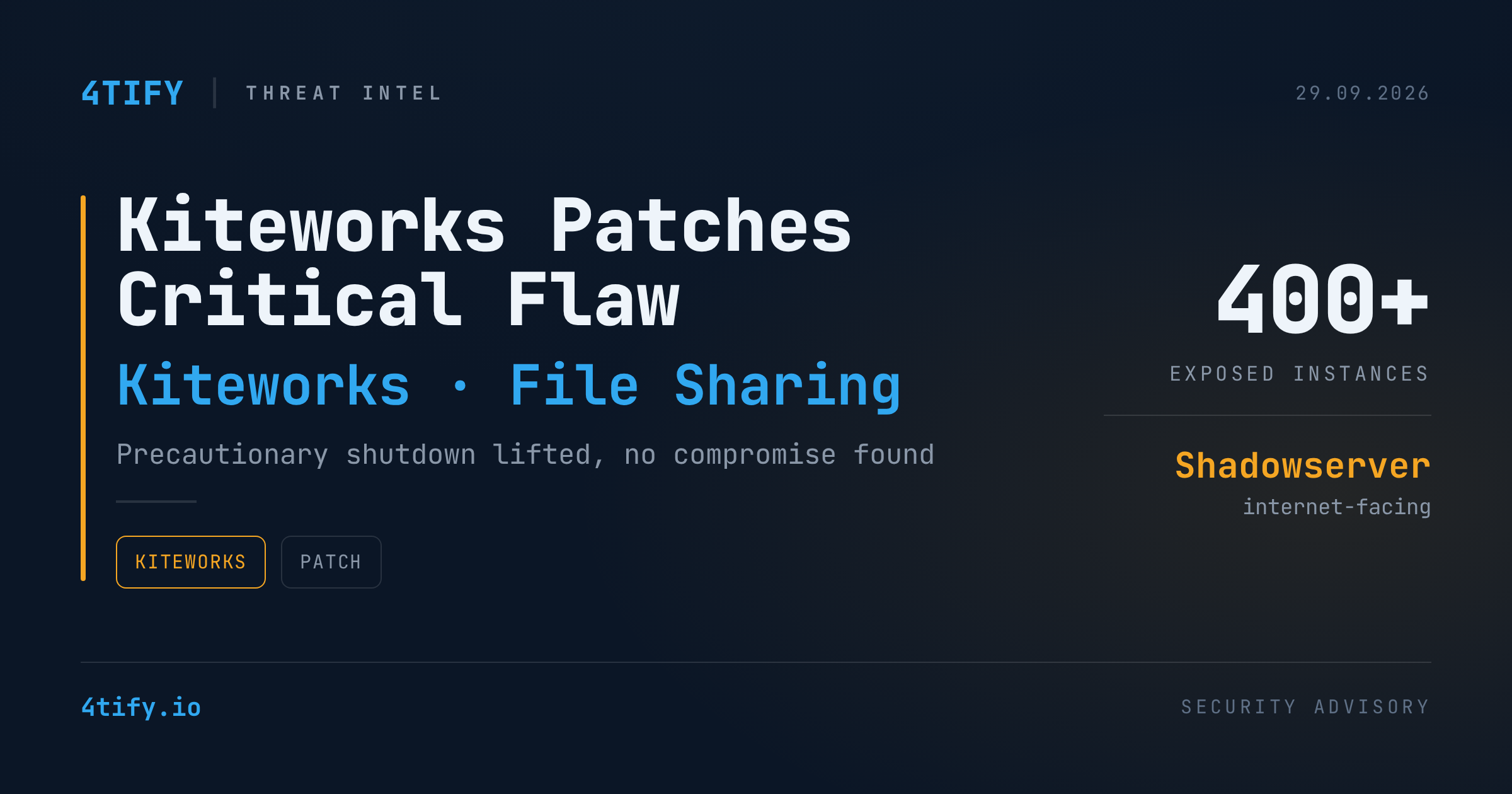
Kiteworks, the enterprise file-sharing platform formerly known as Accellion, has wrapped up a brief security scare that had customers worldwide powering down their systems as a precaution.
What happened
On Saturday, September 27, Kiteworks asked customers running its Private Content Network — the platform enterprises and government agencies use to move sensitive email, files, managed-file-transfer traffic, and web-form submissions — to temporarily shut down their servers. The advisory followed a warning from federal intelligence authorities about a potentially imminent attack. By Monday, the company confirmed that continuous monitoring throughout the shutdown window had shown no abnormal activity and no indication that any Kiteworks or customer system was compromised, and lifted the recommendation for all customers.
Alongside the shutdown, Kiteworks disclosed and patched a critical vulnerability in a single, unnamed feature used by less than 1% of its customer base. The company says it developed and deployed a fix during the incident window and applied an additional protective layer across all environments, with no indication the flaw was ever exploited. Organizations self-hosting the affected feature, Kiteworks Advanced Forms, are advised to contact Kiteworks support directly. No CVE identifier has been assigned yet, and Kiteworks has not published further technical detail on the vulnerability.
Separately, threat-monitoring group Shadowserver found close to 400 Kiteworks instances still reachable from the open internet, the majority of them in the United States, with no visibility into how many are decoys or already patched.
Why it matters
File-sharing and managed-file-transfer platforms sit at the center of extortion economics: they hold exactly the kind of sensitive documents that data-theft crews go looking for, which makes them a recurring target rather than a one-off. Kiteworks' own predecessor learned this the hard way — the legacy Accellion File Transfer Appliance was hit by the Clop extortion gang in a 2021 zero-day campaign that compromised close to a third of the roughly 300 customers still running that software, with close to two dozen suffering significant data theft. Victims spanned finance, energy, retail, telecom, and government, and the campaign was serious enough to prompt a joint advisory from the Five Eyes intelligence alliance. That history is exactly why a precautionary shutdown at a platform serving 100+ million end-users draws attention, even when, as here, no compromise was ultimately found.
What to do
- If you run Kiteworks, confirm your deployment is back online, current on the latest patch, and that the shutdown recommendation has been formally lifted for your environment.
- If you self-host Kiteworks Advanced Forms, contact Kiteworks support directly for the fix and further guidance.
- Don't expose file-transfer or MFT admin interfaces directly to the open internet — Shadowserver's scan is a reminder that hundreds of instances still are.
- Treat file-sharing and MFT platforms as high-value assets in your own risk model: patch promptly, monitor for anomalous data egress, and keep an incident playbook ready given this software category's track record with extortion actors.