

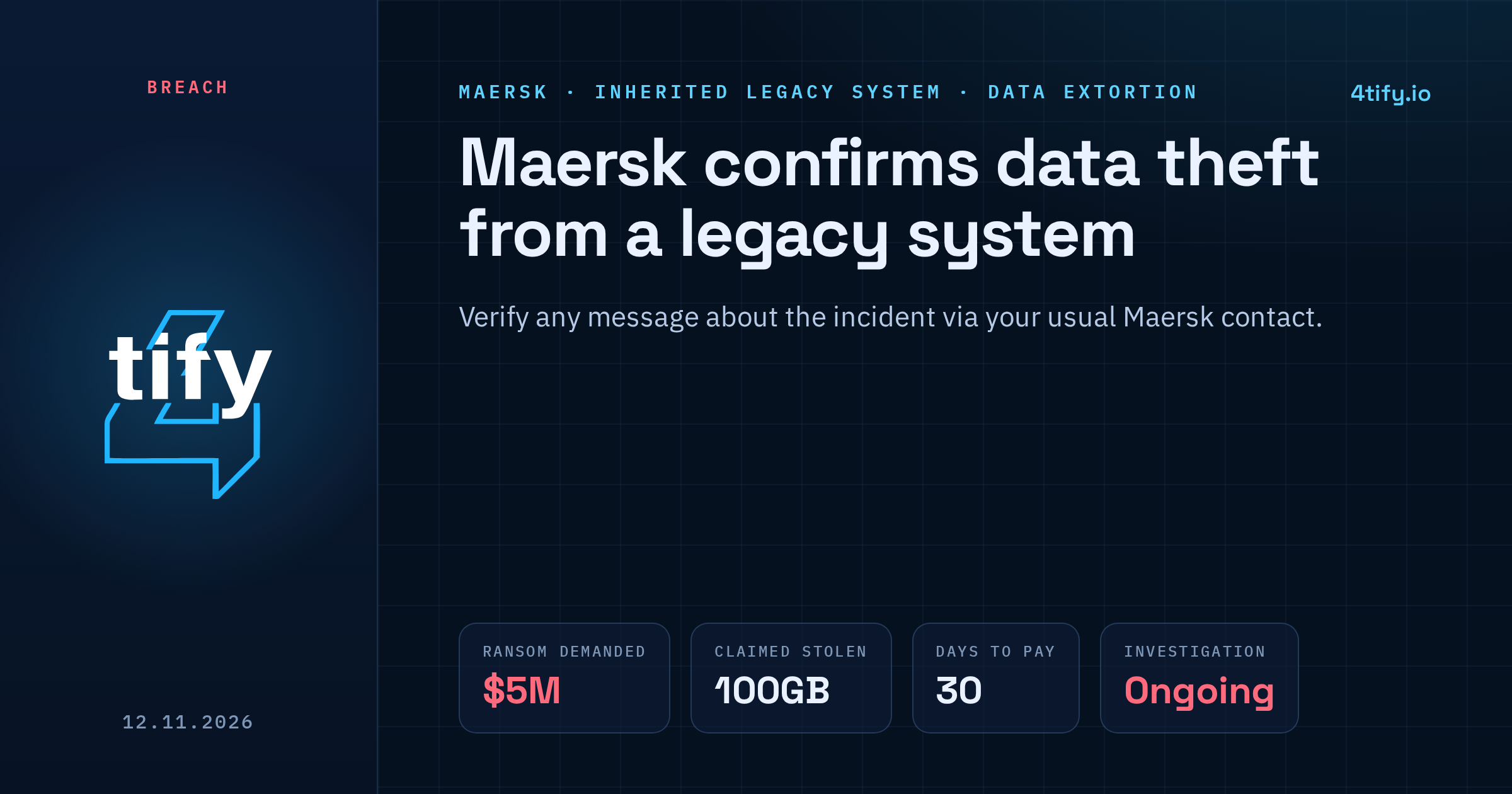
A.P. Moller-Maersk has confirmed that an attacker got into one of its older IT systems and pulled data out of it. The shipping and logistics group disclosed the incident on 11 November 2026, a few days after an extortion group calling itself WhiteArmor put Maersk on its leak site and asked for USD 5 million.
What happened
In its security notice, Maersk says it found unauthorised access to, and data extraction from, a local legacy system that came with a previous acquisition. Its security team opened an investigation as soon as the problem was found and moved to secure the system. The investigation is still running.
Maersk's position so far is cautious. The company says its findings "strongly suggest" no sensitive data has been disclosed. It also says the incident is confined to that one system, with no sign of impact on other Maersk systems or on the customer and partner systems that connect to it through APIs and EDI. Customers can keep booking and managing shipments as normal.
The company has not said when the intrusion began, how the attacker got in, what data was taken or how much.
What the attackers claim
WhiteArmor, a recently emerged extortion group, listed Maersk around 7 November. It says it holds roughly 100GB taken from the OCF/LF Logistics platform and gives Maersk 30 days to pay USD 5 million in bitcoin before the files are published.
According to the group, the haul includes:
- nearly 30,000 driver records, some with passwords stored in plain text
- 33 accounts with super-administrator rights
- more than 27,000 mobile device logs containing phone numbers, email addresses and IMEI identifiers
- delivery recipient details, signed delivery receipts, purchase orders and shipping notices
None of this has been verified. Maersk has not confirmed WhiteArmor's involvement, and it has not named the business the affected system came from. LF Logistics, the Hong Kong contract-logistics company Maersk bought from Li & Fung in a deal that closed in August 2022, is the group's claim and remains unconfirmed by Maersk.
Who is affected
On Maersk's account, the impact is limited to one legacy system. If the group's claims hold up, the people most exposed would be drivers and staff whose accounts sat on that platform, and the recipients named in delivery records. Business customers whose purchase orders and shipping notices were stored there could also see their commercial data surface.
Maersk says it will contact affected parties directly if the investigation finds they need to be informed.
Why legacy systems from acquisitions are a weak spot
Systems inherited through a merger often sit outside the buyer's normal patching, logging and identity controls for years. They keep running because some local operation still depends on them, and they often keep their own user databases, sometimes with weak password storage. If the plaintext-password claim is true, it fits that pattern.
What to do now
- If you work with Maersk or its contract-logistics arm: expect phishing that uses this incident as a lure. Maersk asks customers to treat unexpected messages about the breach with caution and to check them through their usual Maersk contact. Do not act on payment or bank-detail changes sent by email alone.
- If you are a driver or staff member who used the platform: change any password you reused elsewhere, and turn on multi-factor authentication where you can.
- For your own organisation: list every system you inherited through an acquisition, who owns it, and whether it still stores passwords in plain text or with weak hashing. Retire what you can. Put what remains behind your central identity provider and logging.
- Prepare for extortion: CISA's #StopRansomware guide covers both the prevention side and the response checklist for data-theft extortion.
Forgotten and inherited systems are exactly what Attack Surface Management is meant to find. Our team maps the internet-facing assets an organisation actually exposes, including the ones left over from acquisitions that no longer appear in anyone's inventory, so they can be fixed or switched off before someone else finds them.