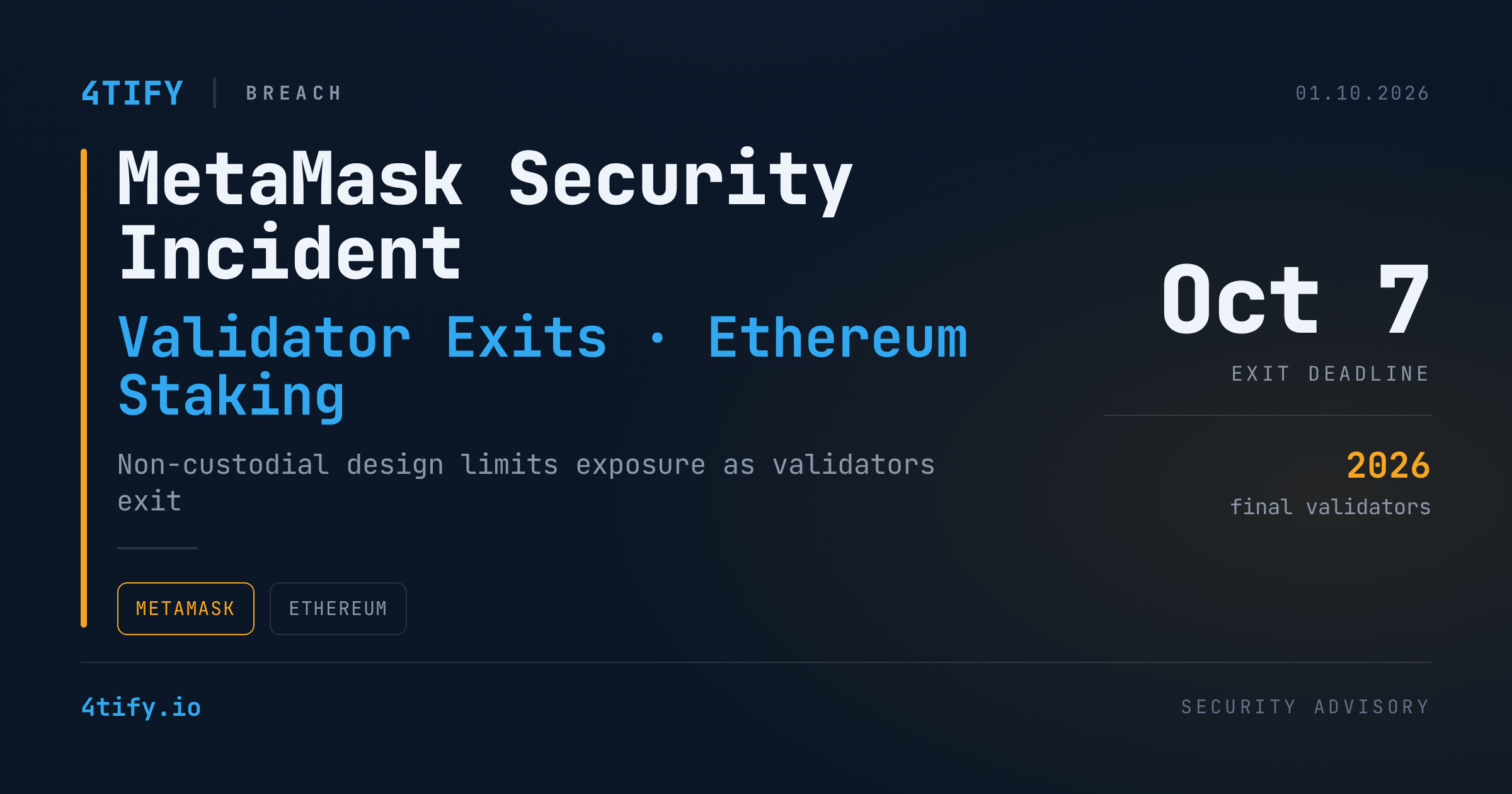
MetaMask has confirmed it is responding to an active security incident affecting part of its infrastructure, triggering a precautionary exit of validators tied to its non-custodial Ethereum staking service.
What happened
The wallet provider disclosed that it is "actively addressing and remediating" an ongoing issue in coordination with external partners and security advisors. Few technical details have been shared publicly, but MetaMask stated that, based on its current assessment, there is no immediate threat to user wallets.
As a precaution, MetaMask is proactively exiting validators within its non-custodial staking operations. Because the service is non-custodial, MetaMask never holds withdrawal keys on behalf of stakers — a structural detail that limits what an attacker could do even in a worst-case scenario.
Lido, the liquid-staking protocol that works with MetaMask-operated validators, confirmed it is taking parallel steps to protect client assets. Lido said the affected validators have begun the exit process, with the final batch expected to be exited — though not yet fully withdrawn — by October 7, 2026. The protocol acknowledged the move will likely mean foregone staking rewards and possible downtime penalties in the short term.
Why it matters
Validator exits are a blunt but effective containment tool: pulling validators offline trades a known, bounded cost (lost rewards, downtime penalties) for removing exposure while the underlying issue is investigated. It's a sign the incident, whatever its root cause, was judged serious enough to touch live staking infrastructure rather than being handled quietly in the background.
For users, the practical risk hinges entirely on custody. Non-custodial staking means the keys controlling withdrawals stay with the client, not the platform — so even if MetaMask's infrastructure were compromised, an attacker would not automatically gain the ability to move staked funds. That architectural separation is doing real work here.
This is still a developing situation, and MetaMask has not disclosed the nature of the incident, how it was discovered, or whether any data or funds were accessed.
What to do
- MetaMask users with staked ETH: monitor official MetaMask and Lido channels for validator-status updates rather than third-party speculation.
- Teams integrating MetaMask staking APIs or SDKs: treat this as a prompt to review your own key-custody assumptions — confirm which keys you hold versus which the platform holds, and where the trust boundary actually sits.
- Security teams at exchanges, wallets, or custodians: use this as a timely trigger to re-verify your own non-custodial claims against your actual key-management architecture — "non-custodial" is only a mitigation if it's actually true end-to-end.
- Everyone else: don't change operational behavior based on headlines alone; wait for confirmed technical detail.
4tify will update this article as further information becomes available.