

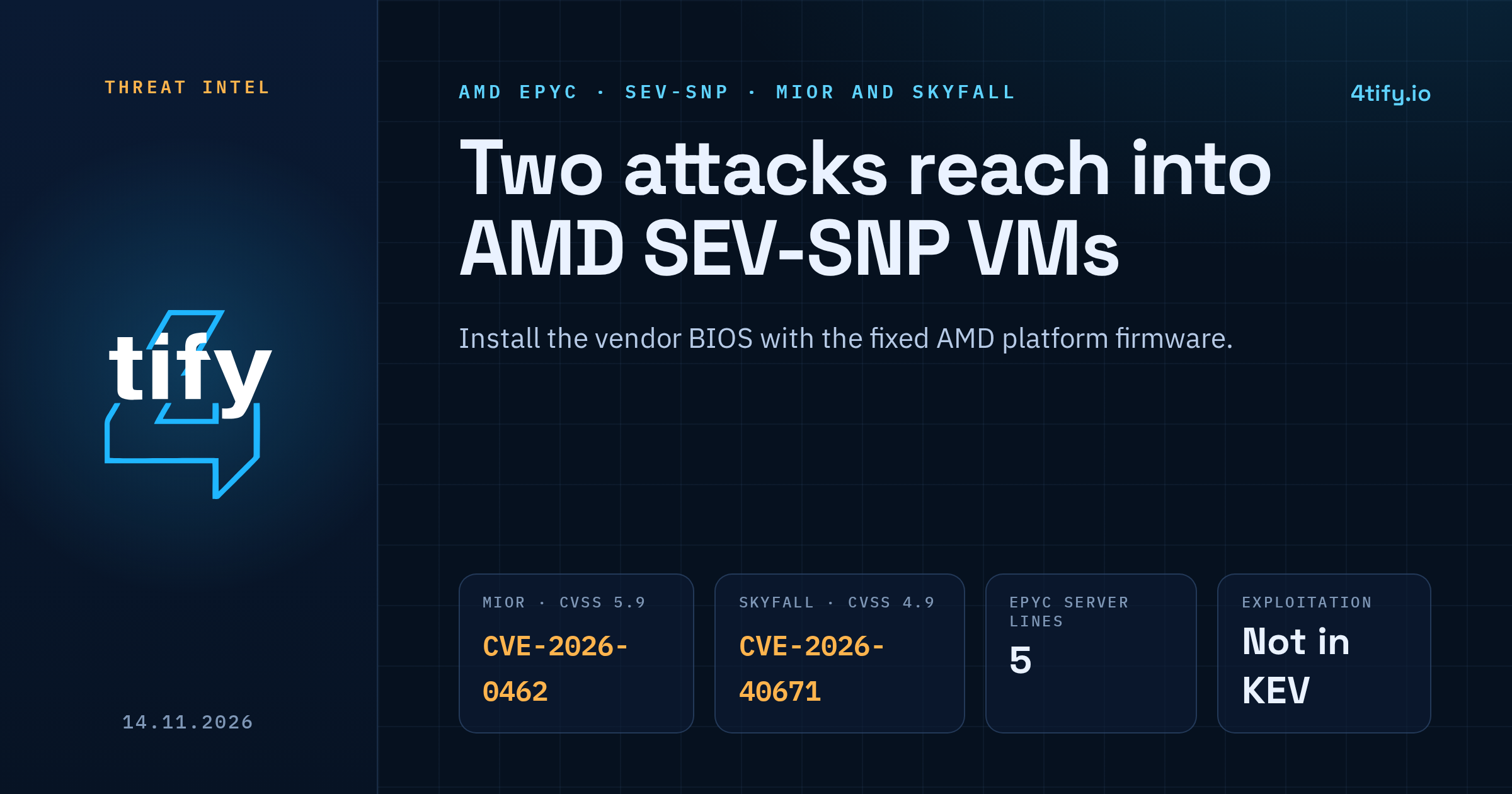
AMD has published two security bulletins for flaws that let a malicious cloud host get at data inside confidential virtual machines protected by SEV-SNP. The two attacks come from academic teams and are called Mior and Skyfall. Both were disclosed on 10 November 2026, when a coordinated embargo ended. AMD shipped firmware and microcode fixes in August, but most server owners will get them through a BIOS update from their hardware vendor. Those BIOS packages are still being rolled out.
What happened
SEV-SNP is the AMD EPYC feature behind many "confidential VM" offerings in the cloud. It encrypts a guest's memory and uses a table called the Reverse Map Table (RMP) to stop the host's hypervisor from tampering with guest pages. The Platform Security Processor (PSP), a small security core on the chip, sets that table up when SEV-SNP starts.
Mior (CVE-2026-0462, CVSS 4.0 score 5.9) goes after that start-up step. The attacker changes the chip's internal memory routing so that some of the PSP's reads and writes go to a PCIe device, such as a GPU, instead of main memory. The device stores what the PSP writes and returns it when the PSP checks, so start-up looks normal. Meanwhile the part of the RMP that protects the table itself is never set up. The researchers used this to turn on debugging for a production confidential VM and read and write its memory. They also made a malicious VM produce attestation reports that describe a different, harmless image. AMD's own wording in AMD-SB-3059 is a loss of guest memory integrity.
Skyfall (CVE-2026-40671, CVSS 4.0 score 4.9) is a side channel. It builds on the Transient Scheduler Attacks AMD disclosed in 2025. When the hypervisor makes a VM fail to start, the processor has already decrypted part of that VM's saved state into its cache and does not clean it up. The hypervisor can then sample those values. In tests the team recovered a VM's saved registers and a disk-encryption key. Memory reads are narrow: only three fixed cache lines in a target page are reachable. The same technique also exposed decrypted microcode updates and data from System Management Mode (SMM). The SMM part is tracked separately as CVE-2026-18448, a missing mitigation in the EDK II firmware code base.
Who is affected
Both bulletins list the AMD EPYC 7003, 8004, 8005, 9004 and 9005 server lines, plus their embedded versions. Skyfall also covers the Instinct MI300A accelerator.
- Mior was shown on a Zen 5 EPYC 9135. The researchers consider Zen 3 and Zen 4 potentially affected, but did not test them. AMD lists only SEV-SNP as affected, not SEV or SEV-ES.
- Skyfall was shown on an EPYC 7313 (Zen 3) and on EPYC 9124 and 9334 (Zen 4).
Neither attack helps against an ordinary VM, which already trusts its host. The risk is to tenants who use confidential VMs precisely because they do not want to trust the cloud operator. Both attacks need full control of the hypervisor. Mior also needs a modified BIOS and a PCIe device. That is a high bar, but it is the exact threat SEV-SNP is designed to stop. No physical access is required.
Neither CVE is in CISA's Known Exploited Vulnerabilities catalog, and there are no reports of use in real attacks. Both research teams have published their code.
Fixes and timelines
AMD released the SEV firmware for Mior on 12 August 2026: version 1.3A.03 for EPYC 7003, 1.3A.4 for 8004 and 9004, and 1.3A.0A for 8005 and 9005. Microcode for Skyfall came out the same day. The MI300A fix followed on 21 September.
Server makers receive the full platform firmware separately:
- Skyfall (AMD-SB-3061): MilanPI-SP3_1.0.0.L, Genoa_100J Patch 3 and TurinPI_1.0.0.C, targeted for November 2026.
- Mior: MilanPI-SP3_1.0.0.L, GenoaPI_1.0.0.K and TurinPI_1.0.0.C, targeted for December 2026.
- Embedded EPYC fixes are planned between January and April 2027.
For the EDK II issue, AMD recommends its earlier TSA mitigations plus an EDK II patch, due in November for the EPYC server lines.
What to do now
- If you run SEV-SNP hosts, ask your server vendor for the BIOS release that bundles the platform firmware above, and install it as soon as it ships. AMD's bulletins do not say whether the August firmware and microcode protect a host on their own, so treat the BIOS update as the fix.
- If you rent confidential VMs, ask your cloud provider when their hosts will carry the fixes. The Mior bulletin lists TCB values for SNP attestation next to each fixed firmware version (for example
TCB[SNP]=0x1Fon EPYC 7003). If your verifier checks the reported TCB, raise the minimum it accepts once your provider confirms the update. - Keep host access tight. Both attacks start from a fully compromised hypervisor, so limit who has administrative access to virtualization hosts and their firmware.
Firmware gaps like these are easy to miss because they sit below the operating system. Our vulnerability scanning tracks firmware and microcode versions alongside software patches, so hosts still waiting for a vendor BIOS update show up instead of being assumed safe.