

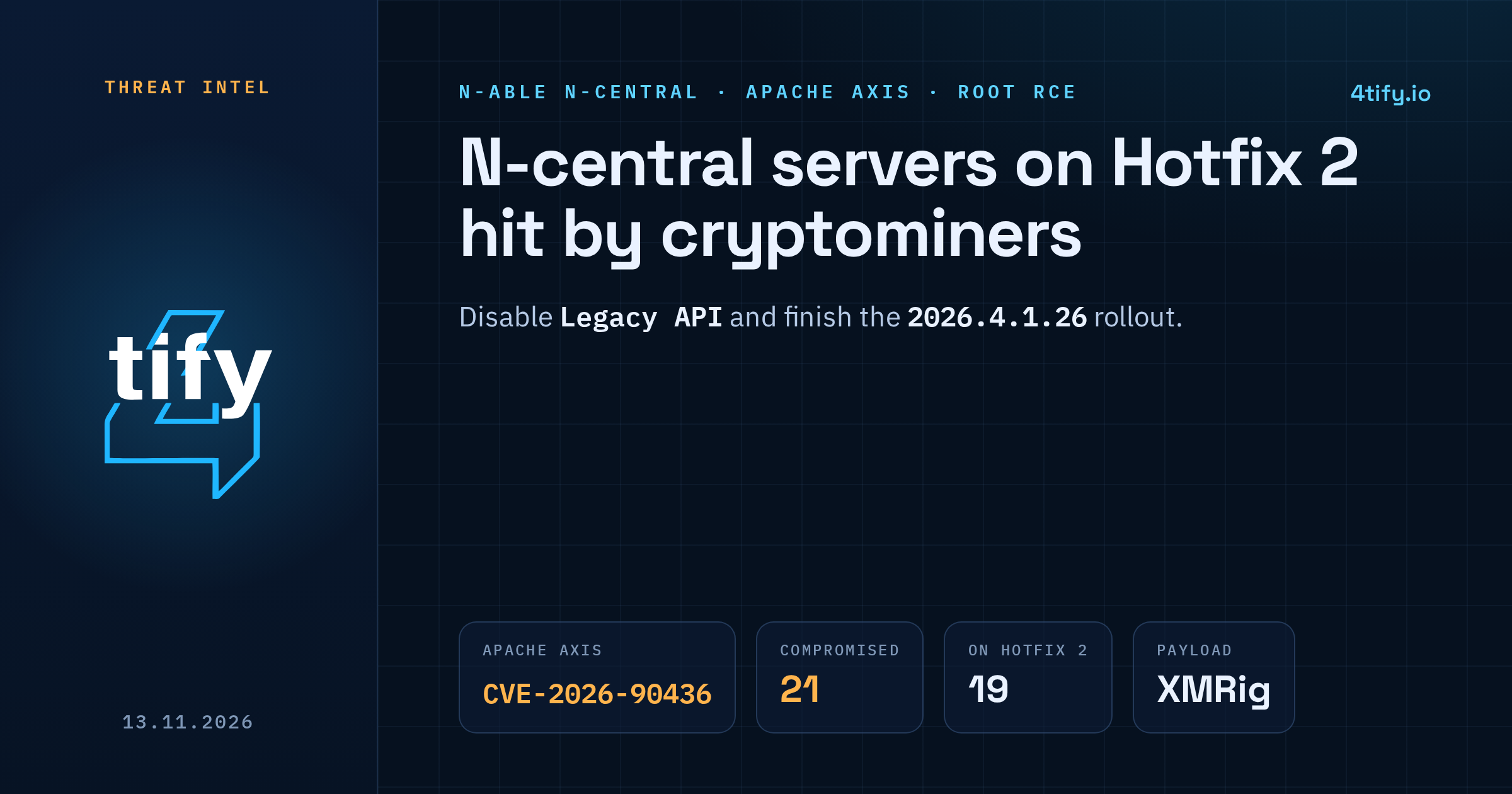
N-central servers on Hotfix 2 hit by cryptominer attacks
Attackers are installing cryptocurrency miners on N-able N-central servers through a new exploit chain called 4EverAble2Shell, and most of the machines they hit were already running the latest hotfix. At least 21 production servers had been compromised by midday on 12 November, and 19 of them were on N-central 2026.4 Hotfix 2.
What happened
It has been a rough week for N-central, the remote monitoring and management platform many managed service providers use to run their clients' networks. Around 9 November, a researcher published details of 33 vulnerabilities in the product. N-able took its hosted N-central environment offline and, on 10 November, shipped N-central 2026.4 Hotfix 2 (build 2026.4.1.26) with fixes for seven CVEs.
Between 11 and 12 November the same researcher released two more exploit chains that work against Hotfix 2:
- 4EverAble2Shell gives an unauthenticated attacker command execution as root on the N-central server.
- Agent2Shell abuses more than ten weaknesses in how the server talks to its Agents and Probes, and can be used to run commands on managed Windows endpoints as SYSTEM.
Probing for 4EverAble2Shell started within hours. Full exploit attempts were seen from 09:16 UTC on 12 November, and by 12:50 UTC the attacker's mining pool showed 21 compromised N-central servers submitting work. The victims are spread across the United States, Canada, South Africa, the United Kingdom, Germany, France and Sweden.
How the attack works
4EverAble2Shell joins two problems. The first is CVE-2026-90436 in Apache Axis 1.x, an old SOAP library that N-central bundles. Axis reads a SOAP fault and loads whatever class name the request supplies before it checks whether that class is legitimate, and this happens before any per-service authentication runs. In N-central, that gives the attacker commands as the nable service account. A separate N-central privilege escalation flaw, which has no CVE yet, then takes them to root.
Apache rates the Axis bug critical. Axis 1.x reached end of life years ago, and the project has said it will not ship a 1.x release to fix it, so the CVE record points users to a patch commit or a move to a different SOAP engine.
The payload seen so far is a shell script pulled from an attacker-controlled server. It installs the XMRig Monero miner, sets up persistence through a systemd service or cron, and caps the miner at about half of the CPU cores, presumably to avoid drawing attention. Cryptomining is the only payload reported so far, but the attacker holds root on a machine that can push scripts to every managed endpoint, so a compromised server should be handled as a full breach.
Who is affected
The server chain needs the Legacy API to be enabled and reachable. N-able says the setting is off by default, and Hotfix 2 servers with Legacy API disabled are not exposed to 4EverAble2Shell. It is not yet confirmed whether Agent2Shell has the same dependency.
N-able has restricted some features in hosted environments while it works on further fixes, warning this may affect functionality. Legacy API is off there, and the Microsoft Intune integration has been switched off as a precaution until new protections are validated.
It is still unclear whether the 21 compromised servers were self-hosted or N-able-hosted. No CISA KEV listing exists yet for these flaws.
What to do now
- Check Legacy API on every on-premises server. If it is on, turn it off. If a business process truly needs it, keep it off the public internet and don't treat an IP allowlist as enough protection.
- Finish the Hotfix 2 rollout. Upgrade the server to 2026.4.1.26, then upgrade Agents first and Probes second, as the release notes describe. Hosted customers still have to upgrade their own Agents and Probes.
- Hunt for signs of compromise if Legacy API was reachable at any point since 11 November. Look for requests to
/dms/services/ServerUIthat mentionjline.internal.TerminalLineSettings, an unexpectedxvd.serviceunit, files under/tmp/.xvdor/var/tmp/.xvd, and unusual CPU load from unknown processes. - Review the endpoints too. Check for new admin accounts, scheduled tasks, scripts and remote sessions, and for PowerShell or
cmd.exelaunched by the N-able Agent or Probe. - If you find any of these, treat it as an incident. Rebuild the server rather than just removing the miner, rotate the credentials it stored, and check what it pushed to clients.
A management server that exposes an optional legacy interface to the internet is the kind of thing nobody notices until it is exploited. Our Attack Surface Management service maps what an organisation actually exposes online, including admin panels and APIs that were meant to stay internal, so issues like a reachable Legacy API are found and closed before someone else finds them.