What happened
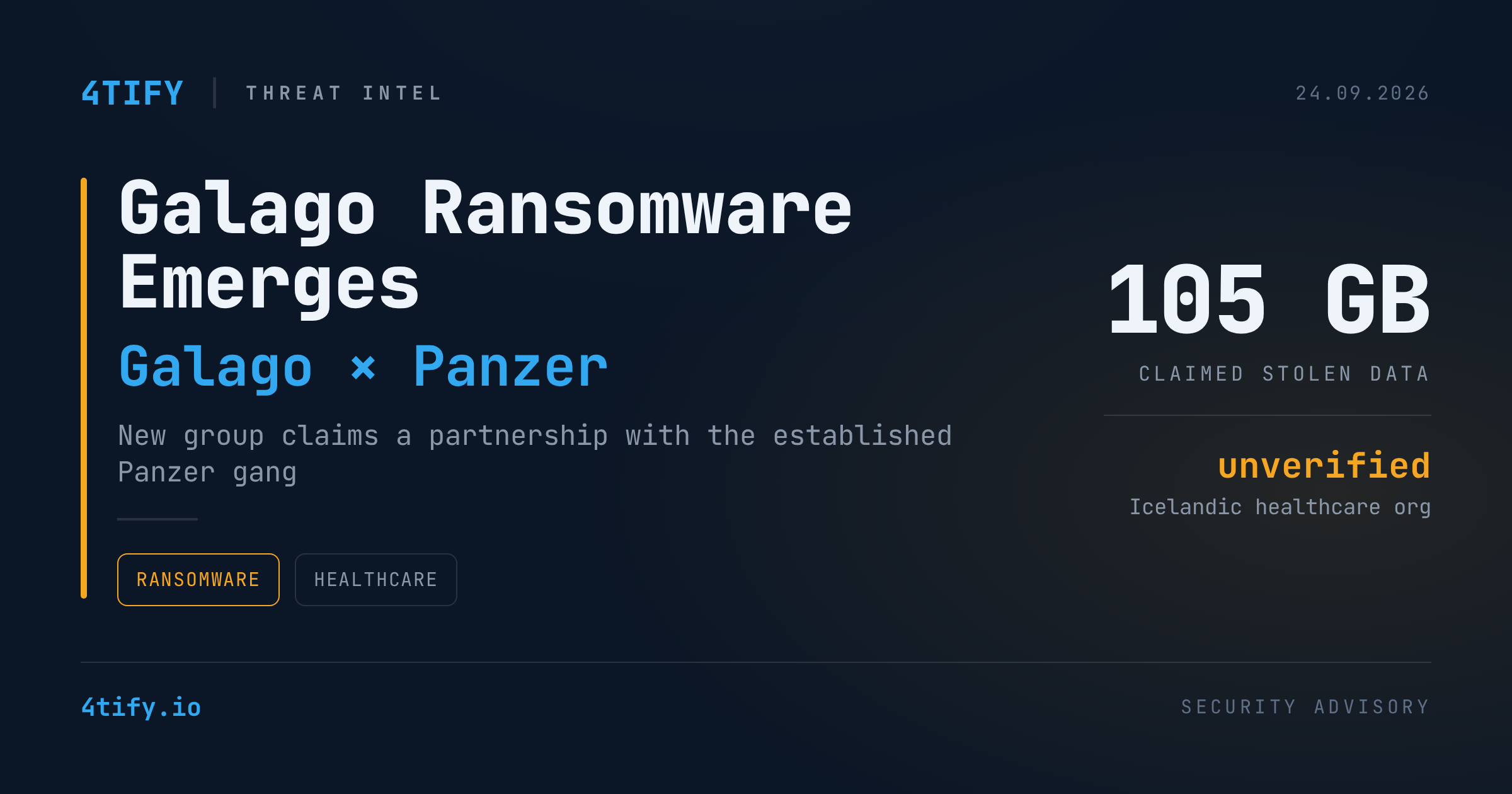
Security researchers began tracking a new ransomware operation calling itself Galago after it surfaced in early September 2026. Its dark-web leak site was found inactive when monitoring began, with no confirmed victims listed.
Days before that monitoring started, an open-source claim had already named a specific target: an alleged breach of an Icelandic healthcare organization, with roughly 105GB of data said to be stolen and a release threatened some two to three weeks later. That window has not closed yet, and no independent source — the organization itself or outside forensic investigators — has confirmed an intrusion actually took place.
A claimed partnership, not a confirmed one
Galago's own site describes a working relationship with Panzer, a more established double-extortion operation that has posted over 30 victims in the past two months and both leaks stolen data and disrupts systems to pressure targets. Researchers noted that Galago's and Panzer's Tor leak-site addresses share the same prefix — a detail consistent with the claimed relationship, but not proof of who actually runs Galago, whether the two share tooling, or whether they follow the same playbook.
An inactive leak site could just as easily reflect a group still building infrastructure as it could a change in plans. Until a working leak site, a victim disclosure, or technical evidence surfaces, the Galago-Panzer link is best treated as a claim backed by a naming coincidence — plausible, not proven.
Why it matters
Newer ransomware brands often borrow credibility from established names, and an unverified affiliation claim can inflate perceived risk before any technical link is proven. That cuts both ways: dismissing the claim outright isn't safe either. If the alleged healthcare breach is genuine, the exposure risk to patient data is real regardless of how the group brands itself or who its partners turn out to be. Preparing for the possibility without reporting it as settled fact is the right call while the picture is incomplete.
What to do
- Patch internet-facing systems and review remote-access accounts, especially VPNs and administrative portals.
- Require phishing-resistant MFA for administrators and VPN users.
- Keep backup and administrative infrastructure segmented from everyday networks, with offline or immutable backup copies.
- Test restoration procedures regularly — a leak-site claim shouldn't be the first time you discover backups don't work.
- Watch for unusually large outbound data transfers or signs that security controls have been disabled, both of which can accompany this kind of activity.
- Hold off on treating an extortion claim as fact until it's confirmed independently — a plausible link to a known group is not proof that an attack happened.