

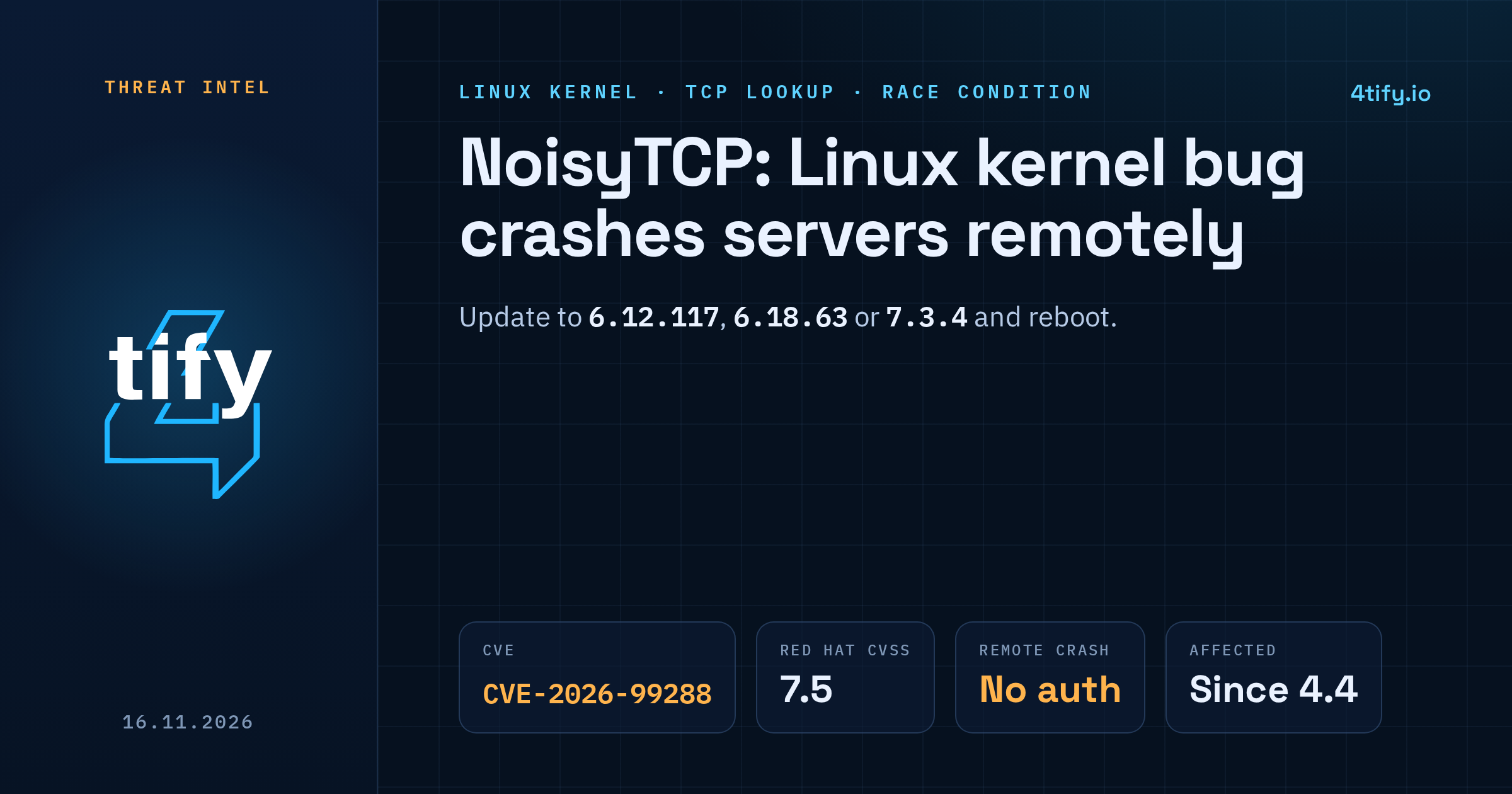
A race condition in the Linux kernel's TCP code, tracked as CVE-2026-99288 and nicknamed NoisyTCP, lets a remote attacker with no credentials crash a server by sending it packets. The bug has been in the kernel since late 2015, so it reaches every kernel from 4.4 onward. Fixed stable kernels are out. Distribution packages are still arriving, so check whether your vendor has shipped one.
What happened
When a TCP packet arrives, the kernel looks up which connection it belongs to without taking a lock. The memory behind those connection records can be freed and handed out again while a lookup is still holding the old address. The kernel checked that the reused object matched the same connection details, but it never checked whether that object was actually live in the connection table.
The researcher who found it built a proof of concept around SYN cookies. A lookup grabs a half-open connection record, another CPU frees it and reuses the same memory for a new SYN cookie request with identical addresses and ports, and the first CPU carries on with the new object. That object has no listening socket attached. The kernel reads through a NULL pointer and panics. The official CVE record includes the resulting crash trace.
A second path can lead to a remote use-after-free. It needs several races to line up in a row and is much harder to hit. Nobody has claimed remote code execution, and Red Hat describes the impact as a denial of service.
Who is affected
- Kernels: Linux 4.4 and later, up to the fixed releases 6.12.117, 6.18.63 and 7.3.4 (mainline is fixed from 7.4-rc2). The CVE record lists fixed versions only for those branches, so older long-term kernels such as 5.15, 6.1 and 6.6 depend on your distribution's backport.
- Configuration: a server that accepts TCP connections and spreads incoming packets across more than one CPU. That means a network card with two or more receive queues, or Receive Packet Steering (RPS) switched on. Both are normal on current hardware and in cloud VMs.
- Services: default installs of Nginx, Apache and SSH were all reachable in testing. No unusual settings, firewall rules or application bugs are required.
- Containers: the crash happens in the host kernel, so a containerised web server going down takes the whole host with it.
How hard is it to pull off
Timing decides it. Against QEMU/KVM virtual machines running stock Nginx, Apache or SSH, the crash came within roughly 5 seconds to 2 minutes. A quiet bare-metal Nginx server with 8 receive queues held out for about 14 hours against a proof of concept tuned for it. Virtualised and cloud servers are the more exposed group.
Red Hat rates the flaw 7.5 (Important) and calls the score preliminary. NVD had not scored it at the time of writing. CVE-2026-99288 is not in CISA's Known Exploited Vulnerabilities catalog, and no attacks using it have been reported.
What to do now
- Patch and reboot. Install your distribution's kernel update as soon as it ships, reboot into it and confirm with
uname -r. If you build your own kernels, pick up the upstream fix or move to 6.12.117, 6.18.63, 7.3.4 or later. - Check your vendor's tracker. Patch status differs a lot between distributions right now. Look up CVE-2026-99288 for each OS you run, including container hosts and appliances.
- If you can't patch yet, two stopgaps block the crash path:
- Disable SYN cookies with
sysctl -w net.ipv4.tcp_syncookies=0. The setting is per network namespace, so every container with its own namespace needs it too. It also removes your protection against SYN floods, so weigh that trade-off on public servers. - Cut the internet-facing interface down to a single receive queue and disable RPS and RFS. This stops the race but costs throughput.
- Disable SYN cookies with
- Watch for unexplained reboots and kernel panics in
tcp_v4_rcvon public Linux hosts.
Keep an eye on the NVD entry for an official score and new vendor references.
Finding every internet-facing Linux host that still runs a vulnerable kernel is the slow part, especially across cloud VMs and container hosts. Our vulnerability scanning service maps exposed systems and flags kernel and package versions behind on fixes like this one, so you know which boxes to patch first.