

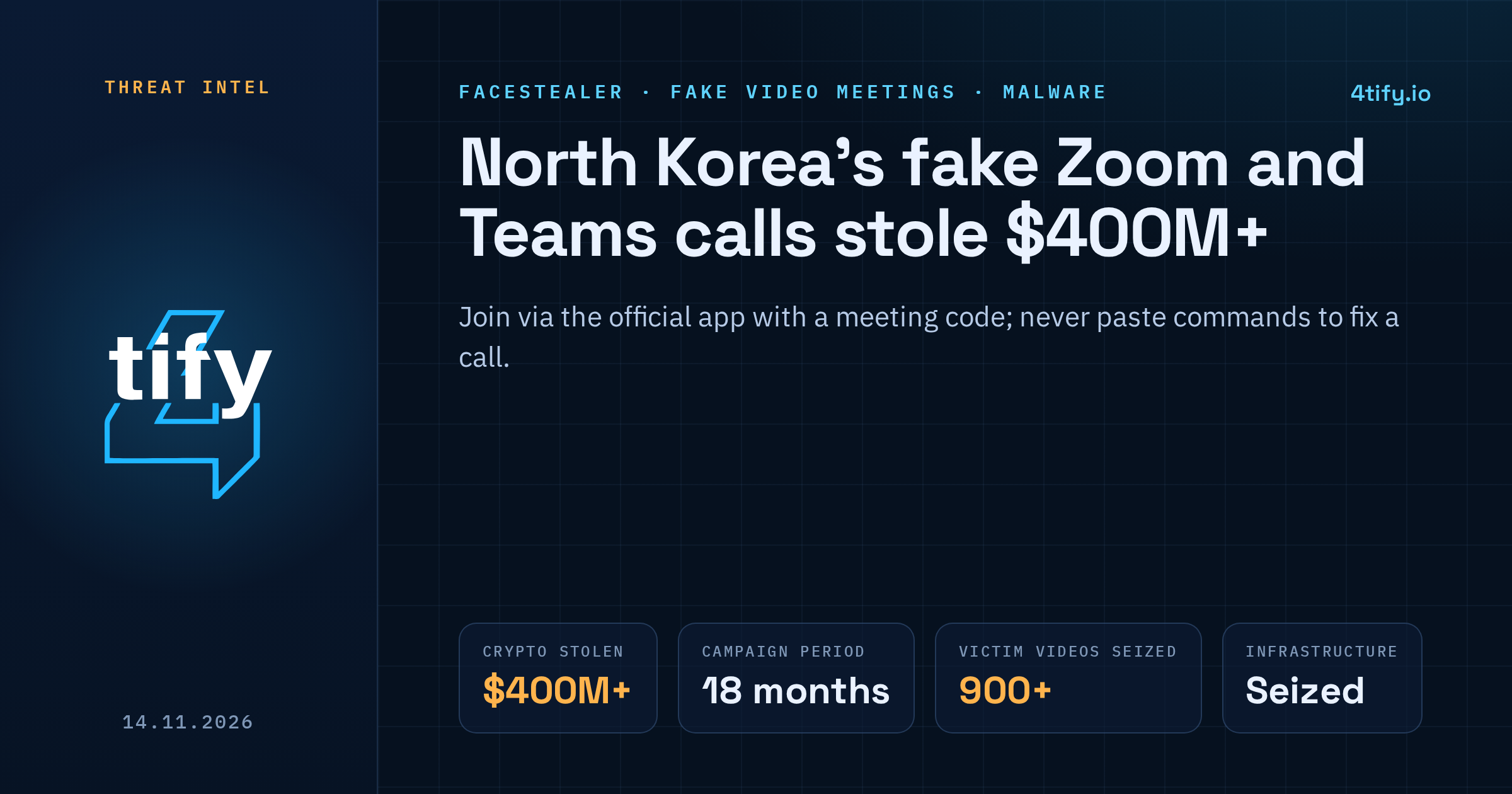
North Korean hackers stole over $400M with fake Zoom and Teams calls, FBI says
The FBI and the U.S. Justice Department said on 12 November 2026 that North Korean state hackers have stolen more than $400 million in cryptocurrency over the past 18 months with a social engineering scheme the bureau calls FaceStealer. Investigators seized the cloud infrastructure behind it, along with a library of more than 900 webcam videos secretly recorded from earlier victims.
What happened
FaceStealer runs on fake video meetings. The attackers take over a victim's messaging accounts, then use them to invite that person's contacts to what looks like a normal Zoom or Microsoft Teams call. The meeting runs on a copycat site under a typo-squatted domain controlled by the attackers. The FBI gives uu01webzoom.us and teams.livemeet.us as examples.
Once the target is let in, the attackers play prerecorded webcam footage of the person who sent the invite, often with extra clips so it looks like several people have joined. Meanwhile the target's own webcam is being recorded. That footage becomes the bait for the next round of invitations.
The FBI attributes the activity to North Korean state-sponsored actors known publicly as Sapphire Sleet, BlueNoroff, APT38, Stardust Chollima, UNC1069, CryptoCore and Dangerous Password. On the same day, the Justice Department announced a court-authorized seizure and restraint of more than $1.2 billion taken in the separate theft of over $6 billion from the Binance exchange, which the FBI blames on the North Korean group it tracks as TraderTraitor.
Who is affected
The main targets are people working in cryptocurrency and Web3. The FBI also warns that open-source maintainers are increasingly in the crosshairs, with several attempts against maintainers on npm and, more recently, Rust crates.
The FBI's alert describes a case from earlier this year. The maintainer of a major JavaScript library with tens of millions of weekly downloads joined one of these fake Teams calls. The attackers used that access to create malicious dependencies designed to be pulled in with the library's normal downloads. The compromise was caught quickly, but it shows how a single infected developer could reach millions of machines.
How the attack works
After a short delay in the meeting, the "contact" sends a chat message saying the target can't be heard and offers a fix: a prompt to click, a script to run, or a command to paste into the terminal. Following those steps installs malware that adds a browser cookie harvester, a keylogger, a screen capturer and a backdoor.
From there the attackers steal what crypto they can reach, hijack the victim's Telegram, LinkedIn, Slack or Discord accounts and use the new footage against the victim's contacts. In several cases the theft came months, even more than a year, after the initial infection. The attackers had copied seed phrases and waited for wallet balances to grow.
The FBI also says the group has started using deepfakes of well-known crypto and Web3 figures in these calls. For now, though, the scheme still relies overwhelmingly on real stolen video.
What to do now
The FBI's FLASH advisory lists concrete steps:
- Join calls through the installed Zoom or Teams app with a meeting code, not through a link to a web version, especially for invites from new or rarely seen contacts.
- Keep your camera off until you can see, hear and talk to the person who invited you.
- Never run a script or paste code into a terminal to "fix" audio or update a meeting client. Update the app separately.
- Be wary of calendar invites with no meeting link. The attackers tend to send the link shortly before the call.
- Confirm the meeting through a different channel, such as a phone call or SMS.
- Turn on multifactor authentication and login alerts on Telegram, WhatsApp and Slack, and use disappearing messages.
- Keep only small amounts in browser-extension wallets and never store seed phrases or private keys on your devices.
If you think you joined one of these calls, move your funds to a new wallet created on a clean device, change passwords, log out all sessions, add MFA (including on developer and package-registry accounts), and warn your contacts and employer. The Justice Department's announcement has the details of the seizures.
Malware like this tends to leave traces after the fact: session cookies and passwords taken by the stealer often end up traded in criminal markets. Our Deep and Dark Web monitoring service watches for an organisation's credentials and sessions appearing there, which can be the first sign that someone on the team was compromised.