

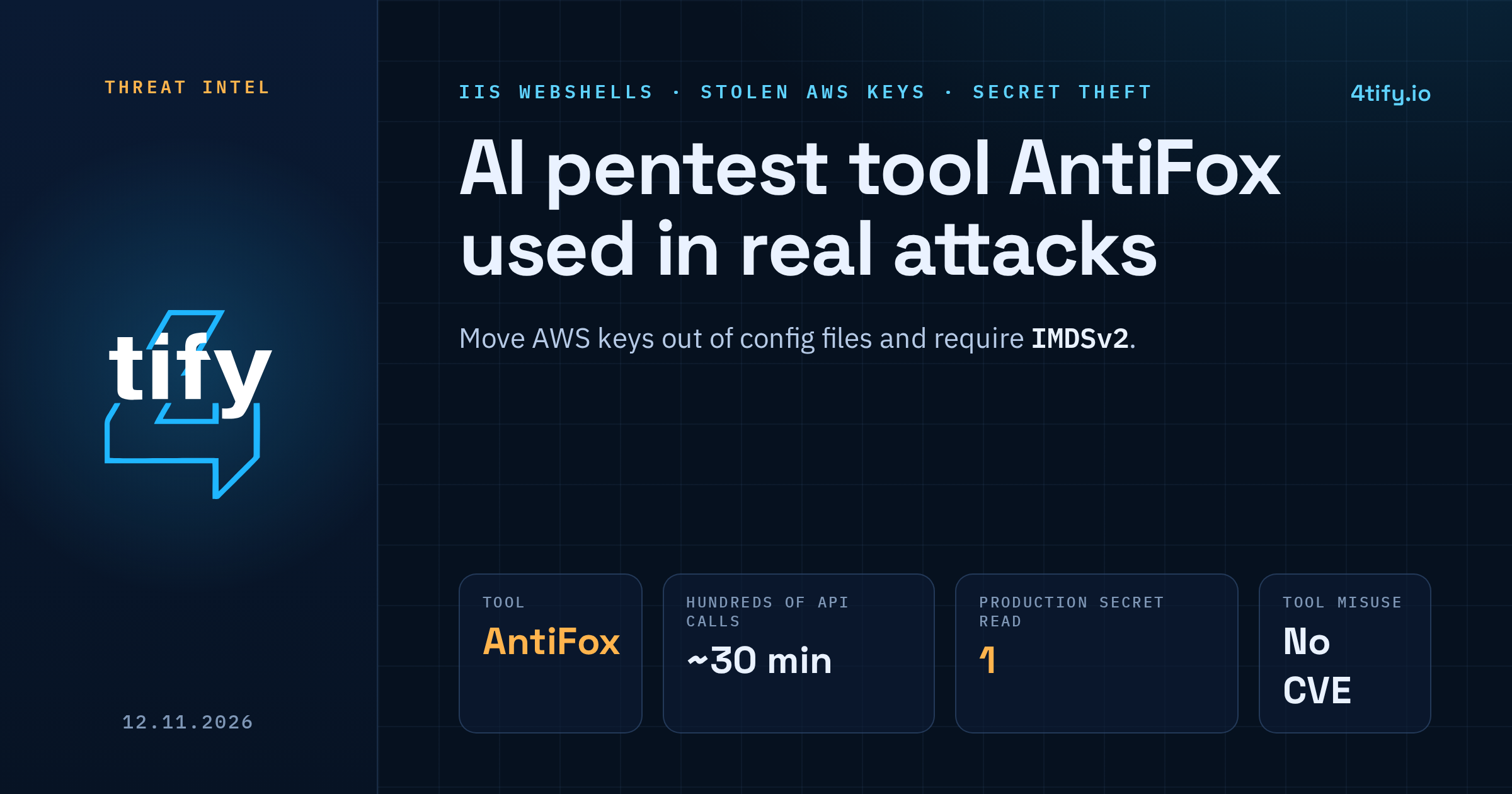
Open-source AI pentest tool AntiFox used in real attacks on IIS servers and AWS accounts
AntiFox, a free AI-driven penetration testing platform, has been tied to real intrusions against companies running web applications on Microsoft IIS and workloads in Amazon Web Services. In at least one case the attackers walked away with a production secret.
What happened
Self-hosted AntiFox instances running on Alibaba Cloud were linked to confirmed malicious activity against internet-facing web services and the AWS accounts behind them. The link is through infrastructure. It shows the tool's servers were involved, but it does not prove that every step was taken by an AI agent rather than a person at a keyboard.
AntiFox started as a fork of ARTEX 0.1.1, another agentic pentest framework. It has a Chinese-language interface and lets an operator send AI agents to map exposed services and probe endpoints. Its developers forbid illegal use, but nothing in the software enforces that. The project is still on GitHub and has reached version 2.0.
How the attacks worked
Two entry points were seen.
Through a web server. Attackers got code execution on a public IIS application. The exact vulnerability has not been identified. The IIS worker process (w3wp.exe) then wrote an ASPX webshell, which the attackers used to run system commands. They checked which account they were running as, used icacls to look at permissions, and tested whether they could write to the web root. Next they read web.config for database connection strings and application settings, looked through error and debug logs, tried to reach an internal production database with the stolen credentials, and copied configuration and log files into an upload folder that anyone could download from the website.
Through stolen AWS keys. In other cases the attackers already held valid AWS credentials, both IAM users and, in some cases, an assumed EC2 role. How they got those keys is not known. They started with identity checks such as GetCallerIdentity, ListUsers and ListRoles, then ran fast List, Get and Describe calls across a long list of services: IAM, EC2, S3, Lambda, Secrets Manager, KMS, RDS, ECS, EKS, Amazon Bedrock and more.
In one intrusion a single source rotated through several AWS identities and sent hundreds of API requests in about 30 minutes. Most were denied. A few were not, and one sequence ended with a successful GetSecretValue call against a production secret. In a separate incident a valid identity was used to list, read, copy and then delete objects in S3.
Who is affected
No victims have been named and there is no count of affected organisations. The pattern matters for anyone who runs internet-facing IIS applications or keeps long-lived AWS access keys inside application config files. There is no CVE here. The problem is a capable tool in the wrong hands, plus credentials sitting where an attacker on the web server can read them.
One point deserves attention from anyone who reviews cloud logs: a burst of mostly AccessDenied errors does not mean the attack failed. The successful calls hide inside the noise.
What to do now
- Get AWS keys out of application files. Use instance roles or a secrets manager instead of keys in
web.configor.envfiles. Rotate any key that has ever lived in a config file on an internet-facing server. - Require IMDSv2 and trim permissions. Enforce IMDSv2 on EC2 instances and give each role only the actions it actually needs. Tight permissions limit how much a stolen key can reach.
- Watch the right signals. Turn on CloudTrail and Amazon GuardDuty. Alert on one IP using many keys or roles in a short time, on rapid enumeration across unrelated services from Boto3, on AWS access from hosting networks an identity has never used, and on any
GetSecretValuethat follows unusual activity. - Check your IIS servers. Alert when
w3wp.exestartscmd.exe,powershell.exe,whoami.exeoricacls.exe. Look for new.aspxfiles in upload, temp and image-conversion folders, and for config or log files saved there with.txtor image extensions. - Protect S3 data. Enable versioning and Object Lock on buckets that hold data you can't afford to lose.
- If you find a webshell, isolate the server, preserve the logs, remove the files, revoke active AWS sessions and keys, and rotate every credential the server could read.
The web-server route in these intrusions began with a public IIS application that let an outsider run code. Our Attack Surface Management service keeps an up-to-date inventory of what you have facing the internet, including forgotten IIS apps and upload endpoints, so you can patch or close them before an automated tool finds them first.