

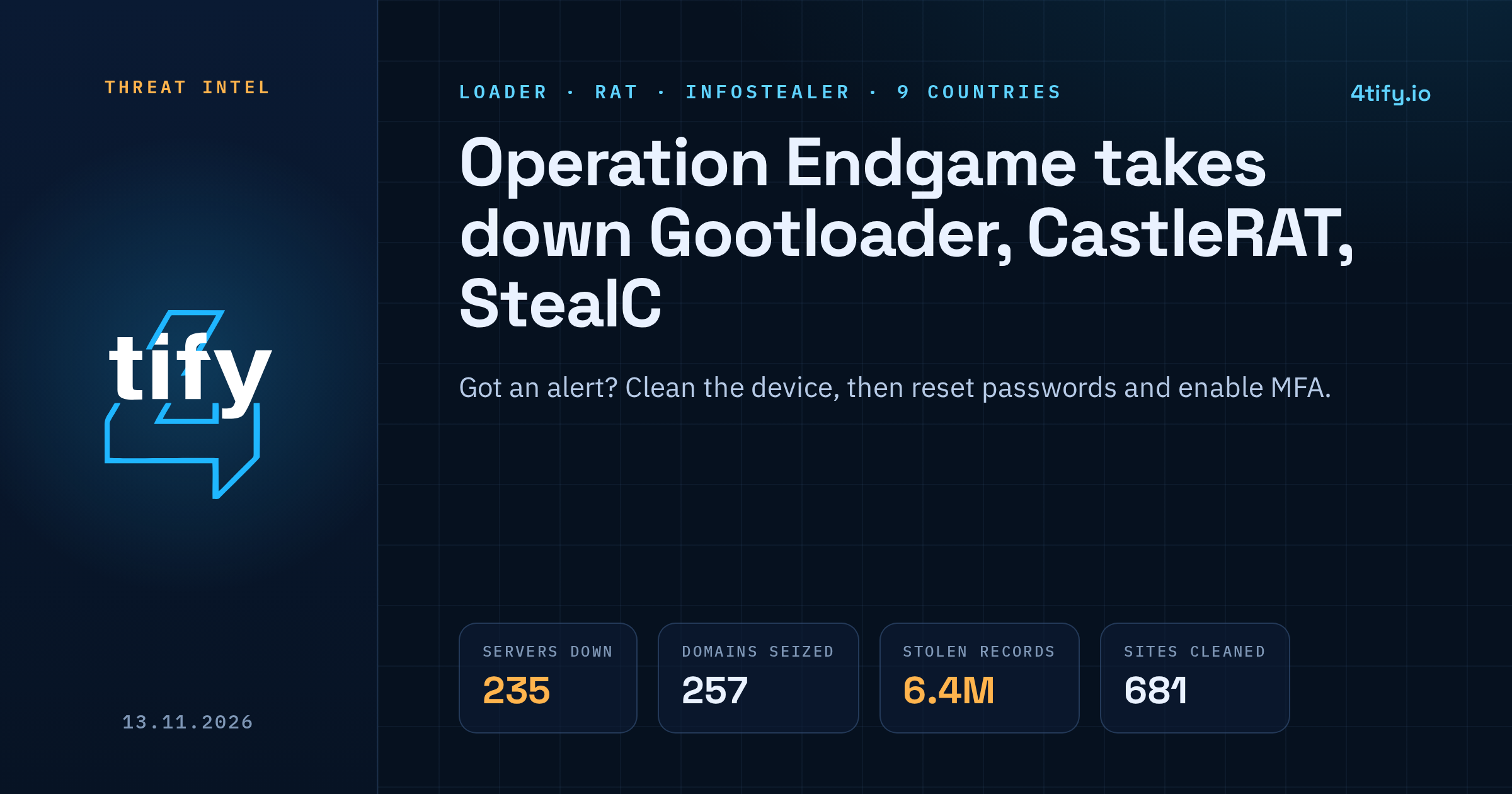
Operation Endgame takes down Gootloader, CastleRAT and StealC
Police in nine countries have taken down the servers behind three malware families used to break into computers and steal logins: the Gootloader loader, the CastleRAT remote access trojan and the StealC infostealer. The action, announced on 12 November 2026 as the latest phase of Operation Endgame, also recovered about 6.4 million stolen data records belonging to victims.
What happened
Europol and Eurojust coordinated the operation with police from Bulgaria, Canada, Denmark, Germany, Moldova, the Netherlands, Poland, the United Kingdom and the United States. In total, 235 servers and 257 domains were taken down or seized across the three families. Europol's announcement lists the full results.
The breakdown by family:
- Gootloader: 14 servers and 218 domains taken down, and 681 infected websites cleaned.
- CastleRAT: 120 servers and 39 domains seized.
- StealC: 102 servers taken down. StealC was already hit in a June 2026 Endgame action, and its operators had rebuilt.
In the United States, agencies acting under court authorization removed Gootloader from more than 100 servers, many of them hacked WordPress sites, and seized U.S. domains the operators used to deliver and control the malware. The Justice Department says Gootloader has infected at least 25,000 computers since 2018 and was used in ransomware attacks on at least 44 U.S. victims, with estimated losses of about $28.8 million.
No arrests have been announced. Dutch police say investigative work also targeted Gootloader's main suspect.
How the malware worked
Gootloader is a loader. Its job is to get a foothold on a computer and then pull down other malware, including ransomware. The operators broke into legitimate websites, often running WordPress, and planted pages offering fake legal documents. Search engine poisoning pushed those pages high in results, so people searching for such documents downloaded the infection themselves.
CastleRAT, first seen in 2025, gives an attacker remote control of an infected machine. StealC collects saved passwords and other login data from infected computers and sends them to its operators, who sell or reuse them. Stolen logins are a common first step into a company network.
Who is affected
Anyone whose computer was infected by one of the three families, and any organisation whose staff logged in to work systems from such a machine. Owners of WordPress sites that were compromised and used to host Gootloader pages are also affected, even if they never noticed.
What to do now
If you are an individual. The Dutch police have loaded CastleRAT data into their Check je hack service, where you can check an email address. More data will be added in the coming weeks, and victim data is also being shared with Have I Been Pwned, The Shadowserver Foundation, DIVD, NoMoreLeaks and the Dutch NCSC. If you get an alert:
- Clean the infected device first. Changing passwords on a machine that still runs an infostealer just hands over the new ones.
- From a clean device, change the affected passwords and any you reused elsewhere.
- Turn on multi-factor authentication wherever it is offered.
If you run a WordPress site.
- Change every administrator password to a unique, long one and enable MFA for admin accounts.
- Remove user accounts you do not recognise.
- Update WordPress core, themes and plugins, and delete plugins you no longer use.
- Look for unfamiliar files, injected scripts and pages you did not create.
If you run security for an organisation. Treat a staff member's appearance in these datasets as a possible breach: reset their credentials, revoke active sessions and tokens, and check the endpoint for infection.
Takedowns slow these crews down but rarely end them, as StealC's return after June shows. Our Deep and Dark Web monitoring team watches for company email addresses and credentials turning up in infostealer logs and leak markets, so a stolen login can be reset before someone uses it.