

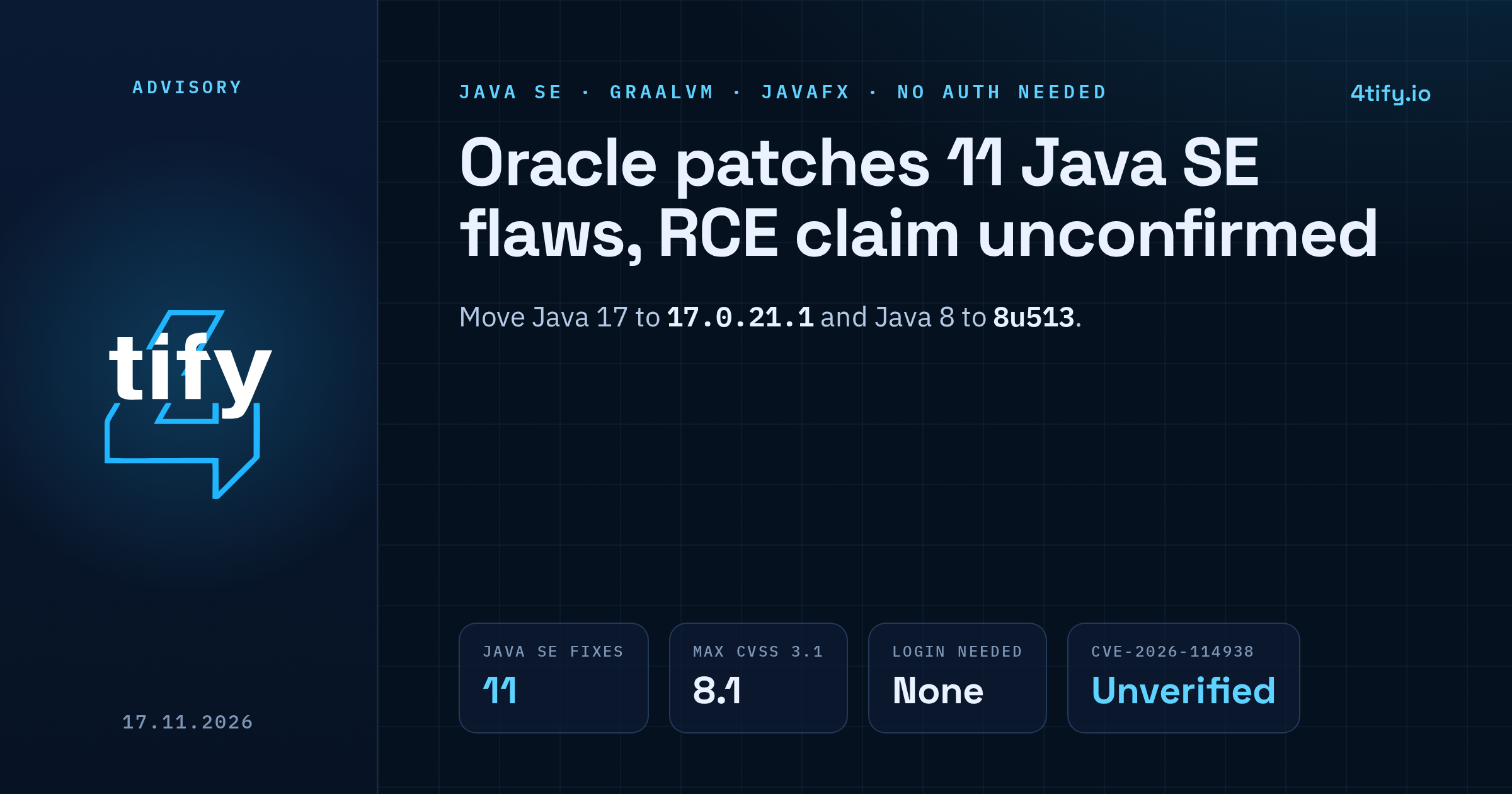
Oracle ships 11 Java SE security fixes as an unconfirmed Java 17 RCE claim circulates
Oracle released its November 2026 Critical Security Patch Update on 17 November, and Java SE takes 11 of the fixes. Oracle says every one of them can be exploited over a network without credentials. On the same day, a separate claim about a critical remote code execution bug in OpenJDK 17, filed under CVE-2026-114938 and nicknamed "Java4Shell", spread quickly. That claim has not been confirmed by Oracle or by any official body, and nothing yet ties it to this month's fixes.
What happened
This is Oracle's monthly Critical Security Patch Update, the smaller release cycle the company added in May 2026 to sit between its quarterly Critical Patch Updates. The highest CVSS 3.1 score among the 11 Java SE flaws is 8.1. Oracle had not published CVE numbers, affected components or per-flaw details when its pre-release notice went out, and it warns that the information may change before the full advisory is posted.
Java is only part of the release. The same update carries fixes scored 10.0 for Oracle Fusion Middleware and Oracle Analytics, 9.9 for Oracle Database Server and 9.8 for E-Business Suite, APEX and REST Data Services. The full list is in Oracle's November advisory.
Who is affected
Oracle lists these versions as affected:
- Oracle Java SE: 8u511, 8u511-perf, 11.0.33, 17.0.21, 21.0.13, 25.0.5 and 27.0.1
- Oracle GraalVM for JDK: 17.0.21 and 21.0.13
- Oracle GraalVM Enterprise Edition: 21.3.20.0.3
- Oracle JavaFX: 21.0.13, 25.0.5 and 27.0.1
"Remotely exploitable without authentication" describes how an attack would reach the flaw. It does not mean each bug allows code execution, and it does not mean every Java application can be hit directly. Oracle has not said which components are involved.
The notice covers Oracle's own builds. Other OpenJDK distributions, such as Eclipse Temurin, Amazon Corretto, Azul Zulu, Red Hat builds and Linux distribution packages, ship on their own schedules. Check each vendor separately.
About CVE-2026-114938
The claim describes an unauthenticated remote code execution flaw in OpenJDK 17.0.6 and later, rated 9.2 under CVSS 4.0. As of 17 November:
- the CVE record is reserved and has no public description, and NVD has no entry for it;
- it is not in CISA's Known Exploited Vulnerabilities catalog;
- no public proof of concept or in-the-wild exploitation has been reported;
- Oracle has not linked it to any of the 11 Java SE fixes, and its highest Java score this month (8.1) does not match the 9.2 in the claim;
- the OpenJDK Vulnerability Group's most recent advisory is dated 24 October.
Treat the affected range and the severity as unconfirmed until a vendor publishes them.
What to do now
- Find your Java. List every JDK and JRE you run, including runtimes bundled inside vendor appliances, application servers, build agents and container base images. Running
java -versionon each host is a start; image scanners will catch the copies hidden in containers. - Update Oracle builds. The replacement releases dated 17 November are 8u513 (1.8.0_513-b04), 11.0.33.1, 17.0.21.1, 21.0.13.1, 25.0.5.1 and 27.0.1.1. The JDK 17.0.21.1 release notes list these as the new security baselines for Java 8, 11 and 17.
- Watch your other vendors. If you run Temurin, Corretto, Zulu or distro OpenJDK packages, track their advisories and plan for an out-of-cycle update in case CVE-2026-114938 is confirmed.
- Start with what faces the internet. Patch exposed Java services first and remove any external access they do not need. Switzerland's National Cyber Security Centre gave the same advice in its warning about this update.
Old Java runtimes tend to sit in places nobody remembers: a reporting server, a vendor appliance, a forgotten Jenkins agent. Our vulnerability scanning service finds outdated runtimes like these across internal and internet-facing systems, so the hosts that still need this update show up on a list.