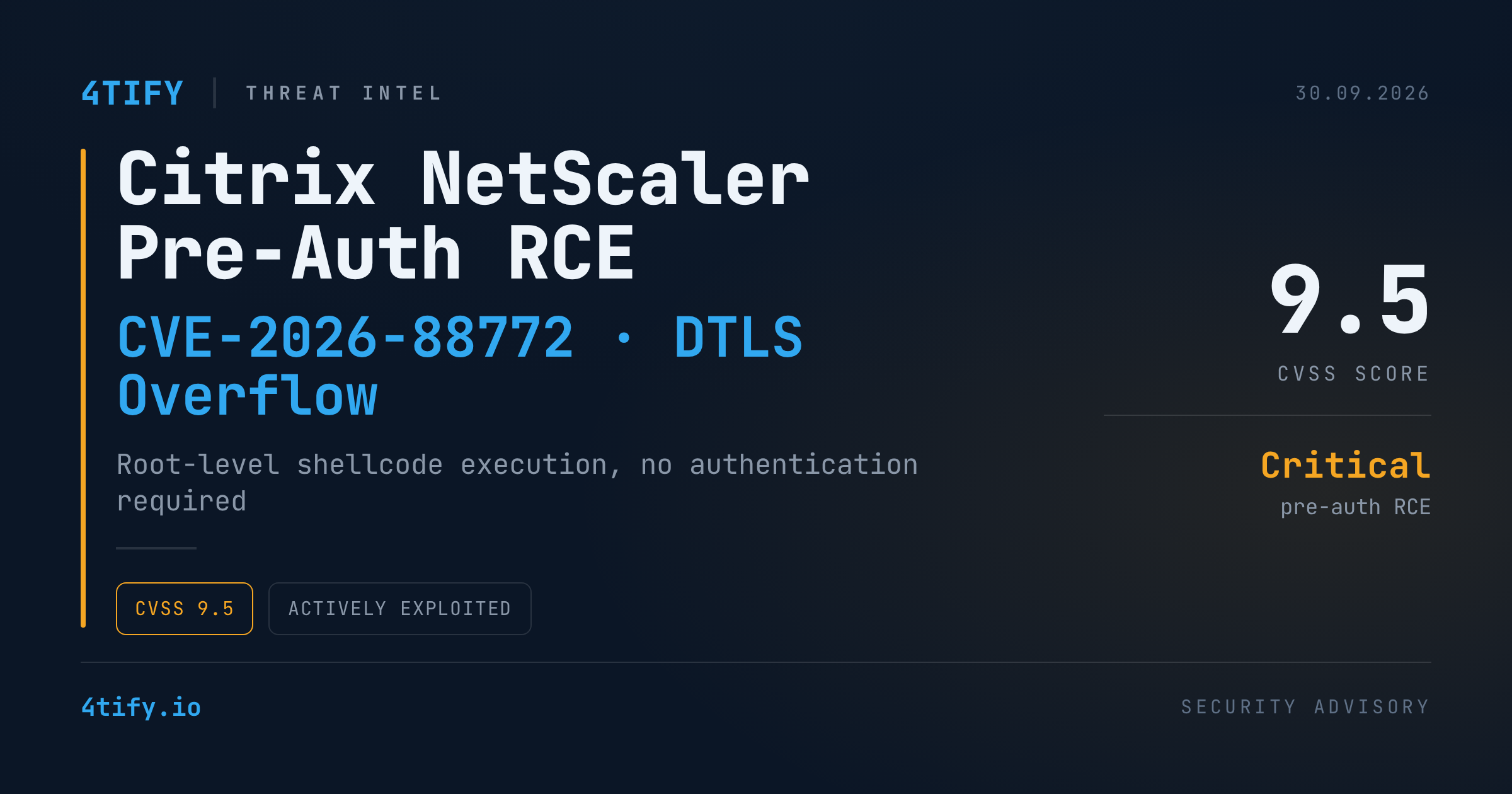
A critical, actively exploited flaw in Citrix NetScaler ADC and Gateway lets unauthenticated attackers corrupt memory during the DTLS handshake and ultimately run code with root privileges.
What happened
Security researchers have published a detailed technical breakdown of CVE-2026-88772, a memory overflow vulnerability in NetScaler's Datagram Transport Layer Security (DTLS) handling, rated 9.5 on the CVSS scale. The bug lives in the Packet Processing Engine (NSPPE) that NetScaler uses to reassemble handshake records.
The root cause: NetScaler reassembles a DTLS handshake message from a series of fragments without properly validating that the fragments actually fit the buffer allocated to hold them. An attacker can split a handshake message into up to 120 single-byte fragments, each carrying a legitimate-looking offset. As NetScaler stitches the fragments back together it keeps almost the entirety of each underlying network record rather than just the declared byte — so what looks like a 120-byte handshake message on paper can balloon to roughly 174 KB of attacker-controlled data by the time reassembly finishes. That data overruns a fixed ~35 KB scratch buffer, corrupting adjacent memory.
Researchers demonstrated that the resulting overflow can be steered to hijack control flow and execute arbitrary shellcode with root-level privileges, using the mprotect() system call to bypass the device's no-execute (NX) memory protections — turning what is nominally a "memory corruption" bug into full pre-authentication remote code execution.
The disclosure lands one day after a proof-of-concept was published for a related flaw, CVE-2026-88771, which threat actors have reportedly already chained together with CVE-2026-88772 in real-world attacks.
Why it matters
NetScaler ADC and Gateway sit at the network edge, fronting VPN, authentication, and load-balancing traffic for a huge number of enterprises — a compromise here hands an attacker a foothold with root privileges before any credentials are checked. With public exploit detail now available and exploitation already observed in the wild, the window between "vulnerability disclosed" and "mass exploitation" is effectively closed. A CVSS score of 9.5 places this among the small handful of flaws each year that warrant emergency patching outside normal change windows.
What to do
- Patch immediately. Apply the Citrix-supplied fixes for CVE-2026-88772 and CVE-2026-88771 to every NetScaler ADC and Gateway appliance — this is not a next-maintenance-window fix.
- Assume compromise if unpatched. If your appliances were internet-facing and unpatched while this bug was under active exploitation, treat them as potentially compromised and review for indicators of root-level access, unexpected processes, or configuration changes.
- Reduce exposure now. Where patching can't happen immediately, restrict management and DTLS-exposed interfaces to trusted networks and monitor for anomalous handshake traffic.
- Verify after patching. Confirm the patched version is actually running device-wide — partial rollouts leave a gap attackers can still hit.
- Watch for chained exploitation. Because this flaw has already been paired with CVE-2026-88771 in the wild, patch both together rather than treating them as independent issues.