

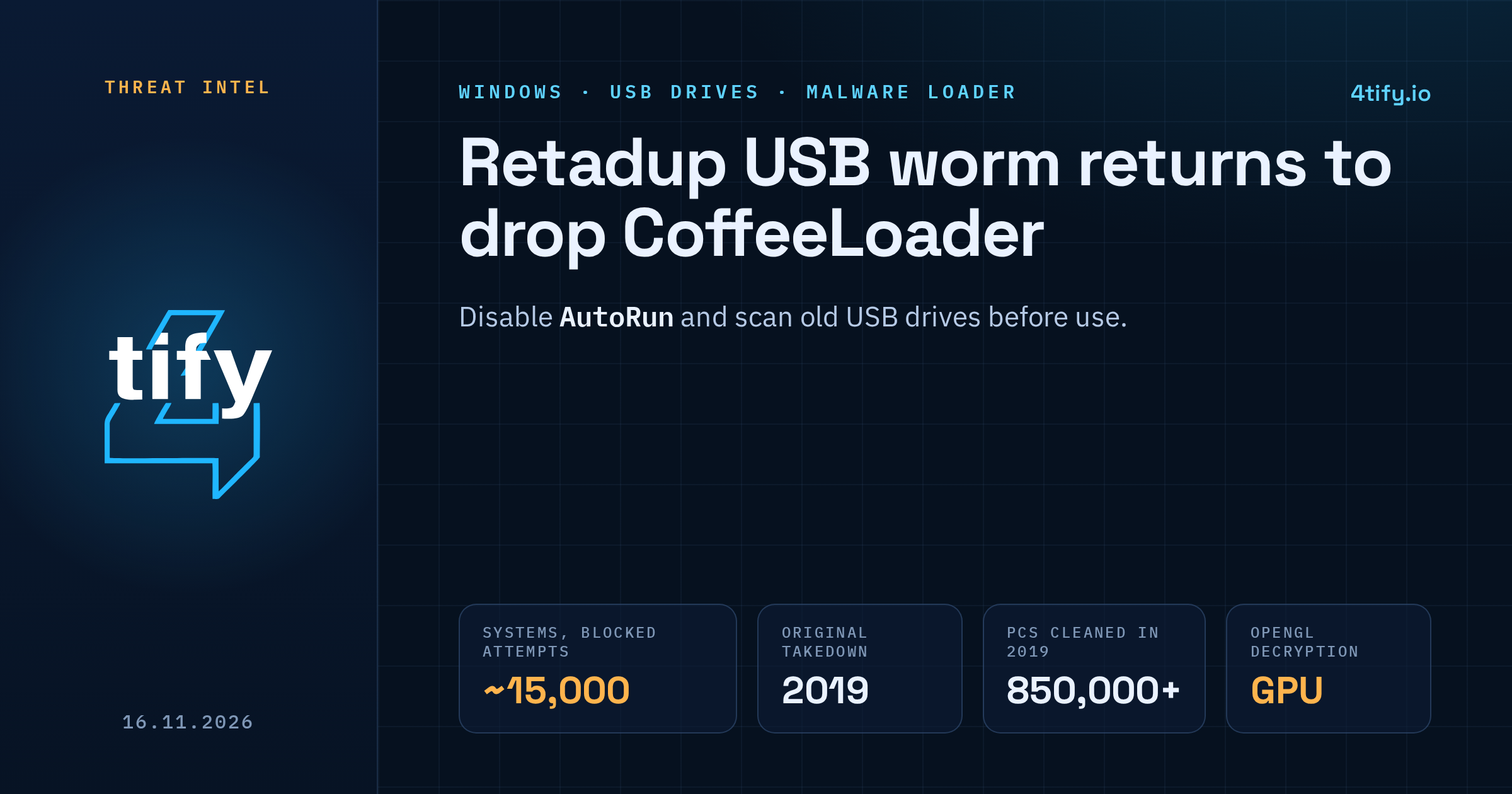
Retadup USB worm is back, seven years after its takedown, and now drops CoffeeLoader
Retadup, a Windows worm that French law enforcement neutralised in 2019, is infecting machines again. Someone has re-registered the worm's old command-and-control domains, and copies still sitting on forgotten USB sticks and offline PCs are calling home to them. Since early 2025 those servers have answered with CoffeeLoader, a stealthy loader built to install whatever malware its operators choose next.
What happened
Retadup first appeared in 2017. It is written in AutoIt and spreads the old-fashioned way: it copies itself onto every connected USB stick or external disk as hidden files plus shortcut (LNK) files. When someone plugs that drive into another computer and clicks a shortcut, the worm runs, joins a botnet and waits for instructions.
In July 2019 the French Gendarmerie took over the botnet's servers and told infected machines to delete the worm. More than 850,000 computers were cleaned within weeks. The servers went quiet, but the infected drives did not disappear.
Around 2024 the expired domains were registered again. At first they handed out the SmokeLoader malware. In early 2025 they switched to CoffeeLoader, and a new variant of that loader was seen in the wild in August 2026. It is still unknown whether the original author or a different group revived the servers.
Who is affected
Security software blocked Retadup infection attempts on about 15,000 Windows systems between January and September 2026, most of them in Peru, Angola, Russia and Bolivia. Those are blocked attempts, not confirmed infections, and they only cover machines that had protection installed. The campaign is far smaller than the 2019 botnet, but any organisation where old drives, kiosks or rarely updated PCs are still in use can be exposed.
How the attack works
- A worm copy on an old drive or PC contacts one of the revived domains and downloads an installer.
- The installer drops a tampered copy of the 7-Zip library (
7z.dll) into a temporary folder and runs it withrundll32.exe. - Part of that library has been replaced with encrypted code that uses the graphics card to decrypt itself. The new version uses OpenGL for this step (the previous one used OpenCL), which makes analysis in sandboxes and virtual machines harder.
- The loader copies itself into a folder under
%ProgramData%or%LocalAppData%named with eight hexadecimal characters, adds an autorun entry under theRunregistry key and editsStartupApproved\Runso the entry can't simply be switched off in Task Manager. - It injects itself into legitimate Windows processes such as
dllhost.exe,WerFault.exeorsvchost.exe, then fetches signed, encrypted instructions over HTTPS. It can inject a payload into a process, or save and run it as an executable or a DLL.
CoffeeLoader's job is delivery. Its operators can use it to install infostealers, ransomware or any other second-stage malware.
What to do now
- Turn off AutoRun/AutoPlay for removable media across your Windows fleet through Group Policy. CISA's guidance on USB drives sets out the essentials, including never plugging in drives of unknown origin.
- Scan old drives before opening anything on them. Show file extensions and treat any
.lnkfile at the root of a USB stick as suspicious. - Check old or offline computers before reconnecting them, ideally with a bootable rescue scanner prepared on a clean machine.
- Hunt for the persistence pattern:
rundll32.exelaunching a DLL from an eight-hex-character folder underProgramDataorAppData\Local, with a matchingRunvalue. - Block known infrastructure at DNS and proxy level, including the revived domains
alphanoob[.]com,newblackage[.]comandradnewage[.]com, and the loader's serverinternet-speed-check[.]com. - Keep offline backups, so that a later ransomware payload does not take your only copy of the data.
Forgotten hardware is hard to see from the outside. Internal vulnerability scanning is the service our team uses to find endpoints that still allow AutoRun, run outdated software or were never enrolled in endpoint protection, before an old USB stick finds them first.