

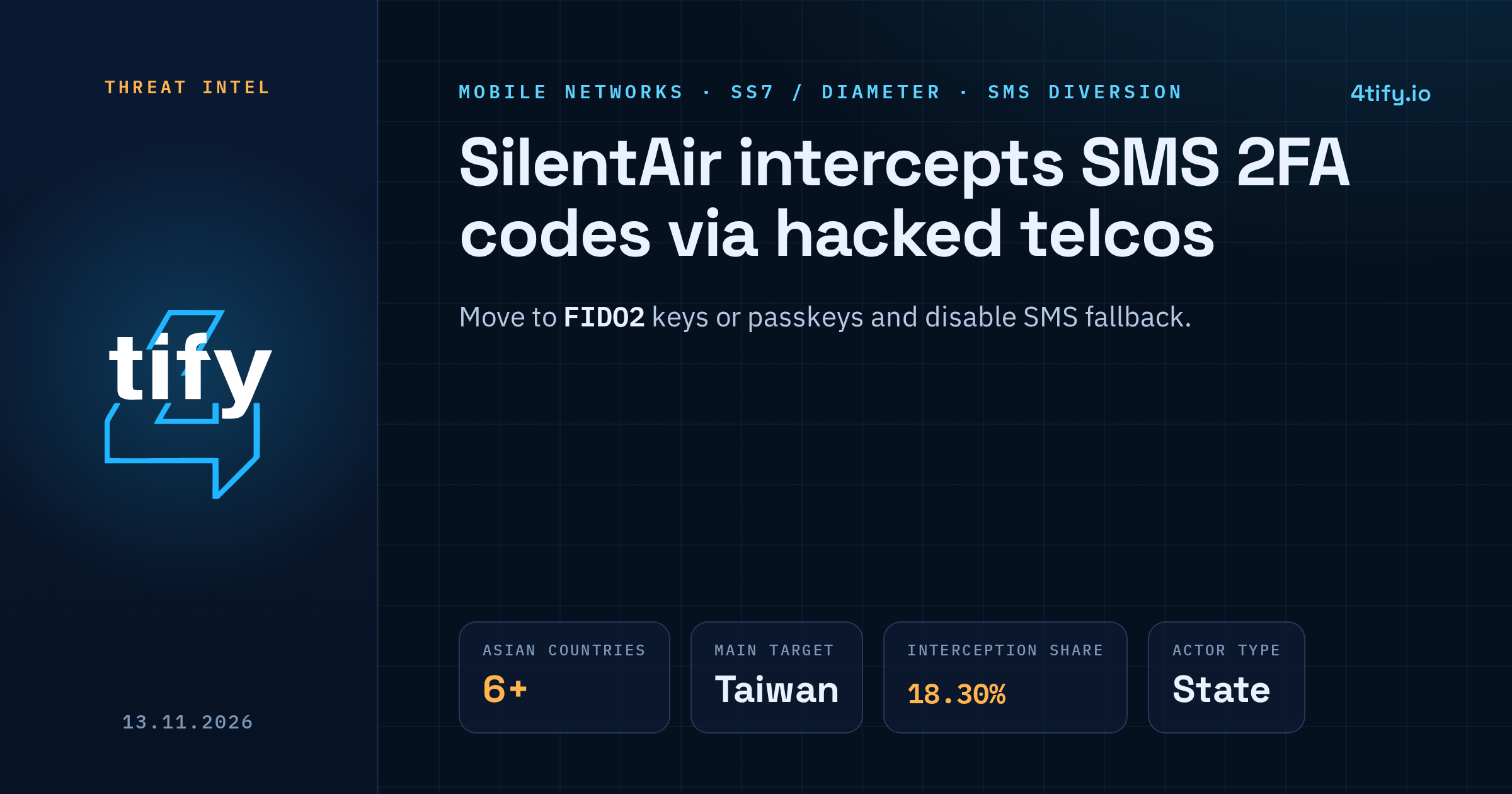
SilentAir hijacked Asian telecom networks to intercept SMS 2FA codes
A state-level espionage group tracked as SilentAir has been using hacked equipment inside Asian mobile operators to divert the calls and text messages of selected people, most of them in Taiwan. In some cases, two-factor authentication (2FA) codes sent by SMS arrived at the attackers' equipment moments after a diversion took effect.
The activity was made public on 11 November 2026. The group is assessed with high confidence to be a state-level actor. A link to China is rated low confidence only.
What happened
Mobile operators route calls, texts and roaming through signalling protocols called SS7 (older 2G/3G networks) and Diameter (4G). Operators exchange that traffic over a shared interconnect, the IPX, and largely trust what arrives from other operators.
SilentAir sent its attacks from compromised nodes inside the operators' own networks, not from spoofed outside addresses. Malicious signalling sources were found at operators in at least six Asian countries, with more suspected. Their targets were subscribers in roughly a dozen further countries and territories, with Taiwan at the top of the list.
Unusual signalling from these operators has been tracked since early 2025, and there are signs it started earlier. The countries, operators and individual targets have not been named publicly.
How the interception works
To take over a person's calls and texts, the attackers sent the target's home network an SS7 UpdateLocation message, or the Diameter equivalent. The message claimed that the hacked node was now serving the target's phone. If the home network accepted it, that person's incoming calls and SMS were routed to the attackers instead of the handset.
Interception made up 18.30% of SilentAir's observed activity. For the commercial surveillance firms behind most signalling attacks, the comparable figure is 2.07%. In other words, this group was far more interested in reading messages than in simply locating people.
The group also sent silent SMS on a large scale, mostly to subscribers in Taiwan and mostly around midnight. A silent SMS does not show up or ring on the phone. If the test message landed on the attackers' node rather than the handset, they knew the diversion was still working. The texts carried spam-like content, so a recipient who did see one would likely ignore it.
There is no public evidence that any online account was actually taken over, and the purpose of the night-time silent SMS has not been confirmed.
Who was targeted
Attacks came in bursts, from a handful of subscribers up to several thousand in a single month, with gaps of several months between waves. Some targets were political and government figures in their own countries.
The low-confidence China assessment rests on several signals: the Taiwan focus, no Chinese networks or subscribers among the targets, and activity that followed a UTC+8 working day starting around 9 a.m., dropped almost to zero at weekends and paused around Chinese holidays.
A connection to Liminal Panda, a known group that attacks telecom operators, is considered possible but is not confirmed. Separately, Liminal Panda's GTPDoor backdoor was blocked at several operators from the first quarter of 2026, with 5 to 10 operators assessed as infected. A new GTPDoor variant hides commands in GTP-U, the part of the protocol that carries user data, and appears to serve mainly as a backup channel.
The operators hosting SilentAir sources have been notified, and the activity is described as disrupted for now. Nothing public says whether the hacked equipment has been cleaned up, and the same techniques remain open to anyone who gets a similar foothold.
What to do now
If you run a mobile network:
- Treat everything arriving over the IPX as untrusted and inspect it in depth.
- Monitor signalling inside your own network, not only at the border. This attack came from internal nodes.
- Deploy GTP-C and GTP-U firewalls and have them share data with your SS7 and Diameter firewalls.
- Feed signalling security alerts into the same monitoring as the rest of your IT security.
If you run an online service or manage staff accounts:
- Stop treating an SMS code as strong proof of identity. Anyone who can redirect a phone number can receive it.
- Move staff and high-value users to phishing-resistant MFA (FIDO2 security keys or passkeys), then remove SMS as a fallback. Leaving it enabled keeps the weak path open. CISA's mobile communications guidance makes the same point: SMS is not encrypted and can be read by an attacker inside a carrier's network.
- Check password reset and account recovery flows. An SMS-only recovery path cancels out a strong login.
If you are a likely target (government, politics, journalism, executives), prefer end-to-end encrypted messaging over plain SMS and calls, and switch your important accounts to an authenticator app or security key.
Weak recovery paths and forgotten SMS fallbacks are easy to miss. A penetration test of your login, MFA and account recovery flows is one way to find out whether a stolen text message would be enough to get into your systems, and our team runs that kind of test.