

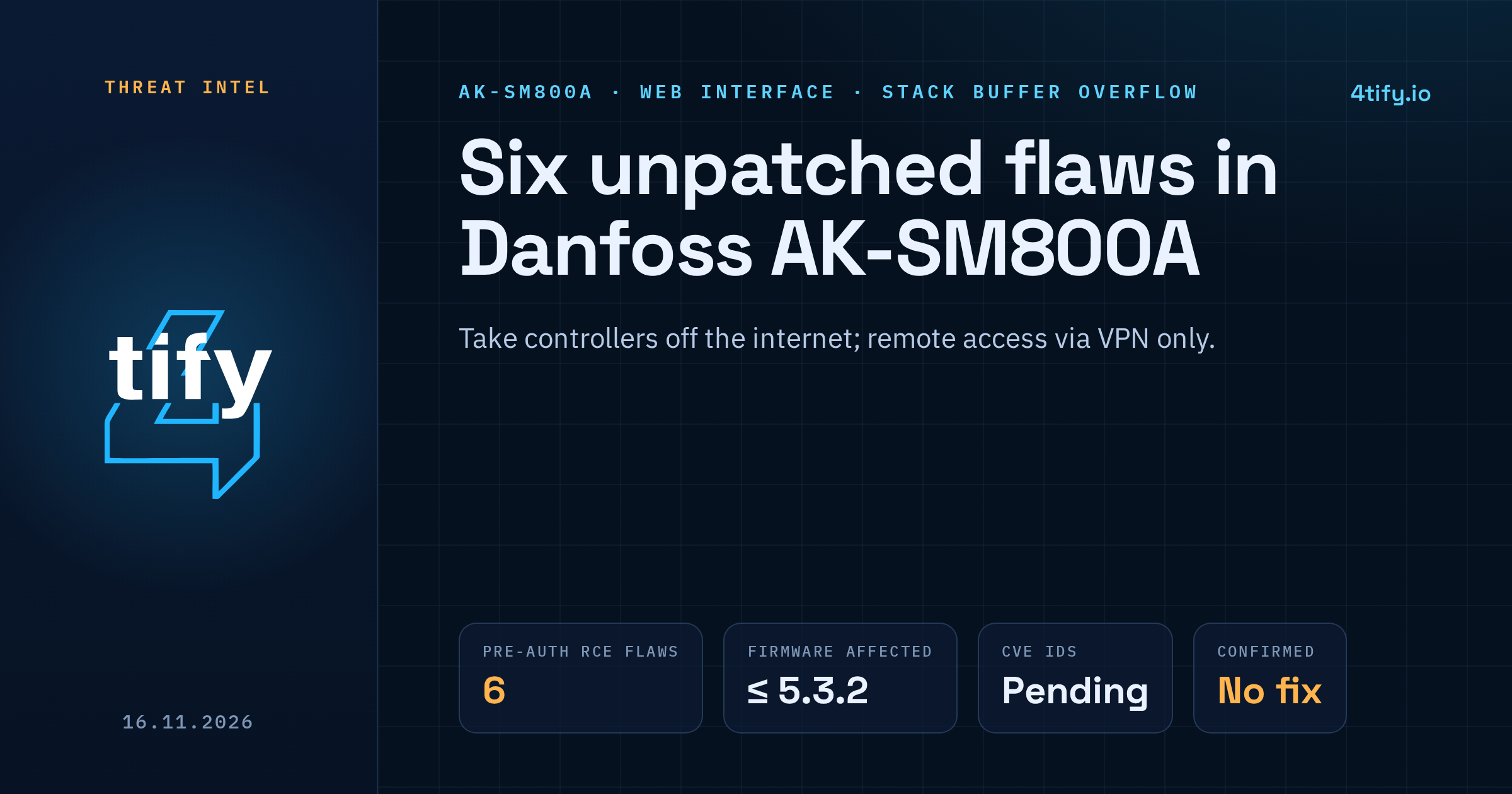
Six unpatched flaws let attackers take over Danfoss AK-SM800A refrigeration controllers
Six newly found vulnerabilities in the Danfoss AK-SM800A, a system manager that runs refrigeration in supermarkets and cold stores, let a remote attacker run code on the controller without logging in. There is no CVE yet and no confirmed fix. For owners, the only reliable protection right now is to take these controllers off the internet.
What happened
The AK-SM800A sits at the centre of a store's cooling setup. It schedules defrost cycles, holds temperature setpoints for display cases and cold rooms, and is usually managed through a web interface, often remotely by a refrigeration contractor.
Security researchers reviewing the firmware found six stack-based buffer overflows in code that handles web requests before any login check. The device's main web application copies attacker-supplied text into fixed-size buffers without checking its length, and the binaries are built without stack canaries or address randomisation. That combination makes the bugs practical to turn into remote code execution.
The disclosure is still being coordinated with Danfoss. CVE identifiers are pending and the technical details are being held back until that process ends.
Who is affected
Every AK-SM800A firmware release up to and including 5.3.2 is affected. No firmware release has been confirmed to fix these six flaws, so treat every controller as exposed, including recently updated ones, until Danfoss publishes an advisory that says otherwise.
Two details make this worse than an ordinary web bug:
- Strict mode does not stop all of them. Danfoss made its "Strict" session control the default from software 4.0. One of the six flaws sits in the component that enforces that mode and can be triggered before authentication with Strict switched on.
- No secure boot. The controllers do not use the secure boot features of their i.MX6 processor. An attacker who gains root could plant code that survives a factory reset or a firmware update, or leave the unit unusable.
Why this matters now
Refrigeration controllers are already under attack. France's national CERT issued alert CERTFR-2026-ALE-012 on 12 October 2026 after numerous compromises of remotely reachable refrigeration controllers, naming the Danfoss AK-SM and AK-SC series alongside Copeland and Dixell xweb units. Attacks began on 11 October, a second wave followed on 2 November, and CERT-FR expects the campaigns to continue.
In the United States, CISA, the FBI and three other federal agencies published a joint fact sheet on 5 November urging operators to lock down refrigeration and cold chain monitoring systems.
There is no evidence so far that the six new flaws were used in those attacks. The point is simpler: attackers are already hunting for these controllers online, and a pre-login code execution bug is exactly what they would want next.
What to do now
- Remove direct internet exposure. Find every AK-SM800A (and any other refrigeration controller) reachable from a public IP address and disconnect it from the internet. Danfoss's own guidance already says the unit should never sit on an open public network.
- Put remote access behind a VPN. Let contractors in only through a secure VPN or a private APN. Allowing only their IP addresses on a firewall is acceptable as a short-term emergency step, not a permanent setup.
- Check your contract before cutting data feeds. If your refrigeration service provider receives data from the controller, confirm what your maintenance and insurance terms require, then set up a protected path for that monitoring.
- Review the configuration. Look at temperature setpoints, defrost schedules, alarm settings, user accounts and remote access settings for anything you did not change. If you suspect tampering, change all credentials and follow CERT-FR's advice to reset and reconfigure the unit before putting it back in service.
- Keep firmware current and Strict mode on. These steps do not close the six new flaws, but they shut out older, already-public bugs. Units that no longer receive updates should not be internet-facing at all.
- Watch for the Danfoss advisory. When CVE IDs and a fixed firmware are published, plan the update quickly.
The controllers compromised in the recent attacks were reachable from the internet. Our Attack Surface Management service continuously maps the hosts and devices an organisation exposes online, including management interfaces like these, so forgotten equipment gets flagged before an attacker finds it.