

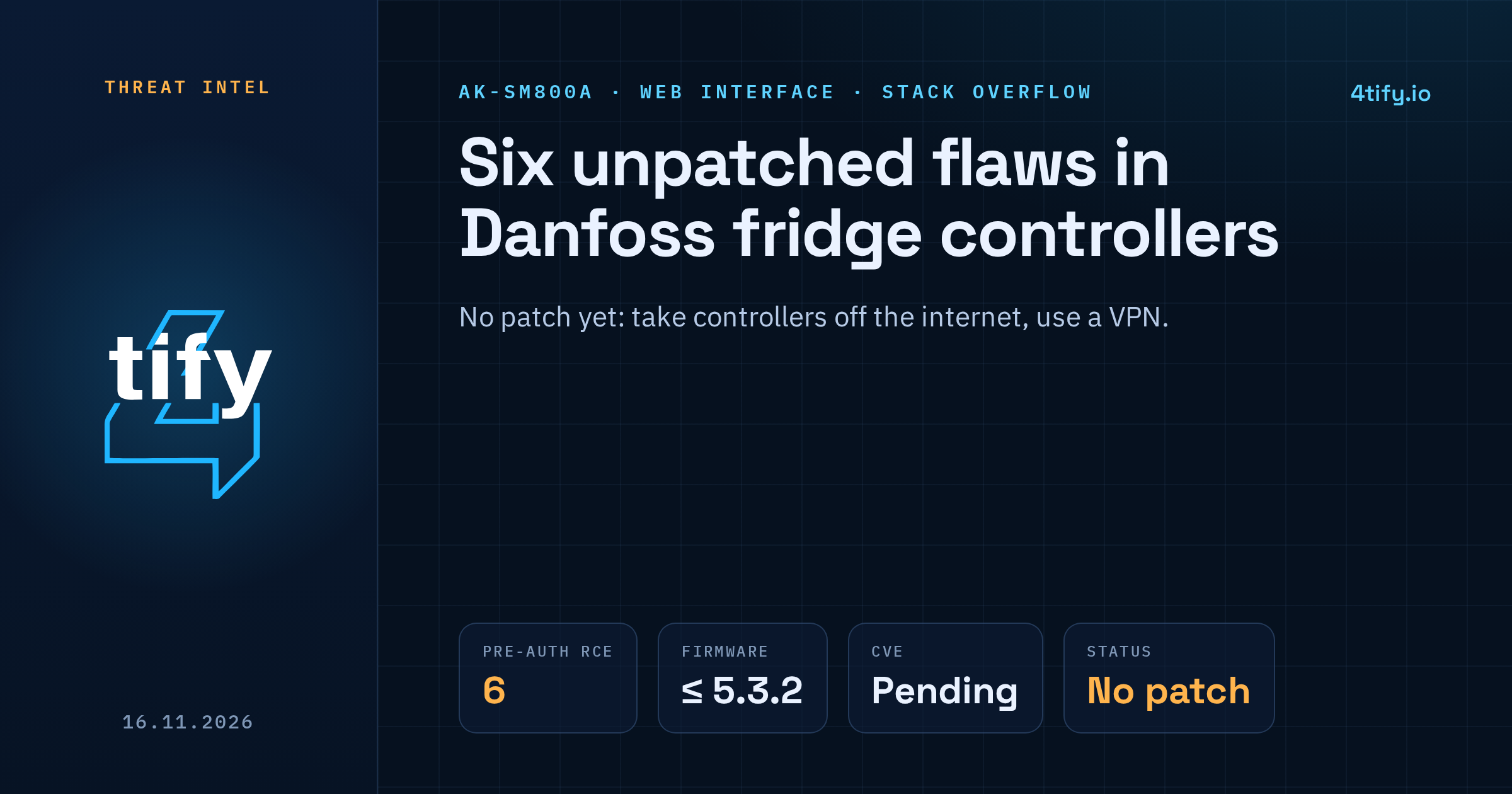
Six new remote code execution flaws have been found in the Danfoss AK-SM800A, the system manager that runs refrigeration in many European supermarkets. All six can be triggered without logging in. There is no patch and no CVE yet, and the controllers involved are the same kind attackers have been switching into defrost mode since October.
What happened
The six bugs are stack-based buffer overflows in the controller's web software. They come from unbounded strcpy() calls in request handlers that answer before any login. Send a long enough value and the program writes past its memory buffer. The main application runs as root and was built without stack canaries or position-independent code, two standard protections that make this kind of bug much harder to turn into an exploit.
A working root exploit has been shown against an older firmware release. The researchers say the same bugs are still present in version 5.3.2. Full technical details are being held back while disclosure with Danfoss continues, and CVE numbers are still pending.
Why strict mode does not close the gap
Since firmware 4.0, Danfoss ships the AK-SM800A with "strict" session control as the default. In that mode almost the whole web interface is closed to anyone who has not logged in, and CERT-FR lists it among its recommended measures. One of the six flaws sits in sm_fcgi_app, the very component that enforces that session control. It is reachable before authentication even with strict mode switched on, so this setting alone does not protect an exposed unit.
The hardware makes things worse. The controllers do not use the secure boot features of their i.MX6 processor, so an attacker with root could install code that survives a factory reset. They could also wipe the flash or push broken firmware and leave the store with a dead controller until the hardware is replaced.
Who is affected
- Danfoss AK-SM800A system managers running firmware up to and including 5.3.2. No fixed version has been announced.
- Any site where the controller's web interface can be reached from the internet, directly or through a maintenance contractor's 4G modem.
Internet scans from mid-November still show hundreds of Danfoss systems online, plus more than 1,000 Copeland and Dixell controllers.
The attacks so far
On 11 October 2026 attackers reached internet-facing refrigeration controllers in French supermarkets and set them to defrost overnight, with food still inside. A second wave on 2 November hit stores in Belgium, Luxembourg, the Netherlands, Sweden, Estonia, Ireland and Portugal. Stock losses run into tens of millions of euros and some stores reported fires. CERT-FR alert CERTFR-2026-ALE-012 covers Danfoss AK-SM and AK-SC, Copeland xweb and Dixell xweb devices and warns that the campaigns are probably still running. US agencies including CISA and the FBI issued a joint warning on refrigeration and cold-chain controllers on 5 November.
Two points are still open. Nobody has shown that these six new flaws were used in the attacks; earlier reporting pointed to exposed admin pages and weak or default passwords. And attribution remains disputed.
What to do now
- Take the controllers off the internet. This matters more than any single patch. List every AK-SM, AK-SC, xweb or similar unit with a public IP address, including the ones behind integrators' 4G routers.
- Put remote access behind a VPN or a private APN. Filtering by the contractor's IP address can work as a stopgap, but CERT-FR is clear that it is not a long-term answer.
- Check the configuration, especially defrost schedules and alarm thresholds, and change any default passwords.
- Update firmware and keep strict session control on. It will not stop these six bugs, but it still closes most of the web interface to anyone who has not logged in. Danfoss lists the earlier fixes on its security advisories page.
- If a unit was compromised, a factory reset is not enough on its own. Remove the exposure first, then rebuild and reconfigure before putting it back in service.
Most of the damage in this campaign came from one thing: devices nobody remembered were reachable from the internet. Our Attack Surface Management service is built to find exactly that, by mapping the IP ranges and hosts an organisation exposes and flagging management interfaces such as refrigeration or building controllers before someone else finds them.