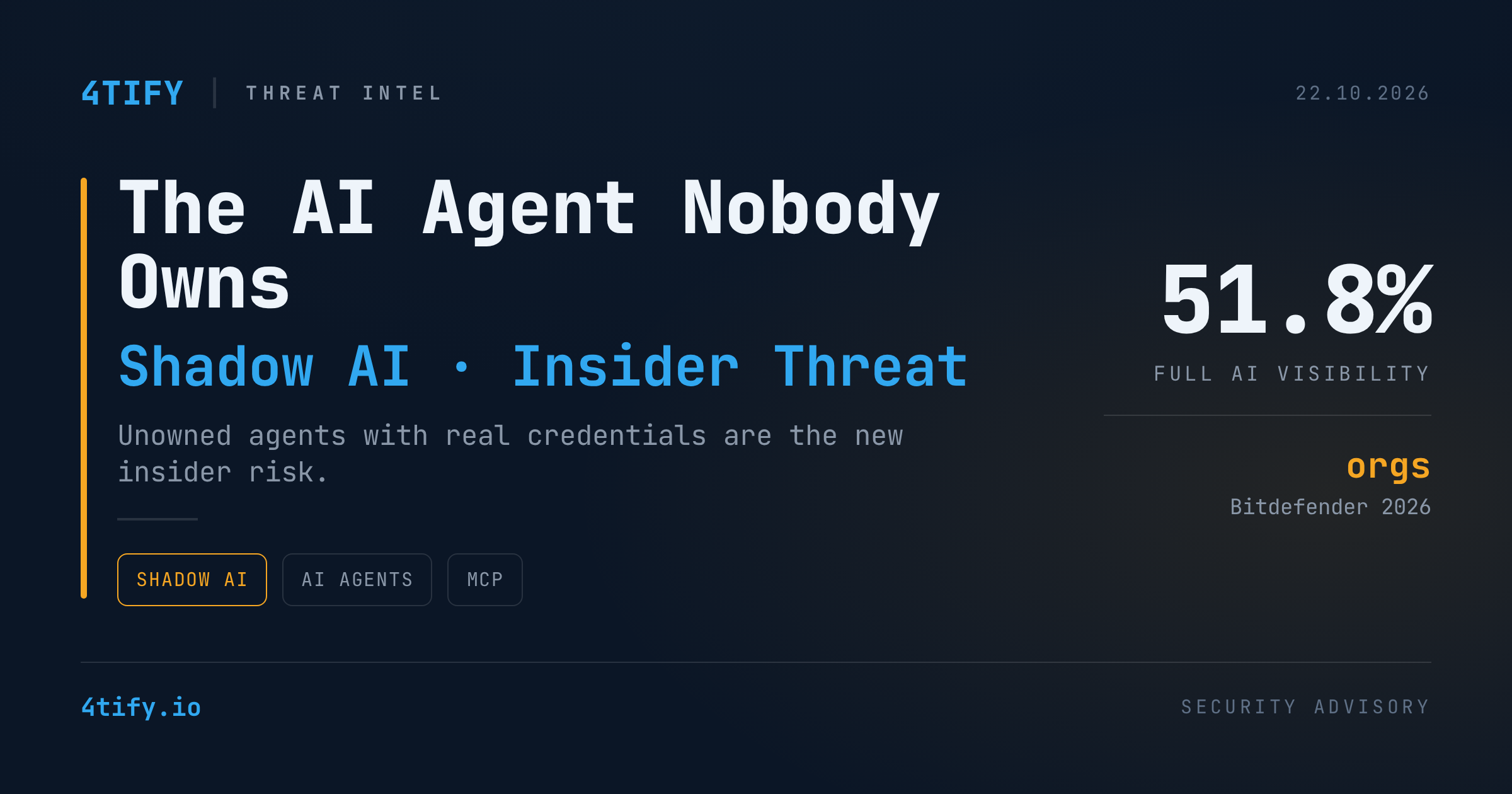
The AI Agent Nobody Owns: Shadow AI Is Becoming an Insider Threat
Somewhere on your network there is probably an AI agent with API keys, database passwords and access to internal systems — and no one is accountable for it. If a human employee had that much reach with that little oversight, we would call it an insider risk. It's time to treat autonomous AI the same way.
What's happening
AI is no longer confined to developer laptops. Coding assistants, autonomous agents, MCP (Model Context Protocol) servers and AI-powered browser extensions are spreading across every department, often installed by staff without security review. Many of them talk directly to cloud APIs and never pass through the network gateway in a way traditional tools would flag.
The result is an uncomfortable irony: the AI tools with the most access are frequently the ones security teams can see least.
Why it matters
The visibility gap is measurable. Bitdefender's 2026 Cybersecurity Assessment report found that only 51.8% of organizations say they have full visibility into the AI tools their employees use — leaving nearly half working partly blind. IBM, for its part, found that 20% of breached organizations were compromised through shadow AI.
The threat isn't theoretical either. Bitdefender Labs, analyzing what actually runs on real endpoints, reports finding a malicious agent skill in the wild — a reminder that the AI supply chain (skills, plugins, MCP servers) is now an attack path in its own right.
An agent that holds credentials, acts autonomously and has no named owner combines the worst traits of an over-privileged service account and an unmanaged endpoint.
What to do
- Inventory AI on endpoints. Find the agents, assistants, MCP servers and browser extensions actually running — not just the ones procurement approved.
- Assign an owner to every agent. Each one needs a responsible person, a documented purpose and a review date.
- Scope and rotate credentials. Give agents least-privilege, short-lived tokens; never long-lived admin keys or shared database passwords.
- Vet the AI supply chain. Treat skills, plugins and MCP servers like third-party code: allow-list sources and review before install.
- Log agent actions. Make sure agent activity lands in your SIEM so anomalous behavior is visible.
- Govern rather than ban. Outright blocking tends to push usage further underground; a sanctioned, monitored path for AI adoption usually works better.
You can't govern what you can't see. That is exactly where Attack Surface Management helps: our team continuously maps the services, endpoints and exposed integrations that make up your real attack surface — including the AI tooling and connectors that quietly appear outside official inventories.
Background: this analysis draws on a webinar briefing published by The Hacker News featuring Bitdefender ("AI as an Insider Threat: From Shadow AI to Governed AI").