

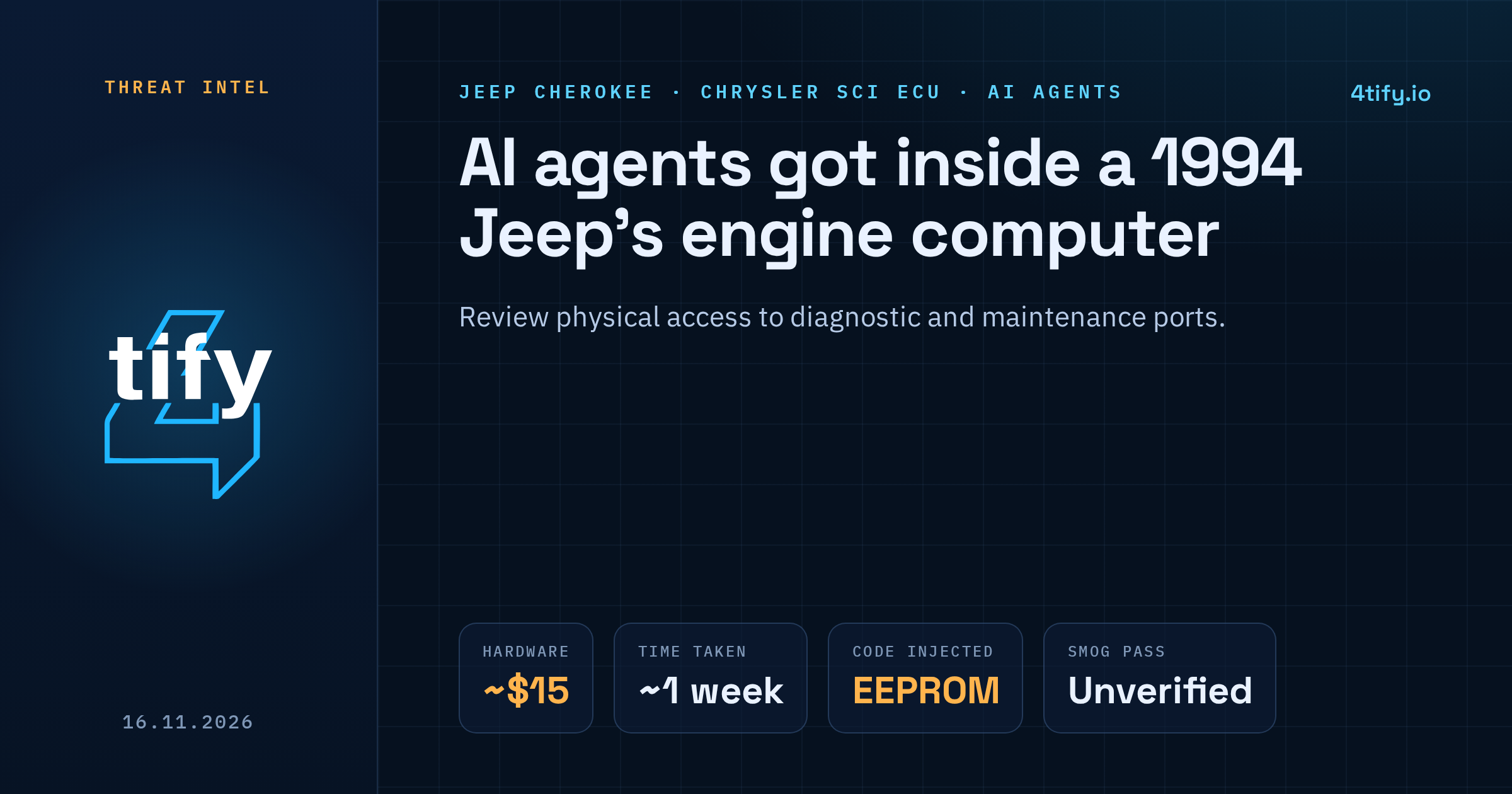
Two AI coding agents got inside a 1994 Jeep's engine computer
A Jeep owner in California has published the code and notes from a week-long project in which two AI coding agents, Claude Code and OpenAI's Codex, read, copied and then ran new code inside the engine computer of a 1994 Jeep Cherokee. The hardware cost about $15. The car had kept failing the state's smog test, and the owner says it passed after several more attempts. Nobody has verified that result independently.
The story matters less for the Jeep than for what it shows about speed. Work that used to take a specialist with years of experience on obscure automotive protocols took one owner and two agents roughly seven days.
What happened
The Cherokee XJ, with the 4.0-litre engine, failed California's emissions test on nitrogen oxides (NOx) at the 25 mph stage. It is too old for an OBD-II port, so ordinary scan tools could not talk to it.
The owner connected a $3 Arduino Nano clone to the car's six-cavity diagnostic plug with three wires and handed the problem to the agents. The agents worked out that the engine computer speaks Chrysler's SCI protocol at roughly 7,800 baud, with the signal inverted compared with a normal serial port. The Nano acted as the translator between the car and a laptop.
From there the project moved in steps:
- Reading. The agents pulled fault codes and live engine data, and logged drives at the speeds used in the test.
- A wrong turn. An early reading suggested the engine was adding about 22% extra fuel. That turned out to be a misread formula in a public parameter table, not a real fault.
- Control. The agent switched the fuel pump on by command. This was the point where the setup stopped being read-only.
- Copying. The agents dumped the computer's entire program to the laptop. The owner suspects a California-specific fuel table is behind the NOx failure, but offers this as a hypothesis, not a confirmed cause.
- Running code. This unit was built too early to be reprogrammed the normal way. Codex instead found a route to place custom code in the computer's EEPROM, memory that survives a disconnected battery, and have the computer run it.
Who is affected
No vulnerability has been disclosed here and no CVE exists. The project targets 1991 to 1995 Chrysler and Jeep engine computers of the same family, needs physical access under the hood, and was tested on a single car. The repository is published under GPLv3 and carries an explicit "use at your own risk" warning. It also warns that one cavity of the diagnostic plug carries 12 volts with the key on and will damage the board if connected.
What has not been disclosed matters too. The owner has not explained what the injected code does, so it is impossible to say whether the smog pass came from the software, a repair, or conditions on test day.
Why security teams should care
Old embedded systems have long been protected mainly by obscurity: undocumented protocols, scarce tooling and few people who still remember how they work. That protection is getting thinner. An AI agent with a cheap microcontroller and a shell can now read protocol notes, write a bridge, test hypotheses against live hardware and recover from its own mistakes in days.
The same applies to industrial controllers, building management systems, medical devices and any other legacy equipment still running in production. The agents also made real changes to a live system (running the fuel pump, writing to memory) once the owner let them. On a test bench that is a feature. On production equipment it is a risk.
What to do now
- Stop counting on obscurity. If an old device is safe only because nobody knows its protocol, assume that no longer holds. Review physical access to diagnostic ports, serial headers and maintenance interfaces.
- Inventory the legacy kit. List embedded and end-of-life systems on your network and on site, including those no vendor still supports.
- Keep agents on a short leash. If your teams use coding agents near hardware or production systems, require human approval before any command that writes, actuates or changes state, and keep a log of what ran.
- Test it before someone else does. A penetration test that covers physical and legacy interfaces is the practical way to learn what an attacker with a $3 board and an AI agent could reach. Our team runs these tests on embedded and older systems as well as on modern applications.