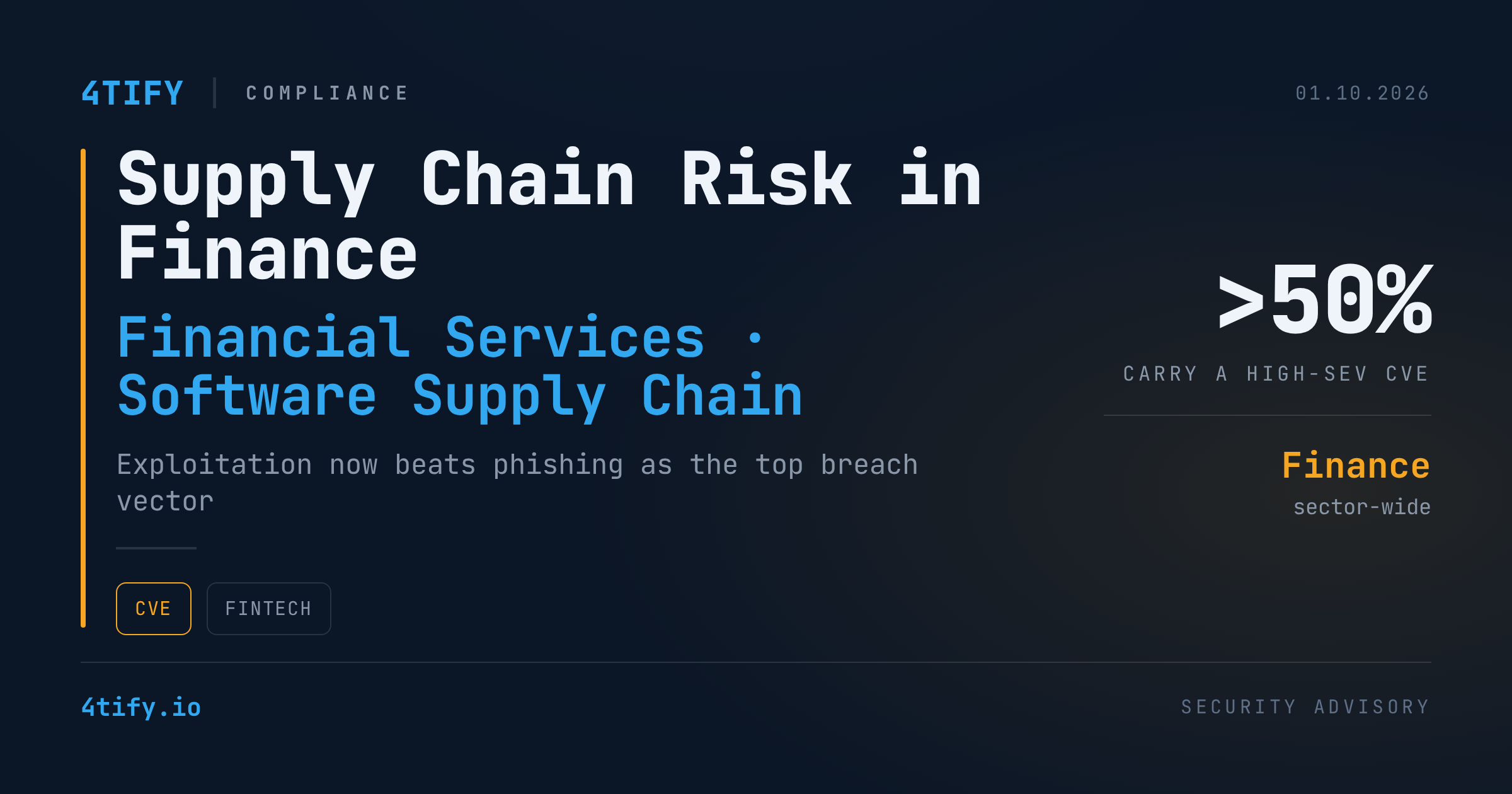
Why Financial Institutions Must Rethink Software Supply Chain Risk
Banks, insurers, and asset managers have long treated a vulnerability backlog as an acceptable cost of doing business — exceptions, compensating controls, and patch cycles measured in months rather than days. That calculus is breaking down.
What's changed
Industry data now shows vulnerability exploitation has overtaken phishing as the leading initial access vector into financial services firms, and more than half of institutions in the sector are carrying at least one unresolved high-severity CVE at any given time. Automated and AI-assisted exploitation tooling has collapsed the gap between a vulnerability going public and it becoming weaponized — often faster than normal patch and change-management cycles can keep up.
Why it matters
The instinct inside most security teams is to point at applications: refactor the monolith, upgrade the runtime, re-test the data flows. But the riskiest layer usually isn't the application code teams actively maintain — it's the software supply chain underneath it. Base container images, open-source libraries, and build tooling get selected once and then left untouched for years.
In regulated environments where every change requires sign-off, that "set and forget" layer is exactly where exposure quietly accumulates — and it stays invisible to teams that have never properly inventoried what's actually running.
What to do about it
Treat the supply chain as something engineered for security by default, not something patched reactively:
- Standardize on hardened, minimal base images that are rebuilt continuously from patched upstream sources, so vulnerabilities are closed automatically instead of rediscovered in the next scan.
- Maintain a signed SBOM and verifiable provenance for every artifact, so "what's running" and "how is it maintained" have a fast, defensible answer during an audit or an incident.
- Roll trusted base images out centrally through shared platform and registry pipelines, instead of asking every application team to re-research and re-harden the same dependencies on its own.
- Stop treating the status quo as the zero-risk option. Every deferred modernization cycle compounds the volume of emergency patching, audit findings, and triage work competing with feature delivery.
Modernizing the supply chain is a smaller, more reversible change than modernizing every application built on top of it — and it pays down risk continuously, instead of deferring it to the next exception review.