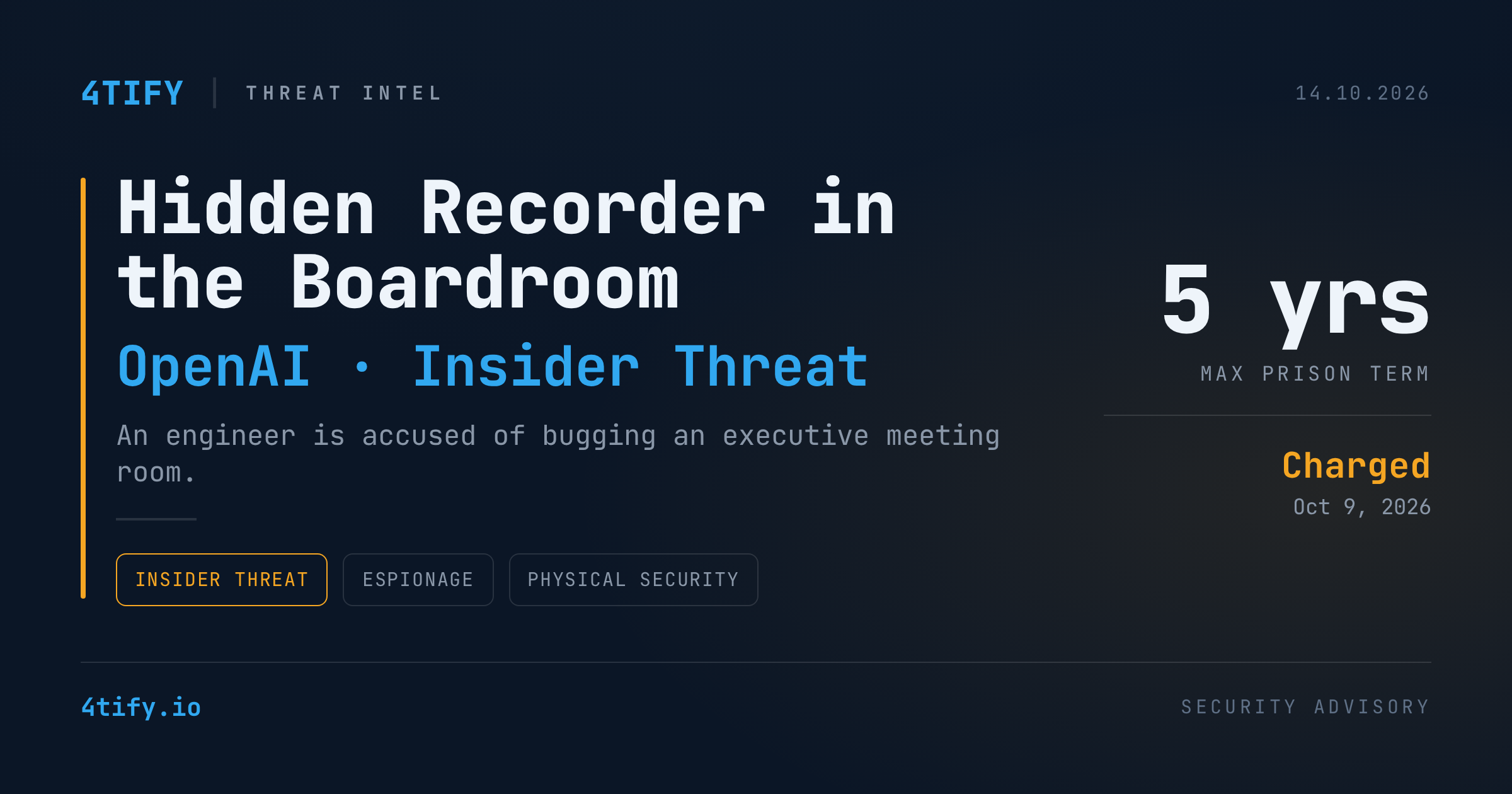
OpenAI Engineer Charged Over Hidden Recorder in Executive Meeting Room
US federal prosecutors have charged an OpenAI engineering lead with allegedly planting a covert audio recording device inside an executive conference room at the company's San Francisco offices. The case is a sharp reminder that the most damaging threat to an AI lab's secrets may not arrive over the network at all — it may already have a badge.
What happened
According to the US Department of Justice, a 35-year-old engineer who had worked at OpenAI since July 2025 was arrested on October 9, 2026, and charged with using, or attempting to use, a device to intercept oral communications. He has since been terminated. As with any criminal complaint, these are allegations and he is presumed innocent unless proven guilty.
The complaint lays out the following timeline:
- Around September 28, 2026 — a small recording device, reportedly wrapped in toilet paper, was allegedly inserted into a USB port on the back of a television in an executive conference room.
- Around September 30 — OpenAI staff discovered the device. The room was reserved for highly confidential discussions: research, product plans, business development, strategy, and government engagements.
- CCTV review — footage reportedly placed the engineer near the room on several dates before the discovery, despite him having no role in the meetings held there.
- Reconnaissance — before the device appeared, he allegedly used an internal productivity tool to map building addresses, meeting rooms, room capacities and calendars, including "leadership and exec" spaces.
- AI-assisted build — investigators say a chatbot account linked to his spouse was used in late September for prompts about building a continuous audio recorder, adding Wi-Fi connectivity, improving live listening, and encrypting the SD card — plus prompts tied to the device's specific hardware identifiers.
- October 5 — he allegedly re-entered the conference room and looked behind the television. The same day, a bag left in another OpenAI building reportedly held a second recording device, along with his wallet and ID.
OpenAI said it used its own AI models to understand the device and trace its origin before referring the matter to the FBI. The company described the hardware as including advanced encryption, audio monitoring capabilities, and a mechanism for moving data designed to evade monitoring. It added that, so far, it has no indication that model weights, source code, or customer data were accessed or exfiltrated.
The FBI framed the case as a counterintelligence priority. If convicted, the defendant faces up to five years in prison and a $250,000 fine. No motive or third-party involvement has been publicly confirmed.
Why it matters
- Insiders bypass perimeter controls. Every step alleged here — room booking lookups, physical access, a USB port on a meeting-room TV — used legitimate access. No firewall, EDR, or MFA prompt sits in that path.
- Physical and digital security converge. The device was hardware, but the reconnaissance was digital (calendar and facilities data), and the build was reportedly assisted by a public AI chatbot.
- Executive spaces are high-value targets. Boardrooms concentrate strategy, M&A, regulatory and R&D conversations — exactly what competitors or state actors want.
- Detection worked — but late. The device was found within days and CCTV supported the investigation. Most organizations would not have the logging to reconstruct a timeline that quickly.
What to do
- Sweep sensitive rooms regularly. Schedule technical surveillance countermeasure (TSCM) sweeps for boardrooms and executive offices, and inspect AV equipment, TVs, and conference phones for unexpected attachments.
- Lock down physical ports. Disable or physically block unused USB ports on meeting-room displays and AV gear; use tamper-evident seals and check them.
- Treat room calendars as sensitive data. Restrict who can see executive meeting schedules and room metadata, and alert on unusual bulk lookups of "leadership" calendars or facilities data.
- Correlate badge, CCTV, and booking data. Flag access to restricted rooms by people with no meeting there, especially outside normal hours.
- Run a real insider-risk program. Pair HR, legal, physical security, and the SOC; define clear reporting channels; apply least privilege to internal tools — not just production systems.
- Prepare a playbook for found devices. Preserve evidence, avoid tipping off the suspect, involve legal early, and know when to bring in law enforcement.
Not sure how exposed your internal tools and physical-digital touchpoints are? 4Tify's assessments help you map where trusted access turns into risk — before someone else does.
Reporting based on the US Department of Justice criminal complaint and coverage by The Hacker News.