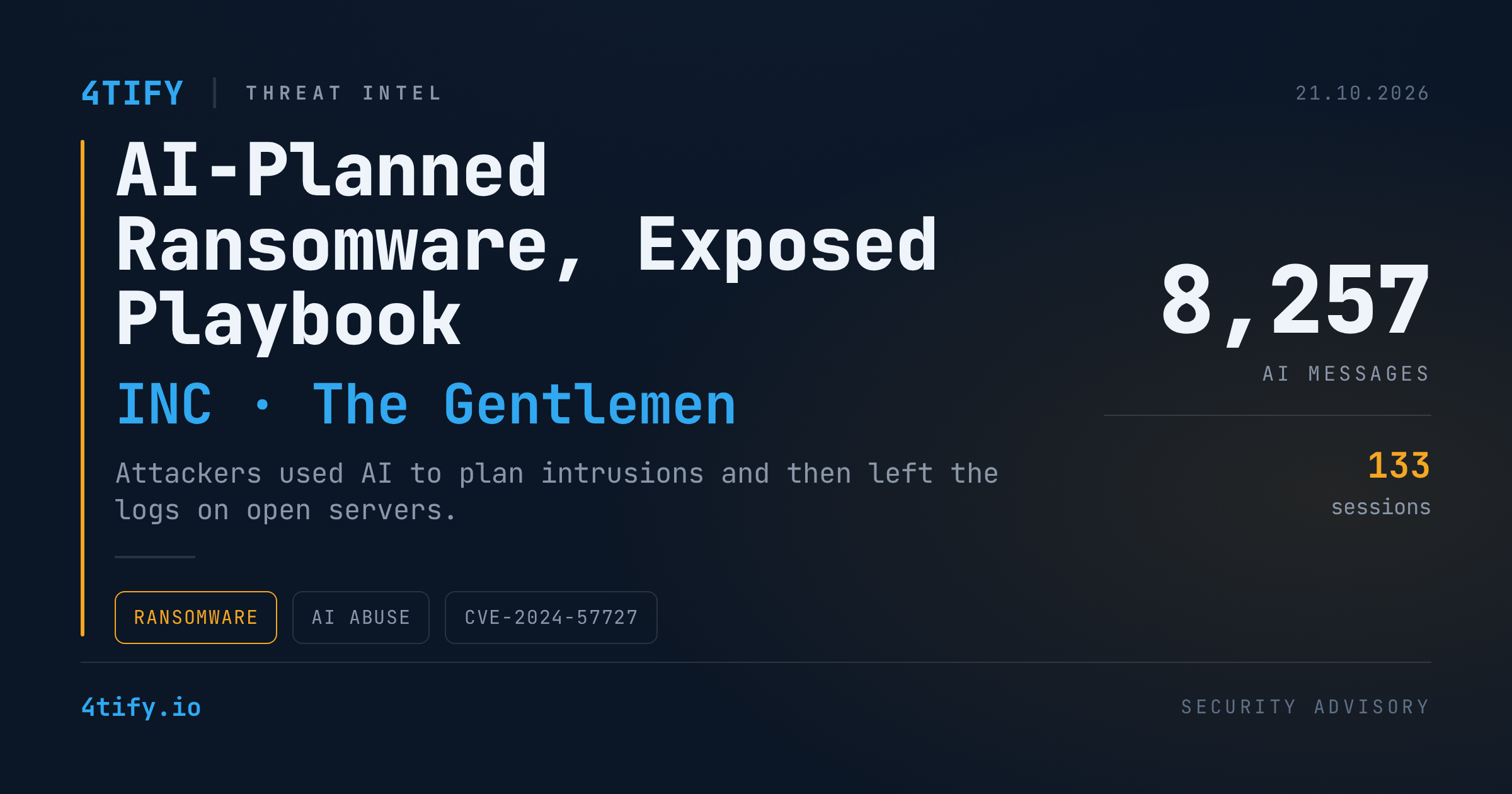
Ransomware Crew Used AI to Plan Attacks — Then Left the Playbook on an Open Server
A ransomware operation linked to affiliates of INC Ransomware and The Gentlemen relied on commercial AI models to plan intrusions, triage stolen data and draft extortion material. The same setup also kept a detailed record of everything it did, and that record was sitting on internet-reachable servers.
What happened
In late September 2026, researchers at the SOCRadar Threat Research Unit (STRU) found an exposed server that held AI chat sessions, a shared knowledge base, stolen credentials and source code for an attack framework called Phantom. Logs, configuration files and credentials on that host led them to six more exposed servers.
According to the investigation:
- The operators used OpenCode as a front end to models served through OpenRouter. Across 8,257 messages in 133 sessions, the AI helped with reconnaissance, choosing techniques, generating commands, troubleshooting tools, reviewing stolen data and writing extortion notes.
- Claude Opus 4.6 and Kimi K3 were among the models named. The researchers describe an operation that used AI for support, not one that AI ran by itself. Humans stayed in the loop and the AI was told to wait for approval before acting.
- When a model refused a request, operators sometimes reworded it as an "authorized red-team assessment." A "WormGPT" persona prompt also appeared, but the researchers say this was only a label, not evidence of a separate uncensored model.
- Recorded AI spending came to more than $23,920.
- The files included 46 INC encryptor builds prepared for six victims, for both Windows and Linux. A September 30 screenshot showed an encryptor running inside a victim environment. A planned October 1 deployment was not confirmed.
How they got in
The operators' own notes describe breaking in through internet-facing management and remote-access products, citing:
- FortiClient EMS: CVE-2026-35616
- SimpleHelp: CVE-2024-57727 (the records claim 242 affected IPs)
- cPanel/WHM: CVE-2026-41940
These figures come from the attackers' records and were not independently verified. CISA has separately warned that ransomware actors exploit CVE-2024-57727 in unpatched SimpleHelp instances, which matters most where a service provider's tooling connects into customer networks.
After getting in, the operators moved laterally with stolen or reused credentials. In one case a single reused password opened remote access, servers and backup tools. They went after finance, HR, legal and executive files, using Phantom, Ghost C2, RevSocks tunnelling and a tool built to interfere with some security products.
Why it matters
The records named 62 organizations, but only four had been publicly listed for extortion. The rest were at earlier stages such as reconnaissance or initial access. Stolen financial and customer data was used to shape demands and to script pressure calls, which shows that data theft can matter as much as encryption.
The investigators did not conclude that INC and The Gentlemen had a formal alliance. A shared operating environment or a service provider supporting several ransomware partners is the more likely explanation.
The bigger takeaway: AI makes it easier for a small crew to coordinate complex intrusions, but that does not change where they get in. Unpatched edge devices and reused passwords were still the way in.
What to do
- Patch edge and remote-access systems first. Check FortiClient EMS, SimpleHelp and cPanel/WHM against the CVEs above, and treat any internet-facing management console as high priority.
- Shrink the exposed management surface. Put admin interfaces behind VPN or allow-lists and never expose them directly.
- Enforce MFA on all remote administration and kill password reuse, especially for backup and RMM accounts.
- Isolate backups so a compromised domain or admin account cannot reach or delete them.
- Watch for the signs: unexpected changes to VPN settings or accounts, new remote-management tools, and large outbound transfers.
- Hunt for the published indicators (IPs, domains, onion services and encryptor hashes) in your SIEM or threat-intel platform.
You can't patch a management console you don't know is exposed. That blind spot is what our Attack Surface Management service covers: it continuously maps your internet-facing hosts and subdomains and flags exposed admin panels and vulnerable remote-access products before an attacker's reconnaissance finds them.
Source: original research by the SOCRadar Threat Research Unit (STRU), as reported by Cyber Security News.