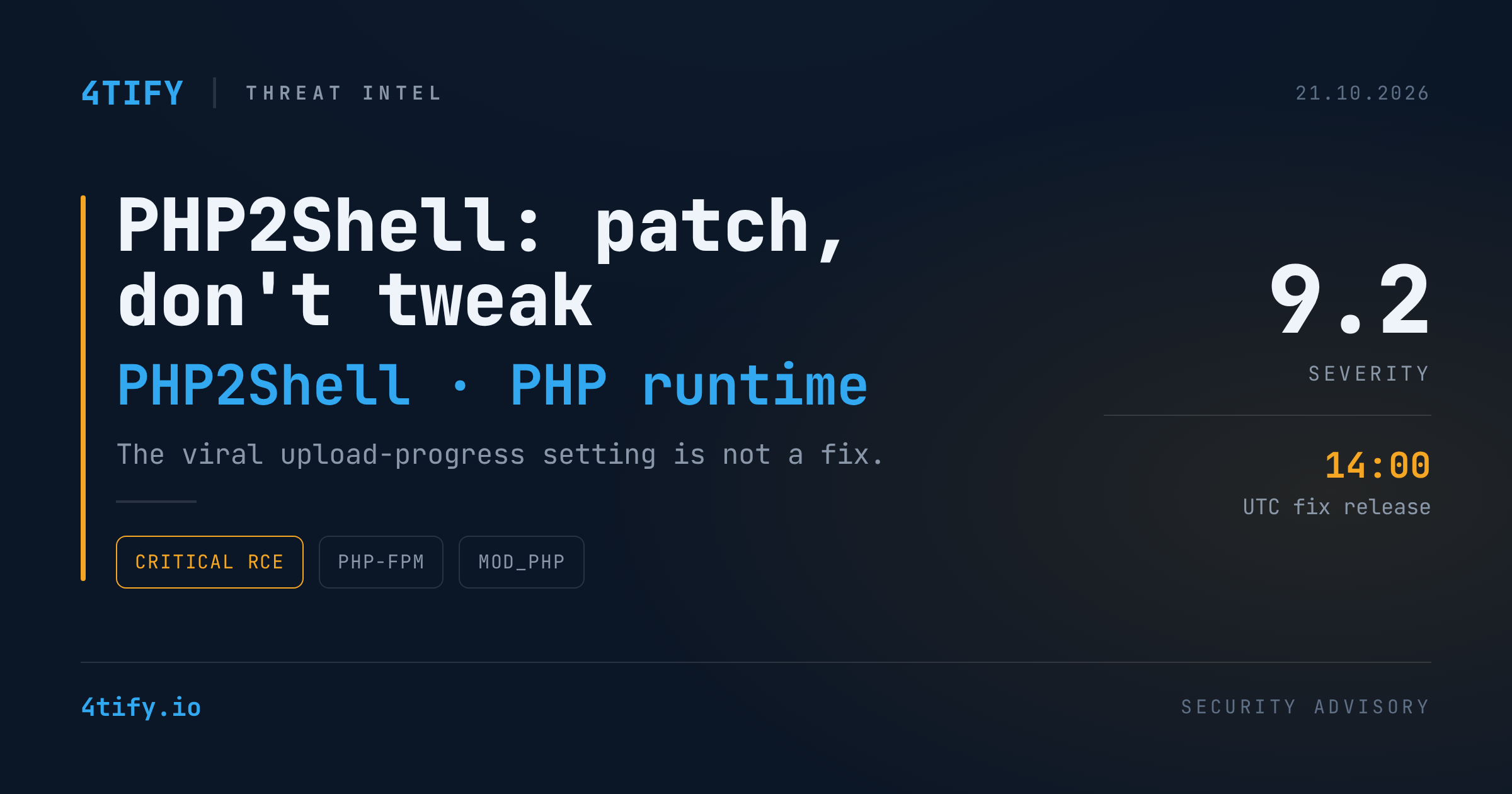
PHP2Shell: What Actually Lowers Your Risk Before the PHP Patch Lands
PHP is shipping fixes for two critical remote code execution flaws, collectively nicknamed PHP2Shell, at 14:00 UTC on October 21, 2026. The project rates them 9.2 out of 10 and has published no workaround of its own. The config tweak that spread across social media as a quick fix is, by the account of the people closest to the bug, not a fix at all.
What happened
Details are deliberately thin. PHP has not said which versions are affected, which component is involved, or whether any configuration setting changes the risk. Full details and fixed builds are due with the release. Until then, nobody outside the group that found the flaws can reliably test whether a given defence works.
Early on October 21, a Tokyo-based security firm suggested disabling Session Upload Progress (session.upload_progress.enabled=0) as a possible mitigation, while cautioning it could not be sure the change fully addressed the issue. Hours later the same firm walked it back: the setting alone is not a complete fix and bypasses are expected. PHP core contributors were blunter, saying that patching is the only real mitigation and that ini settings won't save you.
Even the premise is disputed. The idea that the bug lives in Session Upload Progress has not been confirmed by PHP, and an anonymous code audit argues the specific flaw others describe in that feature does not exist in released PHP. Treat every technical claim about the root cause as unverified until the advisory is out.
Why it matters
- Exploitation is early and unconfirmed. Cloudflare reports seeing initial exploitation attempts and has pushed emergency WAF rules it explicitly calls a stopgap. Another research team says it reproduced one of the flaws but has not reported attacks in the wild.
- No confirmed compromise yet. Publicly circulating proof-of-concept code has not been shown to work against released PHP, and neither flaw was in CISA's Known Exploited Vulnerabilities catalog as of October 21.
- PHP runs a large share of the web. WordPress, Laravel and countless custom apps sit on top of a PHP runtime that application updates do not touch.
This picture can change by the hour, so plan for the worst case rather than the current one.
What to do
If you can patch at 14:00 UTC
- Prepare now: confirm your update procedure and post-update checks, rehearse any config change, and line up the people and approvals for an emergency restart.
- Patch the runtime that serves web traffic (PHP-FPM, mod_php or CGI), not just the application on top of it.
- PHP only ships fixes for its supported branches, 8.2 through 8.5.
If you already disabled upload progress
- Leave it off if you don't use upload progress bars; PHP's own manual already recommends that. Just don't count it as protection.
- Verify the value on the process that actually serves your site (PHP-FPM or mod_php), not with
php -ion the command line..user.inifiles are only read by CGI/FastCGI and are re-read every 300 seconds by default; under the Apache module, use.htaccessor server config.
If you can't patch immediately, or run an unsupported version
- Reduce exposure: take internet-facing PHP apps offline, or put them behind a VPN, client allowlists or authenticated access at the edge, and make sure the origin can't be reached directly around those controls.
- Shrink the blast radius: minimise data and privileges on the server, remove stored credentials (including cloud roles), and ship logs somewhere an attacker can't tamper with.
- Consider blocking
multipart/form-dataat the web server for all methods, not only POST, since PHP 8.4'srequest_parse_body()can parse multipart bodies on other verbs too. Expect broken uploads, and remember it targets a suspected entry path. - Treat WAF rules as a stopgap: they only see traffic that actually passes through them and can miss new attack paths.
- PHP 8.1, 7.x and 5.x are end-of-life and will get no upstream fix: upgrade, isolate or take them offline.
If someone else runs your PHP
- On managed or shared hosting, ask your provider when a fixed build will land. Hosting vendors and Linux distributions build only after the upstream release.
- On Debian, Ubuntu and similar, security fixes are backported, so a patched package can keep an old-looking version number. Check the package changelog or your distribution's advisory, not the version string.
When the release lands Check the fixed version for your branch, the official list of affected versions, whether PHP endorses any setting as a mitigation, and then review your logs for anything that happened before you patched. Advisories will appear on php.net and PHP's GitHub security advisories.
How 4Tify can help
The hardest part of an emergency like this is often knowing where PHP is actually exposed: forgotten subdomains, staging boxes, legacy apps on end-of-life branches. Our Attack Surface Management service continuously maps your internet-facing assets and the technology behind them, so when the next critical runtime flaw drops, you already have the list of what to patch first.
Reporting based on coverage by The Hacker News (October 21, 2026), independently summarized by the 4Tify team. Details were evolving at the time of writing.