Threat intel5 min read
AMD SEV-SNP flaw lets a rogue host read confidential VM memory
CVE-2026-0462 (Mior) lets a host that controls the hypervisor and BIOS read and change memory in AMD SEV-SNP confidential VMs and fake attestation. BIOS fixes are due in December 2026.
4Tify Team
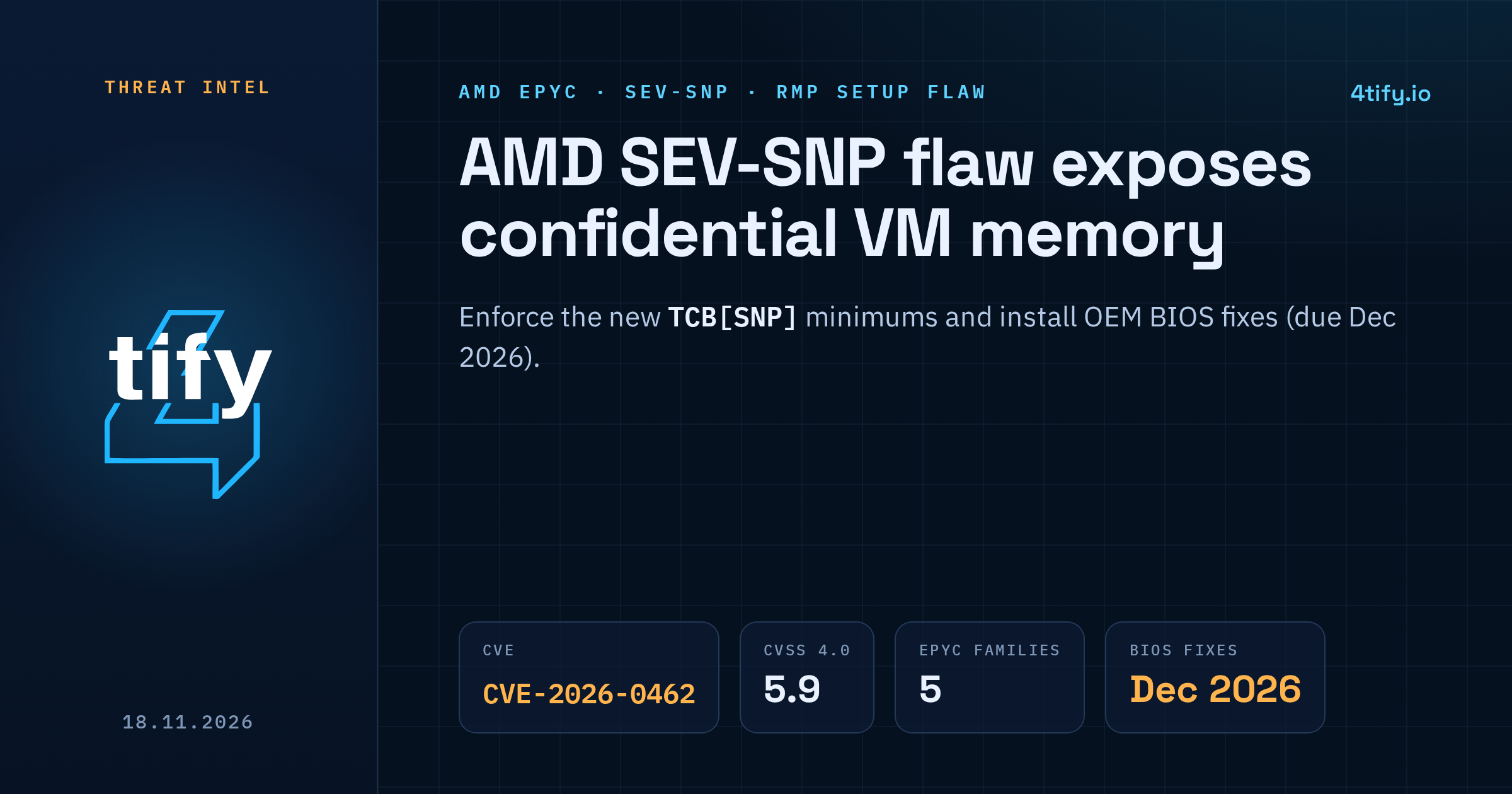
AMD has confirmed a flaw in SEV-SNP, the feature that keeps confidential virtual machines on EPYC servers sealed off from the host they run on. Tracked as CVE-2026-0462 and nicknamed Mior, it lets a host that controls the hypervisor and the BIOS read and change memory inside a protected VM, and make a tampered VM pass attestation as if it were a trusted one. AMD shipped fixed SEV firmware in August, but the BIOS updates that bring it to most servers are not due from hardware makers until December 2026.
What happened
AMD published security bulletin AMD-SB-3059 on 10 November 2026. It rates CVE-2026-0462 at 5.9 on CVSS 4.0, and its scoring vector counts only the impact on integrity. The bug was reported to AMD in February and disclosed after an embargo that ended on 10 November. A paper describing the attack is being presented at ACM CCS 2026 this month.
There is no sign of use outside the lab. The CVE is not in CISA's Known Exploited Vulnerabilities catalog, and the public CVE record has not been published yet.
Who is affected
The bulletin lists only SEV-SNP. The older SEV and SEV-ES modes are marked as not affected. Five EPYC server families are covered:
| Processors | SEV firmware with the fix | Minimum TCB[SNP] in attestation | Platform (BIOS) firmware |
|---|---|---|---|
| EPYC 7003 | 1.3A.03 | 0x1F | MilanPI-SP3_1.0.0.L, target Dec 2026 |
| EPYC 8004 and 9004 | 1.3A.4 | 0x1E | GenoaPI_1.0.0.K, target Dec 2026 |
| EPYC 8005 and 9005 | 1.3A.0A | 0x8 | TurinPI_1.0.0.C, target Dec 2026 |
The SEV firmware fixes are dated 12 August 2026. The embedded EPYC 7003, 8004, 9004 and 9005 parts have no version number yet and a target of February 2027.
The researchers ran the full attack on an EPYC 9135, a Zen 5 chip. They believe Zen 3 and Zen 4 share the same logic but did not test them, so treat those generations as potentially affected until your vendor says otherwise.
How it works
SEV-SNP relies on the Reverse Map Table (RMP), which records who owns each page of memory. The AMD Platform Security Processor (PSP) builds this table at boot and checks first that its writes will land in system RAM. It does that check by combining routing settings from several parts of the chip's internal fabric with a bitwise OR, and that combined view can hide a range that actually points at a device.
A host with control of the firmware can use this to send some of the PSP's table writes to a PCIe card's memory instead of RAM. A graphics card was used in the demonstration. The card stores the data and hands it back when the PSP checks its work, so boot finishes normally. The real table in RAM, which the CPU enforces, never gets those entries, including the ones meant to protect the table itself.
From there, the host can switch on debugging for a production VM and use the PSP's debug commands to read and write its memory. It can also copy the launch measurement of a clean VM into a modified one, so the attestation report vouches for software that is not actually running. The GPU breaks no encryption here and recovers no keys. It only stands in for RAM. In lab tests the memory access worked in all 1,000 attempts, including with ciphertext hiding turned on.
This is an attack by the host on its guests. It needs control of the hypervisor, the BIOS settings and a PCIe device. A normal cloud customer cannot run it against a neighbour. The risk sits with whoever operates the hardware, which is exactly the party SEV-SNP is meant to protect you from.
What to do now
- If you run your own EPYC hosts with SEV-SNP: ask your server vendor for the BIOS release built on the platform firmware listed above and install it when it ships. Until then, lock down BIOS/UEFI settings and limit who can attach PCIe devices to those machines.
- If you rent confidential VMs: ask your provider whether the hosts behind your workloads run the fixed firmware. Updating the guest operating system does nothing for a host firmware bug.
- If you rely on attestation: set your verifier or key-release service to reject reports below the minimum TCB[SNP] value for each family in the table, and make it fail closed. Logging the value without enforcing it leaves you exposed.
- If secrets were released to hosts that cannot yet prove they are patched: plan to rotate them once the fix is confirmed.
The full table of versions and dates is in AMD's bulletin AMD-SB-3059.
Firmware and BIOS versions on self-hosted servers drift out of date quietly, because no one sees them change. Keeping them on the same list as operating systems and applications is part of the vulnerability scanning work our team does for clients with their own infrastructure, so a gap like this one shows up as a finding instead of a surprise.