Threat intel4 min read
Anthropic cuts its disclosure deadline for serious bugs to 30 days
From 1 January 2027, high- and critical-severity flaws found by Claude will go public 30 days after they are reported, not 90. Other issues get 45 days.
4Tify Team
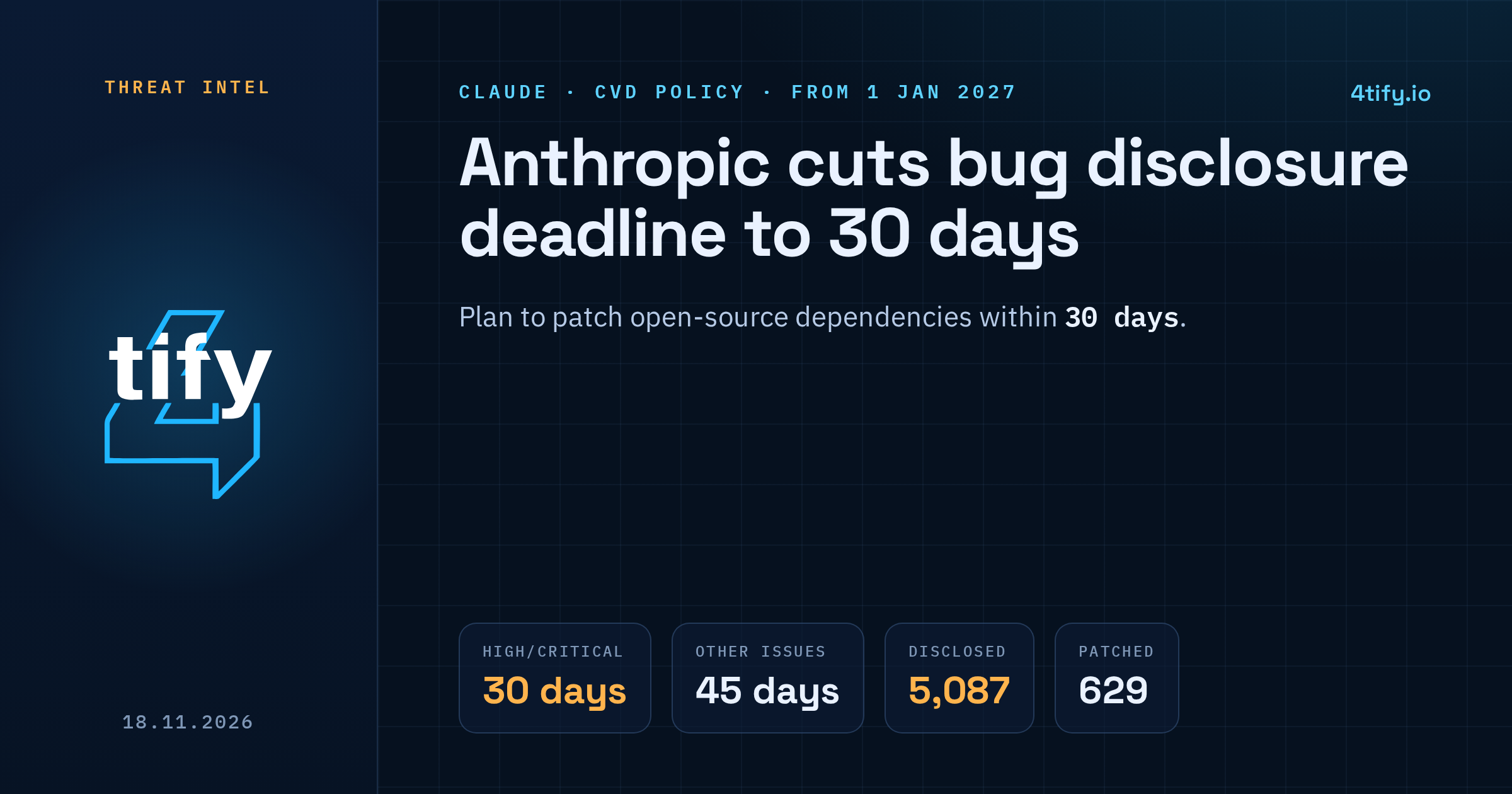
Anthropic is giving software maintainers less time to fix the vulnerabilities its Claude models find. In an update published on 16 November 2026, the company said high- and critical-severity issues will be made public 30 days after they are reported, down from the 90 days that has long been the industry default. Every other issue gets 45 days.
What changed
The new rules apply to reports sent to vendors and maintainers on or after 1 January 2027. Reports already open on that date keep their current deadlines. The announcement also changes three other parts of the policy:
- If a maintainer does not answer the first report, Anthropic will escalate to an external vulnerability coordinator after 15 days instead of 30.
- Once a patch is out, full technical details will follow after 30 days instead of 45.
- The seven-day window for vulnerabilities under active exploitation stays as it is.
There is a backlog too. Some high- and critical-severity bugs were reported more than 90 days ago, have already passed the current deadline and are still private. Their maintainers are being told they have 30 more days. After that, the reports will appear on Anthropic's public disclosure dashboard under the new policy from 1 January 2027.
Why Anthropic says 90 days no longer works
The company argues that older disclosure norms assumed two things: that fixes move at human speed, and that two people rarely find the same bug on their own. It says neither is true anymore. Models can now help write patches, and a flaw one model finds is increasingly likely to be found by another. Anthropic says it is already seeing more of these rediscoveries, so a bug kept quiet for three months may not stay quiet.
The volume is large. The disclosure dashboard shows that as of 2 November 2026, Anthropic had disclosed 5,087 vulnerabilities across 680 open-source projects. Only 629 are known to have been patched. The models flagged 37,966 findings in total, but external security firms had reviewed just 6,009 of them, and Anthropic names human triage as the bottleneck.
Exceptions
Some flaws cannot be fixed in 30 or 45 days. Anthropic gives two examples: software that is hard to deploy, such as systems in critical infrastructure, and bugs that need a change to a specification or RFC. In those cases it will agree a remediation timeline with the vendor. The new deadlines also do not cover AI findings that no human has reviewed, such as results from its opt-in OSS Scanner service.
To ease the load, Anthropic says each report will keep including practical guidance and, where possible, a patch or mitigation. It will also agree a pace with maintainers before sending a large batch of findings to one project. Maintainers of critical open-source projects can apply for OSS Scanner at no cost, and eligible maintainers can get six months of free Claude access through its open-source program.
Who is affected
Open-source maintainers who receive these reports have the least time to react. Everyone downstream is affected as well. Shorter windows mean public details, and the chance for attackers to use them, arrive sooner after a fix ships. A library you depend on may now go from patched to fully documented in a month.
What to do now
- Keep an accurate inventory of the open-source components and versions in your products (an SBOM helps).
- Watch the advisories for those components, including GitHub Security Advisories and CVE feeds, and treat high and critical fixes as a matter of weeks.
- Shorten your own patch cycle for third-party dependencies so a 30-day public window does not catch you unpatched.
- If you maintain a project, publish a security contact and a clear process so reports reach the right person on day one.
Faster disclosure only helps if your own code and dependencies are checked just as quickly. Our AI-assisted code review looks at your repositories and the libraries they pull in, so outdated or vulnerable components are flagged before their details go public.